
UNITED STATES
SECURITIES AND EXCHANGE COMMISSION
WASHINGTON, D.C. 20549
FORM 40-F
[Check one]
REGISTRATION STATEMENT PURSUANT TO SECTION 12 OF THE SECURITIES EXCHANGE ACT OF 1934 | |||||
OR | |||||
ANNUAL REPORT PURSUANT TO SECTION 13(a) OR 15(d) OF THE SECURITIES EXCHANGE ACT OF 1934 | |||||
For the fiscal year ended: December 31 , 2025001-42021
(Exact name of Registrant as specified in its charter)
Not applicable
(Translation of Registrant’s name into English (if applicable)
(Province or other jurisdiction of incorporation or organization)
N/A | ||||||||
(Primary Standard Industrial Classification Code Number (if applicable)) | (I.R.S. Employer Identification Number (if applicable)) | |||||||
(587 ) 318-5410
(Address and telephone number of Registrant’s principal executive offices)
(713 ) 701-2163
(Name, address (including zip code) and telephone number (including area code) of agent for service in the United States)
Securities registered or to be registered pursuant to Section 12(b) of the Securities Exchange Act of 1934 (“Exchange Act”).
Title of each class | Trading symbol | Name of each exchange on which registered | ||||||||||||
Securities registered or to be registered pursuant to Section 12(g) of the Exchange Act.
None
Securities for which there is a reporting obligation pursuant to Section 15(d) of the Exchange Act.
None
(Title of Class)
For annual reports indicate by check mark the information filed with this Form:
Annual information form | Audited annual financial statements | ||||||||||
Indicate the number of outstanding shares of each of the issuer’s classes of capital or common stock as of the close of the period covered by the annual report.
Indicate by check mark whether the Registrant (1) has filed all reports required to be filed by Section 13 or 15(d) of the Exchange Act during the preceding 12 months (or for such shorter period that the Registrant was required to file such reports) and (2) has been subject to such filing requirements for the past 90 days.
Indicate by check mark whether the registrant has submitted electronically every Interactive Data File required to be submitted pursuant to Rule 405 of Regulation S-T (§232.405 of this chapter ) during the preceding 12 months (or for such shorter period that the registrant was required to submit such files).
Indicate by check mark whether the registrant is an emerging growth company as defined in Rule 12b-2 of the Exchange Act. Emerging growth company ☐
If an emerging growth company that prepares its financial statements in accordance with U.S. GAAP, indicate by check mark if the registrant has elected not to use the extended transition period for complying with any new or revised financial accounting standards† provided pursuant to Section 13(a) of the Exchange Act. ☐
† The term “new or revised financial accounting standard” refers to any update issued by the Financial Accounting Standards Board to its Accounting Standards Codification after April 5, 2012.
Indicate by check mark whether the registrant has filed a report on and attestation to its management’s assessment of the effectiveness of its internal control over financial reporting under Section 404(b) of the Sarbanes-Oxley Act (15 U.S.C. 7262(b)) by the registered public accounting firm that prepared or issued its audit report. ☒
If securities are registered pursuant to Section 12(b) of the Exchange Act, indicate by check mark whether the financial statements of the registrant included in the filing reflect the correction of an error to previously issued financial statements. ☐
Indicate by check mark whether any of those error corrections are restatements that required a recovery analysis of incentive-based compensation received by any of the registrant’s executive officers during the relevant recovery period pursuant to §240.10D-1(b). ☐
The document (or portions thereof) forming part of this Form 40-F is incorporated by reference into the following registration statement under the Securities Act of 1933, as amended:
Form | Registration No. | ||||
| S-4 | 333-288161 | ||||
| S-4 | 333-288163 | ||||
S-8 | 333-282631 | ||||
F-10 | 333-288159 | ||||
F-10 | 333-288160 | ||||
F-10 | 333-288162 | ||||
EXPLANATORY NOTE
South Bow Corporation is a “foreign private issuer” as defined in Rule 3b-4 under Securities Exchange Act of 1934, as amended (the “Exchange Act”), and is a Canadian issuer eligible to file its Annual Report pursuant to Section 13 of the Exchange Act on Form 40-F (this “Annual Report”) pursuant to the multi-jurisdictional disclosure system (the “MJDS”) adopted by the United States Securities and Exchange Commission (the “SEC” or the “Commission”).
The Company’s common shares are listed in the United States on the New York Stock Exchange (“NYSE”) under the trading symbol “SOBO” and in Canada on the Toronto Stock Exchange under the trading symbol “SOBO”.
In this Annual Report, references to “we,” “our,” “us,” the “Registrant,” the “Company,” or “South Bow,” mean South Bow Corporation unless the context suggests otherwise.
FORWARD-LOOKING INFORMATION
Certain statements in this Annual Report, and the documents incorporated by reference herein, constitute “forward-looking information” or “forward-looking statements” (collectively, “forward-looking information”) within the meaning of the applicable securities legislation. Often, but not always, forward-looking information use words or phrases such as: “advancing”, “anticipate”, “believe”, “committed”, “continue”, “ensure”, “estimate”, “expect”, “focus”, “future”, “goal”, “guidance”, “implement”, “intend”, “likely”, “objective”, “opportunity”, “plan”, “potential”, “seek”, “strategy”, “target” or state that certain actions, events or results “may”, “can”, “could”, “would”, “might”, “should”, “will”, “regularly” or “from time to time” be taken, occur or be achieved. Such forward-looking information, include, but are not limited to, statements included or incorporated by reference, South Bow’s growth strategy and properties, the Company’s anticipated business plans, opportunities, objectives, strategies and production.
In particular, forward-looking statements in this Annual Report include information, including certain financial outlooks, about the following, among other things South Bow’s financial and operational performance; expectations about strategies and goals for growth and expansion and the methods South Bow expects to employ to implement such strategies; South Bow’s financial outlook for 2026 and beyond, including 2026 normalized EBITDA, 2026 interest expenses, 2026 distributable cash flow and 2026 capital expenditures; expected dividends and other returns to shareholders; expected cash flows and future financing
options available, including portfolio management; expectations regarding the size, timing, conditions and outcome of ongoing and future transactions; expected access to and cost of capital; expected costs and schedules for planned projects, including projects under construction, as well as the benefits and timing thereof; expected capital expenditures, contractual obligations, commitments and contingent liabilities, including environmental remediation costs; the outcomes and effectiveness of the Company’s disclosure controls and procedures and internal controls over financial reporting ("ICFR"); the remediation plan and the effectiveness of the actions taken pursuant to the remediation plan to remediate the identified material weakness in the Company's internal controls; expected regulatory processes and outcomes; expected outcomes with respect to legal proceedings, including arbitration and insurance claims; the expected impact of future legal, accounting and regulatory changes, including the potential impacts of tariffs; expected industry, market and economic conditions, including their impact on us and on our customers and suppliers; the future prospects and growth opportunities of South Bow, including the timing thereof and their expected impact on South Bow; the programs and policies of South Bow, including the systems used to implement such policies and the effectiveness thereof; South Bow’s dividend policy, including the declaration or payment of future dividends and the sustainability thereof; the business environment in which South Bow operates, including expected crude oil supply and demand levels and the sources thereof; South Bow’s competitive position and business prospects; expected earnings and future cash flows of South Bow, including the stability and sufficiency thereof; factors affecting South Bow’s financial results; treatment under current and future regulatory regimes, including those relating to taxes, tariffs and the environment; the timing and outcome of court and regulatory filings, proceedings and decisions, as well as their impact on South Bow; expectations regarding South Bow’s pipeline integrity spending; expected sources of environmental risks; South Bow’s contract profile; and South Bow’s intentions with respect to future issuances of first preferred shares of South Bow and second preferred shares of South Bow.
This forward-looking information reflects South Bow’s beliefs and assumptions based on information available to South Bow at the time the statements were made and, as such, is not a guarantee of future performance. By its nature, forward-looking information is subject to various assumptions, risks and uncertainties which could cause actual results and achievements to differ materially from the anticipated results or expectations expressed or implied in such forward-looking information. These assumptions, risks and uncertainties include, but are not limited to: realization of expected benefits from acquisitions, divestitures and energy transition; South Bow’s ability to successfully implement its strategic priorities, and whether they will yield the expected benefits; South Bow’s ability to implement a capital allocation strategy aligned with maximizing shareholder value; the operating performance and integrity of South Bow’s assets; the amount of capacity sold and the tolls and rates achieved; the supply and demand for crude oil; energy industry exploration and development activities and production levels within supply basins; South Bow’s reputation with key stakeholders; the performance of key officers, employees and consultants; South Bow maintaining its status as a foreign private issuer; construction and completion of capital projects in a manner consistent with management’s expectations; cost, availability of and inflationary pressures on labour, equipment and materials; the availability and market prices of commodities; access to capital markets on competitive terms; South Bow maintaining its current credit ratings; interest, tax and foreign exchange rates; performance and credit risk of South Bow’s counterparties; regulatory decisions and outcomes of legal proceedings, including arbitration and insurance claims; outcomes related to the Milepost 171 incident and Milepost 14 incident and the withdrawal of variable toll disputes on the Keystone system; performance by TC Energy, South Bow, as applicable, and the other parties thereto, of their respective obligations under the Separation Agreement and the Transition Services Agreement; South Bow’s ability to effectively anticipate and assess changes to government policies and regulations, including those related to tariffs, trade and the environment; competition in the businesses in which South Bow operates; unexpected or unusual weather; acts of civil disobedience; cyber security and technological developments; sustainability-related risks; the impact of the energy transition on South Bow’s business and results of operations; economic conditions in North America as well as globally; global health crises, such as pandemics and epidemics and the impacts related thereto; and other risks, uncertainties and factors, many of which are beyond the control of South Bow, and some of which are discussed in the section entitled “Risk Factors” in South Bow’s Annual Information Form for the year ended December 31, 2025, which is available on the Company’s profile on SEDAR+ at http://www.sedarplus.ca and in its filings with the SEC at http://www.sec.gov.
Although South Bow has attempted to identify important factors that could cause actual results to differ materially from those contained in forward-looking information, there may be other factors that cause results not to be as anticipated, estimated or intended. There can be no assurance that such information or statements will prove to be accurate, as actual results and future events could differ materially from those anticipated in such information or statements. The Company has and continues to disclose in its other publicly filed documents, changes to material factors or assumptions underlying the forward-looking information and to the validity of the information, in the period the changes occur. The forward-looking information is made as of the date hereof and South Bow disclaims any obligation to update any such factors or to publicly announce the result of any revisions to any of the forward-looking information contained herein to reflect future results, unless so required by Canadian securities laws. Accordingly, readers should not place undue reliance on forward-looking information.
PRINCIPAL DOCUMENTS
The following documents have been filed as part of this Annual Report:
A. Annual Information Form
The Registrant’s Annual Information Form for the fiscal year ended December 31, 2025 (the “Annual Information Form”) is attached as Exhibit 99.1 to this Annual Report and is incorporated by reference herein.
B. Audited Annual Financial Statements
The Registrant’s consolidated audited annual financial statements, including the report of the independent registered public accounting firm with respect thereto, are attached as Exhibit 99.2 to this Annual Report and is incorporated by reference herein.
C. Management’s Discussion and Analysis
The Registrant’s management’s discussion and analysis of financial condition and results of operations for the year ended December 31, 2025 (the “MD&A”) is attached as Exhibit 99.3 to this Annual Report and is incorporated by reference herein.
TAX MATTERS
Purchasing, holding or disposing of securities of the Registrant may have tax consequences under the laws of the United States and Canada that are not described in this Annual Report.
DISCLOSURE CONTROLS AND PROCEDURES
For information on disclosure controls and procedures, see "Accounting Matters" on page 26 of the MD&A under the subheadings, "Disclosure Controls and Procedures" and "Management's Report on Internal Control over Financial Reporting".
ATTESTATION REPORT OF THE REGISTERED PUBLIC ACCOUNTING FIRM
The attestation report of the Company’s registered public accounting firm is included within Exhibit 99.2 to this Annual Report and is incorporated by reference herein.
CHANGES IN INTERNAL CONTROL OVER FINANCIAL REPORTING
Other than with respect to the material weakness and remediation efforts described in the MD&A and incorporated herein by reference, the preparation for management’s first report on the Company’s ICFR and the first attestation report of the Company’s registered public accounting firm, there were no changes in the Company's ICFR.
AUDIT COMMITTEE FINANCIAL EXPERT
The Registrant’s Board of Directors has determined that it has at least one audit committee financial expert serving on its Audit committee. Shannon Ryhorchuk has been designated as an audit committee financial expert and is independent, as that term is defined by the NYSE’s listing standards applicable to the Registrant. The Commission has indicated that the designation of Shannon Ryhorchuk as an audit committee financial expert does not make Shannon Ryhorchuk an “expert” for any purpose, impose any duties, obligations or liability on Shannon Ryhorchuk that is greater than those imposed on members of the Audit committee and Board of Directors who do not carry this designation or affect the duties, obligations or liability of any other member of the Audit committee.
CODE OF ETHICS
The Registrant has adopted a code of business ethics (“Code”) that applies to all employees, directors, officers and contingent workforce contractors of the Registrant and its wholly-owned subsidiaries and/or operated entities in all countries in which the Registrant conducts business.
The Registrants’ Code is available on South Bow’s website at https://www.southbow.com/ and any person can obtain the Code without charge upon request from Investor Relations at investor.relations@southbow.com. No waivers have been granted from any provision of the Code during the 2025 fiscal year.
PRINCIPAL ACCOUNTANT FEES AND SERVICES
Our independent registered public accounting firm is KPMG LLP , Calgary, AB, Canada , Auditor Firm ID: 85 . For information on principal accountant fees and services, see “Audit Fees” on page 36 of the South Bow Corporation 2025 Annual Information Form.
OFF-BALANCE SHEET ARRANGEMENTS
For information on off-balance sheet arrangements, see “Off-balance Sheet Arrangements” on page 20 of the MD&A.
DISCLOSURE OF CONTRACTUAL OBLIGATIONS
For information on disclosure of contractual obligations, see “Contractual Obligations” on page 19 of the MD&A.
IDENTIFICATION OF THE AUDIT COMMITTEE
The Registrant has a separately-designated standing audit committee established in accordance with Section 3(a)(58)(A) of the Exchange Act and satisfies the requirements of Exchange Act Rule 10A-3. The members of the audit committee are: Shannon Ryhorchuk (Chair), Chansoo Joung, George Lewis and Frances M. Vallejo.
MINE SAFETY DISCLOSURE
Not applicable.
DISCLOSURE REGARDING FOREIGN JURISDICTIONS THAT PREVENT INSPECTIONS
Not Applicable.
NEW YORK STOCK EXCHANGE CORPORATE GOVERNANCE RULES
A comparison of NYSE Corporate Governance Rules required to be followed by U.S. Domestic Issuers under the NYSE's listing standards and the Corporate Governance practices of the Company (disclosure required by section 303A.11 of the NYSE Listed Company Manual) is available on the About – Governance section of the Registrant’s website at https://www.southbow.com/.
UNDERTAKING AND CONSENT TO SERVICE OF PROCESS
A. Undertaking
The Registrant undertakes to make available, in person or by telephone, representatives to respond to inquiries made by the Commission staff, and to furnish promptly, when requested to do so by the Commission staff, information relating to: the securities registered pursuant to Form 40-F; the securities in relation to which the obligation to file an annual report on Form 40-F arises; or transactions in said securities.
B. Consent to Service of Process
The Registrant has previously filed with the SEC a written consent to service of process and power of attorney on Form F-X. Any change to the name or address of the agent for service of process of the Registrant shall be communicated promptly to the Commission by an amendment to the Form F-X referencing the file number of the relevant registration statement.
DOCUMENTS FILED AS PART OF THIS REPORT
The following documents have been filed as part of this Registration Statement on Form 40-F as Exhibits hereto:
Exhibits | Documents | ||||||||||||||||
97.1 | |||||||||||||||||
99.1 | |||||||||||||||||
99.2 | |||||||||||||||||
99.3 | |||||||||||||||||
99.4 | |||||||||||||||||
99.5 | |||||||||||||||||
99.6 | |||||||||||||||||
99.7 | |||||||||||||||||
99.8 | |||||||||||||||||
99.9 | |||||||||||||||||
101.SCH | Inline XBRL Taxonomy Extension Schema Document. | ||||||||||||||||
101.CAL | Inline XBRL Taxonomy Extension Calculation Linkbase Document. | ||||||||||||||||
101.DEF | Inline XBRL Taxonomy Definition Linkbase Document. | ||||||||||||||||
101.LAB | Inline XBRL Taxonomy Extension Label Linkbase Document. | ||||||||||||||||
101.PRE | Inline XBRL Taxonomy Extension Presentation Linkbase Document. | ||||||||||||||||
104 | Cover Page Interactive Data File (formatted as Inline XBRL and contained in Exhibit 101). | ||||||||||||||||
SIGNATURES
Pursuant to the requirements of the Exchange Act, the Registrant certifies that it meets all of the requirements for filing on Form 40-F and has duly caused this annual report to be signed on its behalf by the undersigned, thereto duly authorized, in the City of Calgary, Province of Alberta, Canada.
SOUTH BOW CORPORATION | ||||||||
By: | /s/ Lori M. Muratta | |||||||
Name: Lori M. Muratta Title: Senior Vice-President and General Counsel | ||||||||
Date: March 13, 2026 | ||||||||
Clawback Policy 1 Policy statement This Policy provides direction for the clawback or prevention of excess Incentive Compensation granted to Executive Personnel in certain circumstances. Appendix A to this Policy is intended to satisfy the requirements of the NYSE Listing Standards and Rule 10D-1 as adopted by the U.S. SEC to implement Section 954 of the Dodd-Frank Wall Street Reform and Consumer Protection Act of 2010. Scope This Policy will operate in addition to any legal requirements that may apply to South Bow and its Team Members, Executive Personnel, officers, and directors. This Policy is in addition to any other action or remedy available to South Bow against the individual under applicable law, up to and including termination of employment and/or legal action for breach of fiduciary duty or fraud. Principles 1 Accountability and accuracy 1.1 Intentional Misconduct such as fraud or willful noncompliance with laws, regulations, stock exchange rules, or other applicable internal policies will trigger clawback or hold back of Incentive Compensation. 1.2 Incentive Compensation must reflect accurate financial and operational performance. If a material error or Restatement occurs, compensation will be recalculated and any excess recovered. Implementation 1 Incentive compensation clawback and holdback 1.1 In addition, and without limitation, to the recourse available to the Corporation pursuant to Appendix A of this Policy, the Committee will, in appropriate cases, as permitted by applicable law and to the extent determined to be in the Corporation’s best interests, require an Executive Personnel to reimburse all or any portion of any Incentive Compensation and shall require South Bow to hold back Incentive Compensation if: Exhibit 97.1
Clawback Policy 2 a) the amount of Incentive Compensation was calculated based on the achievement of certain financial results that were subsequently the subject of a restatement or correction of a material error; b) an appropriate investigation confirmed that the Executive Personnel engaged in Intentional Misconduct that directly caused or partially caused the need for the restatement or caused or partially caused the material error; and c) the amount of Incentive Compensation that would have properly been awarded or paid to the individual in the three year period preceding the date of the restatement or correction of a material error is lower than the amount of Incentive Compensation actually awarded or paid. 1.2 The amount of Incentive Compensation subject to reimbursement or hold back, if any, will be determined by the Committee, which will recommend appropriate action to the Board. 1.3 In determining the amount to be reimbursed or held back, the Committee may take into account any factors it deems relevant, including the following: • the Executive Personnel’s position and degree of responsibility for financial restatement or material error; • the effect of tax and any actual or potential penalties which regulators or third parties may impose on the Executive Personnel or South Bow and whether any credits are appropriate; • the cost and likely outcome of any potential litigation relating to the reimbursement or holdback; and • the best interests of South Bow in the particular circumstances. 1.4 To the extent practicable and as permitted by law, including securities laws and stock exchange requirements pertaining to public disclosure, investigations and related findings under this Policy shall be undertaken and treated in a confidential manner. Your responsibility Team Members must follow all applicable provisions and the spirit and intent of this Policy and support others in doing so. You must promptly report any suspected or actual violation of this Policy through available channels so that South Bow can investigate and address it appropriately. Those who violate this Policy or knowingly permit others under their supervision to violate it may be subject to appropriate corrective action, up to and including termination of employment or contract, as applicable, in accordance with the Company’s corporate governance documents, employment practices, contracts, and agreements. South Bow supports the reporting of suspected breaches of governance, laws, regulations, health, safety, environmental incidents, and near hits, and takes all reports seriously. Those who
Clawback Policy 3 report in good faith are protected from retaliation, though this protection does not extend to intentionally false or malicious reports or attempts to shield personal negligence or misconduct. Interpretation and administration The Company has sole discretion to interpret, administer and apply this corporate governance document and to change it at any time to address new or changed legal requirements or business circumstances. Definitions Committee means the Human Resources Committee of the South Bow Board of Directors as described in the Charter of the Human Resources Committee. Executive Personnel means full-time and part-time South Bow employees and consultants, who at the relevant time, hold the title of Vice-President or above. Incentive Compensation includes short-term and long-term incentive compensation whether paid or unpaid, and any vested or unvested awards previously granted pursuant to any of South Bow's incentive compensation programs. Intentional Misconduct means (i) fraud or (ii) intentional and material non-compliance with applicable laws or stock exchange regulations, South Bow’s policies and procedures relating to financial and operational reporting or South Bow’s Code of Business Ethics. South Bow or the Company means South Bow Corporation and its wholly-owned subsidiaries and/or operated entities. Team Members means full-time, part-time and temporary employees and Contingent Workforce Contractors of South Bow. References Related corporate governance and supporting documents • Code of Business Ethics Policy How to contact us • Policy Questions and Comments South Bow’s reporting channels • Ethics Helpline • Corporate Compliance • Human Resources
Clawback Policy 4 • Legal department • Compliance Coordinators
Clawback Policy 5 Appendix A This Appendix A to the Clawback Policy has been adopted to provide direction for the process of recouping Erroneously Awarded Compensation in order to comply with the requirements of the NYSE Listing Standards and Rule 10D-1 as adopted by the U.S. SEC to implement Section 954 of the Dodd-Frank Wall Street Reform and Consumer Protection Act of 2010. For the avoidance of doubt, recovery of any amount that may be recouped under the general provisions of the Policy to which this Appendix A is attached shall be in addition to and not in lieu of the recovery of Erroneously Awarded Compensation under this Appendix A. Implementation 1 Recoupment event 1.1 If South Bow Corporation is required to prepare a Restatement, then, as determined by the Human Resources Committee, the Covered Executive’s Incentive-Based Compensation will be subject to forfeiture, recovery and recoupment, subject to the following: d) This Policy applies to Incentive-Based Compensation received by a Covered Executive: (i) on or after the Effective Date, (ii) after beginning services as a Covered Executive, and any subsequent changes in a Covered Executive’s employment status, including retirement or termination of employment, do not affect the Company’s rights to recoup Erroneously Awarded Compensation pursuant to this Policy, and (iii) if the Covered Executive served as a Covered Executive at any time during the performance period for such Incentive-Based Compensation. e) The amount to be forfeited or recouped will equal the Erroneously Awarded Compensation. The Human Resources Committee will take actions necessary to recoup the Erroneously Awarded Compensation reasonably promptly following a Restatement. Where the amount of Erroneously Awarded Compensation is not subject to mathematical recalculation directly from the information in the Restatement, the amount must be based on a reasonable estimate of the effect of the Restatement on stock price or total shareholder return upon which the Incentive-Based Compensation was received. The Company will maintain documentation of the determination of that reasonable estimate and provide such documentation to the New York Stock Exchange (NYSE). The amount of the Erroneously Awarded Compensation must not be reduced based on, or otherwise calculated with regard to, any taxes paid by the Covered Executive with respect to such amounts. f) This Policy must only apply to Incentive-Based Compensation that was received during the Applicable Period and that was received (or would have been settled in the absence of an elective deferral of payment by the individual) while South Bow Corporation has a class of securities listed on a U.S. national securities exchange or a national securities association. For purposes of this Policy, Incentive-Based Compensation is deemed received in the fiscal period during which the Financial Reporting Measure(s) specified
Clawback Policy 6 in the applicable Incentive-Based Compensation is attained, even if the payment or grant of the Incentive-Based Compensation occurs after the end of such fiscal period. 1.2 In the event of a recoupment of Erroneously Awarded Compensation from a Covered Executive, the Human Resources Committee may also seek reimbursement of all reasonable costs, including legal fees, incurred in connection with the recoupment of the Erroneously Awarded Compensation from such Covered Executive. 2 Impracticability 2.1 The Company must recoup any Erroneously Awarded Compensation unless the conditions set forth in the following clauses (a), (b) or (c) are met and such recoupment would be impracticable, as determined by the Human Resources Committee in accordance with Rule 10D-1 and the NYSE Listing Standards. No recoupment will be required if: a) the direct expense paid to a third party to assist in enforcing this Policy would exceed the amount to be recouped, provided that before concluding that it would be impractical to recoup any amount of Erroneously Awarded Compensation based on this clause (a), the Company must make a reasonable attempt to recoup such Erroneously Awarded Compensation, document such reasonable attempt(s) and provide such documentation to the NYSE; b) recoupment would likely cause an otherwise tax-qualified retirement plan, under which benefits are broadly available to Employees of the Company, to fail to meet the applicable requirements of the U.S. Internal Revenue Code, or any successor provision thereof; or c) recoupment would violate home country law where that law was adopted prior to November 28, 2022, provided that before concluding that it would be impractical to recoup any amount of Erroneously Awarded Compensation based on this clause (c), the Company must obtain an opinion of home country legal counsel, acceptable to the NYSE, that recoupment would result in such violation, and must provide such opinion to the NYSE. 3 No indemnification 3.1 The Company must not indemnify any current or former Covered Executive against the loss of Erroneously Awarded Compensation, and must not pay, or reimburse any Covered Executives for premiums, for any insurance policy to fund such Covered Executive’s potential repayment obligations. 4 Other recoupment rights 4.1 The Human Resources Committee may require that any employment agreement, equity award agreement, or similar agreement entered into, amended or restated on or after the Effective Date must, as a condition to the grant of any benefit thereunder, require a Covered Executive to agree to abide by the terms of this Policy and the application of this Policy to any award made prior to the Effective Date.
Clawback Policy 7 5 Notification requirements 5.1 In the event of a Restatement or potential Restatement, the Financial Reporting department must notify the Corporate Secretarial Legal department and the Human Resources department as soon as reasonably possible. 6 Effective Date 6.1 This Policy is effective as of the Effective Date. 6.2 To the extent there are any inconsistencies, as of the Effective Date, this Appendix A supersedes all prior contracts, agreements and understandings, written or oral, with any Covered Executive. In the event any contract, agreement or understanding with any Covered Executive is inconsistent with the terms of this Policy, including Appendix A, the terms of this Policy will govern. 6.3 The terms of this Policy, including this Appendix A, must apply to any Incentive-Based Compensation that is received by a Covered Executive on or after the Effective Date, even if such Incentive-Based Compensation was approved, awarded, granted or paid to the Covered Executive prior to the Effective Date. Subject to applicable law, the Human Resources Committee may effect forfeiture or recoupment under this Policy from any amount of compensation approved, awarded, granted, payable or paid to the Covered Executive prior to, on or after the Effective Date. Definitions Applicable Period means the three completed fiscal years prior to the earlier of: • the date South Bow Corporation’s Board of Directors, a committee of the Board of Directors, or officer(s) authorized to take such action if action by the Board of Directors is not required, concludes, or reasonably should have concluded, that South Bow Corporation is required to prepare a Restatement; or • the date a court, regulator, or other legally authorized body directs South Bow Corporation to prepare a Restatement. In addition to the last three completed fiscal years described in the preceding sentence, the Applicable Period includes any transition period (that results from a change in South Bow Corporation’s fiscal year) within or immediately following those three completed fiscal years; provided, however, a transition period between the last day of South Bow Corporation’s previous fiscal year end and the first day of its new fiscal year that comprises a period of nine to 12 months would be deemed a completed fiscal year for purposes of the Applicable Period. Covered Executive means all of South Bow Corporation’s current and former executive officers, as determined by the Human Resources Committee, in accordance with the Listing Standards and Rule 10D-1 and the definition of executive officer as defined in Rule 10D-1(d). Effective Date means October 1, 2024.
Clawback Policy 8 Employee means full-time, part-time, temporary and student employees of the Company. Erroneously-Awarded Compensation means the amount of Incentive-Based Compensation received by a Covered Executive that exceeds the amount of Incentive-Based Compensation that otherwise would have been received had it been determined based on the Restatements. Exchange Act means the U.S. Securities Exchange Act of 1934, as amended. Financial Reporting Measures means measures that are determined and presented in accordance with the accounting principles used in preparing South Bow Corporation’s financial statements, and any measures that are derived wholly or in part from such measures, including stock price and total shareholder return. Human Resources Committee means the Human Resources Committee of the South Bow Corporation Board of Directors. Incentive-Based Compensation means all compensation, such as cash bonuses or other cash incentive awards (including any deferred element thereof), and vested and unvested equity awards (including options, restricted stock and restricted stock units, performance stock unit awards and performance stock awards) from the Company that is granted, earned, or vested based wholly or in part upon the attainment of a Financial Reporting Measure. For the avoidance of doubt, Incentive-Based Compensation does not include annual salary, compensation awarded based on completion of a specified period of service, or compensation awarded based on subjective standards, strategic measures, or operational measures, unless also based on attainment of a Financial Reporting Measure. NYSE Listing Standards means Section 303A.14 of the New York Stock Exchange Listed Company Manual. Restatement means an accounting restatement of South Bow Corporation’s financial statements due to material noncompliance with any financial reporting requirement under the U.S. federal securities laws, including any required accounting Restatement to correct an error in previously issued financial statements that is material to the previously issued financial statements, or that would result in a material misstatement if the error were corrected in the current period or left uncorrected in the current period. Rule 10D-1 means Rule 10D-1 promulgated under the Exchange Act. South Bow or the Company means South Bow Corporation and its wholly-owned subsidiaries and operated entities. U.S. SEC means the United States Securities and Exchange Commission.
Exhibit 99.1

ANNUAL INFORMATION FORM
For the Year Ended December 31, 2025
March 13, 2026
TABLE OF CONTENTS
South Bow Corporation 2025 Annual Information Form | 1
PRESENTATION OF INFORMATION
Throughout this Annual Information Form ("AIF"), the terms the "Company" and "South Bow" mean South Bow Corporation and its subsidiaries. Effective October 1, 2024, South Bow completed its spinoff from TC Energy Corporation ("TC Energy" or "Former Parent") of all of the assets and liabilities comprising TC Energy's Liquids Pipelines business segment (the "Liquids Pipelines business") by way of plan of arrangement ("Plan of Arrangement") and began operating as an independent, publicly traded entity (the "Spinoff"). South Bow is an energy infrastructure company that owns and operates critical liquids pipelines and facilities extending across Canada and the United States ("U.S."), safely and reliably connecting robust crude oil supplies to key refining and demand markets in the U.S. Midwest and Gulf Coast.
Unless otherwise noted, the information contained in this AIF is given as of December 31, 2025. Amounts are expressed in U.S. dollars, unless otherwise indicated. The Glossary found at the end of this AIF contains certain terms defined throughout this AIF and abbreviations and acronyms that may not otherwise be defined in this AIF.
Certain portions of South Bow's management's discussion and analysis for the year ended December 31, 2025 (the "2025 Annual MD&A"), are incorporated by reference into this AIF, as stated below and elsewhere in this AIF. The 2025 Annual MD&A can be found on South Bow's website at www.southbow.com, under South Bow's SEDAR+ profile at www.sedarplus.ca, and in its filings with the U.S. Securities and Exchange Commission ("SEC") at www.sec.gov.
Unless otherwise indicated, all financial information has been prepared in accordance with U.S. generally accepted accounting principles ("GAAP").
FORWARD-LOOKING INFORMATION
This AIF, including the 2025 Annual MD&A disclosure incorporated by reference herein, includes forward-looking information or forward-looking statements (collectively, "forward-looking information") within the meaning of applicable Canadian and U.S. securities laws. The words "anticipate", "expect", "believe", "may", "will", "should", "estimate", "project", "outlook", "forecast", "intend", "target", "plan", or other similar words are often used to identify such forward-looking information. Forward-looking information in this AIF includes, but is not limited to, statements regarding:
•South Bow's future objectives and strategies and the methods it expects to employ to achieve those objectives and to implement such strategies and the outcomes thereof;
•expectations with respect to the development, costs, schedules and outcomes for planned projects, including those relating to the Blackrod Connection Project (defined below);
•the future prospects and growth opportunities of South Bow, including the timing thereof and their expected impact on South Bow;
•the programs and policies of South Bow, including the systems used to implement such policies and the effectiveness thereof;
•South Bow's dividend policy, including the declaration or payment of future dividends and the sustainability thereof;
•the business environment in which South Bow operates, including expected crude oil supply and demand levels and the sources thereof generally, and in relation to the WCSB;
•expected industry, market, and economic conditions, including their expected impact on South Bow and on its customers and suppliers;
•South Bow's competitive position and business prospects;
•expected earnings and future cash flows of South Bow, including the stability and sufficiency thereof;
•factors affecting South Bow's financial results;
South Bow Corporation 2025 Annual Information Form | 2
•the remediation plan and the effectiveness of the actions taken pursuant to the remediation plan to remediate the identified material weakness in the Company's internal controls;
•treatment under current and future regulatory regimes, including those relating to taxes, tariffs, and the environment;
•the timing and outcome of court and regulatory filings, proceedings, and decisions, as well as their impact on South Bow;
•expectations regarding South Bow's pipeline integrity spending;
•expected sources of environmental risks;
•South Bow's contract profile; and
•South Bow's intentions with respect to future issuances of first preferred shares of South Bow and second preferred shares of South Bow.
This forward-looking information reflects South Bow's beliefs and assumptions based on information available to South Bow at the time the statements were made and, as such, is not a guarantee of future performance. By its nature, forward-looking information is subject to various assumptions, risks, and uncertainties which could cause actual results and achievements to differ materially from the anticipated results or expectations expressed or implied in such forward-looking information. These assumptions, risks and uncertainties include, but are not limited to:
•realization of expected benefits from acquisitions, divestitures, and energy transition;
•South Bow's ability to successfully implement its strategic priorities, and whether they will yield the expected benefits;
•South Bow's ability to implement capital allocation priorities aligned with maximizing long-term shareholder returns;
•the operating performance and integrity of South Bow's assets;
•the amount of capacity sold and the tolls and rates achieved;
•the supply and demand for crude oil;
•energy industry exploration and development activities and production levels within supply basins;
•South Bow's reputation with key stakeholders;
•the performance of key officers, employees, and consultants;
•South Bow maintaining its status as a foreign private issuer;
•construction and completion of capital projects in a manner consistent with Management's expectations;
•cost, availability of, and inflationary pressures on labour, equipment, and materials;
•the availability and market prices of commodities;
•access to capital markets on competitive terms;
•South Bow maintaining its current credit ratings;
•interest, tax, and foreign exchange rates;
•performance and credit risk of South Bow's counterparties;
•regulatory decisions and outcomes of legal proceedings, including arbitration and insurance claims;
South Bow Corporation 2025 Annual Information Form | 3
•outcomes related to the MP-171 incident (defined below) and MP-14 incident (defined below) and the Withdrawal of Variable Toll Disputes on Keystone (defined below);
•performance by South Bow's Former Parent, South Bow, as applicable, and the other parties thereto, of their respective obligations under the Separation Agreement (defined below) and the Transition Services Agreement (defined below);
•South Bow's ability to effectively anticipate and assess changes to government policies and regulations, including those related to tariffs, trade, and the environment;
•South Bow's ability to effectively remediate the identified material weakness in the Company's internal controls in a timely manner;
•competition in the businesses in which South Bow operates;
•unexpected or unusual weather;
•acts of civil disobedience;
•cybersecurity and technological developments;
•sustainability-related risks;
•the impact of the energy transition on South Bow's business and results of operations;
•economic conditions in North America as well as globally;
•global health crises, such as pandemics and epidemics and the impacts related thereto; and
•other risks, uncertainties, and factors, many of which are beyond the control of South Bow, and some of which are discussed under Risk Factors in this AIF.
The forward-looking information in this AIF also includes financial outlooks and other related forward-looking information. Management approved the financial outlooks contained in this AIF as of the date of this AIF. This financial outlook information is based on, among other things, the various assumptions disclosed in this AIF, including those under Forward-looking Information above. The internal projections, expectations, or beliefs are based on the 2026 budget, which is subject to change in light of ongoing results, prevailing economic conditions, commodity prices, and industry conditions and regulations. The purpose of these financial outlooks is to inform readers about Management's expectations for South Bow's financial and operational results in 2026, and such information may not be appropriate for other purposes.
You can read more about these factors and others in the 2025 Annual MD&A and in other reports South Bow has filed with Canadian securities regulators and the SEC. As actual results could vary significantly from the forward-looking information, you should not put undue reliance on forward-looking information. South Bow does not update its forward-looking statements due to new information or future events, unless it is required to by law.
SPECIFIED FINANCIAL MEASURES
This AIF references certain non-GAAP financial measures and non-GAAP ratios that do not have standardized meanings under GAAP and may not be comparable to similar measures presented by other entities. These non-GAAP financial measures and non-GAAP ratios include or exclude adjustments to the composition of the most directly comparable GAAP measures. Management of South Bow considers these non-GAAP financial measures and non-GAAP ratios to be important in evaluating and understanding the operational performance and liquidity of South Bow. These non-GAAP financial measures and non-GAAP ratios should not be considered in isolation or as a substitute for financial information or measures of performance presented in accordance with GAAP.
South Bow's non-GAAP financial measures and non-GAAP ratios include normalized EBITDA, normalized net income, normalized net income per share, distributable cash flow, net debt, and net debt-to-normalized EBITDA. These measures and ratios are further described with a reconciliation, as applicable, to their most directly comparable GAAP measure in the "Specified Financial Measures" section of the 2025 Annual MD&A,
South Bow Corporation 2025 Annual Information Form | 4
which is incorporated by reference into this AIF and can be found on South Bow's website at www.southbow.com, under South Bow's SEDAR+ profile at www.sedarplus.ca, and in its filings with the SEC at www.sec.gov.
MARKET DATA AND INDUSTRY DATA
This AIF contains statistical data, market research, and industry forecasts that were obtained from third-party sources, industry publications, and publicly available information. South Bow believes that the market and industry data presented throughout this AIF are accurate and, with respect to data prepared by South Bow or on its behalf, that its estimates and assumptions are reasonable; however, there can be no assurance as to the accuracy or completeness thereof. The accuracy and completeness of the market and industry data presented throughout this AIF is not guaranteed and South Bow makes no representation as to the accuracy of such information. Although South Bow believes it to be reliable, it has not independently verified any of the data from third-party sources referred to in this AIF, or analyzed or verified the underlying studies or surveys relied upon or referred to by such sources, or ascertained the underlying economic and other assumptions relied upon by such sources or makes any representation as to the accuracy of such data. Actual outcomes may vary materially from those forecast in such reports or publications, and the prospect for material variation can be expected to increase as the length of the forecast period increases. Market and industry data are subject to variations and cannot be verified due to limits on the availability and reliability of data inputs, the voluntary nature of the data gathering process, and other limitations and uncertainties inherent in any statistical survey.
CORPORATE STRUCTURE
Incorporation
South Bow Corporation was incorporated on December 15, 2023 under the Canada Business Corporations Act ("CBCA") in order to carry out the Spinoff. South Bow did not carry on any active business prior to the completion of the Spinoff and, at all times prior to the completion of the Spinoff, South Bow did not have any assets or liabilities, did not conduct operations, and did not issue any shares. South Bow's head and registered office is currently located at Suite 900, 707 – 5 Street S.W., Calgary, Alberta, Canada, T2P 1V8. On October 1, 2024, following completion of the Spinoff, South Bow restated its articles of incorporation and by-laws to reflect the amendments thereto contemplated in the Plan of Arrangement.
Inter-corporate Relationships
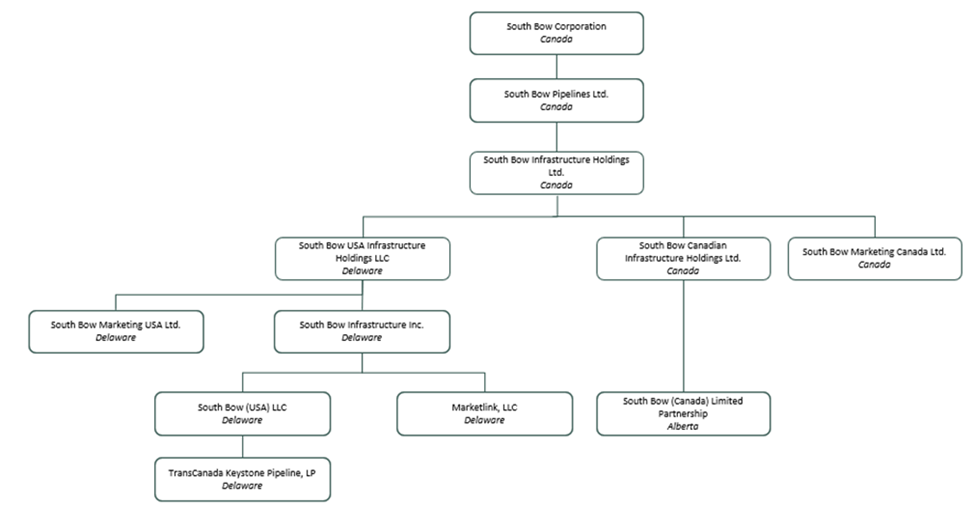
The following diagram presents the name and jurisdiction of incorporation, continuance, or formation of the principal subsidiaries of South Bow. Each of the subsidiaries shown have total assets that exceed 10 per cent of the consolidated assets of South Bow or revenues that exceed 10 per cent of the consolidated revenues of South Bow. South Bow beneficially owns, controls, or directs, directly or indirectly, 100 per cent of the voting shares or units in each of these subsidiaries.
South Bow Corporation 2025 Annual Information Form | 5
GENERAL DEVELOPMENT OF THE BUSINESS
The following is a summary of significant developments in South Bow following the Spinoff and in the Liquids Pipelines business of TC Energy prior to the Spinoff, over the past three years:
Spinoff Transaction
On June 4, 2024, the shareholders of TC Energy and the Alberta Court of King's Bench approved the Spinoff. The Spinoff and the related transactions resulted in two separate, independent, investment-grade, publicly listed companies: (a) TC Energy; and (b) South Bow. South Bow is an energy infrastructure company that owns and operates critical liquids pipelines and facilities extending across Canada and the U.S., safely and reliably connecting robust crude oil supplies to key refining and demand markets in the U.S. Midwest and Gulf Coast. Pursuant to the Spinoff: (a) all of the assets and liabilities comprising the Liquids Pipelines business were transferred from TC Energy to South Bow; and (b) all of the common shares of South Bow were distributed to TC Energy shareholders on a pro rata basis.
On June 23, 2023, each of South Bow Infrastructure Holdings Ltd. ("HoldCo"), South Bow USA Infrastructure Holdings LLC ("U.S. LiquidsCo"), and South Bow Canadian Infrastructure Holdings Ltd. ("Canadian LiquidsCo") were formed as indirect wholly owned subsidiaries of TC Energy. In August 2023, the assets of the Liquids Pipelines business of TC Energy were consolidated under these newly formed entities to facilitate the Spinoff. HoldCo, U.S. LiquidsCo, and Canadian LiquidsCo are wholly owned subsidiaries of South Bow.
Related to the Spinoff, on August 28, 2024, each of U.S. LiquidsCo and Canadian LiquidsCo completed the issuance of U.S. dollar-equivalent notes in the aggregate principal amount of approximately $5.8 billion U.S. dollar-equivalent (the "Initial Notes Offering"). The net proceeds of the Initial Notes Offering were released to South Bow upon completion of the Spinoff and used to repay indebtedness owed by South Bow and its subsidiaries to TC Energy and its subsidiaries. Certain of the notes issued in the Initial Notes Offering were subsequently exchanged for new notes in August 2025 (see Description of Capital Structure – Notes in this AIF). Separately, South Bow established a C$2.0 billion four-year senior unsecured revolving credit facility (the "Revolving Credit Facility") in the third quarter of 2024, which was amended and restated on October 3, 2025, to extend the maturity date to October 1, 2029. There were no modifications to the financial covenants.
South Bow Corporation 2025 Annual Information Form | 6
Effective October 1, 2024, the Spinoff was implemented by way of the Plan of Arrangement pursuant to the terms of the Arrangement Agreement.
At closing of the Spinoff:
•TC Energy and South Bow entered into a separation agreement (the "Separation Agreement"), which set forth the agreement between TC Energy and South Bow with respect to the separation of the Liquids Pipelines business from the business of TC Energy in connection with the Spinoff, including the transfer of certain assets related to the Liquids Pipelines business from TC Energy to South Bow and the allocation of certain liabilities and obligations related to the Liquids Pipelines business between TC Energy and South Bow, including responsibility and liability for certain legal actions existing at the time of completion of the Spinoff. In particular, TC Energy agreed to indemnify South Bow for 86 per cent of remaining total net liabilities and costs associated with the Milepost 14 ("MP-14") incident and the variable toll disputes on Keystone (excluding any future impacts to the variable toll), subject to a maximum liability for South Bow of $22 million (C$30 million) for those two matters (collectively, the "TC Energy Indemnified Liquids Liabilities"). See Separation Agreement.
•TC Energy and South Bow provided certain services to one another pursuant to a transition services agreement (the "Transition Services Agreement"), which services were limited to those matters which, for practical reasons, TC Energy or South Bow, as applicable, could not feasibly self-perform or outsource to third parties as of the time of completion of the Spinoff. Such services were primarily provided by TC Energy to South Bow. South Bow provided limited transition services to TC Energy. Effective April 1, 2025, the Company transitioned to its own enterprise resource planning system, marking a significant milestone in fully establishing South Bow as an independent company. South Bow also completed the transition to its new supervisory control and data acquisition system in November 2025, the final significant item in the path to exiting the Transition Services Agreement.
•TC Energy and South Bow entered into a tax matters agreement (the "Tax Matters Agreement"), which governs the parties' respective rights, responsibilities, and obligations with respect to taxes, including taxes arising in the ordinary course of business and taxes, if any, incurred as a result of any failure of the Spinoff and certain related transactions to qualify as tax-free for Canadian or U.S. federal income tax purposes, tax attributes, the preparation and filing of tax returns, tax elections, the control of audits and other tax proceedings, and assistance and cooperation in respect of tax matters.
•TC Energy assigned employees and transferred certain employee benefit plan assets and liabilities to South Bow, and both South Bow and South Bow USA Services, Inc. have established benefit plans and arrangements for the transferred employees pursuant to an employee matters agreement (the "Employee Matters Agreement") that was entered into between, among others, TC Energy and South Bow.
Separation Agreement
The Separation Agreement, which was entered into at closing of the Spinoff, sets forth the agreement between TC Energy and South Bow with respect to the separation of the Liquids Pipelines business from the business of TC Energy in connection with the Spinoff, including the transfer of certain assets related to the Liquids Pipelines business from TC Energy to South Bow and the allocation of certain liabilities and obligations related to the Liquids Pipelines business between TC Energy and South Bow, including responsibility and liability for certain legal actions existing at the time of completion of the Spinoff.
Under the terms of the Separation Agreement, South Bow agreed to indemnify TC Energy and its affiliates from and against any liabilities that were primarily attributed to the Liquids Pipelines business, whether arising or accruing at, prior to or after the time of completion of the Spinoff and whether the facts on which such liability were based occurred at, prior to, or after the time of completion of the Spinoff. This arrangement is subject to two primary exceptions, as TC Energy agreed to indemnify South Bow for the TC Energy Indemnified Liquids Liabilities, the effect of which is to limit South Bow's liability for the TC Energy Indemnified Liquids Liabilities to $22 million (C$30 million), in aggregate. Effective September 30, 2025, South Bow and associated parties mutually agreed to withdraw all complaints and protests associated with the variable toll disputes filed with the CER, FERC, the Court of King's Bench, and the District of Columbia
South Bow Corporation 2025 Annual Information Form | 7
Circuit Court (the "Withdrawal of Variable Toll Disputes"). Pursuant to an associated partial release of the indemnification agreement and the Separation Agreement, TC Energy was obligated to indemnify South Bow for certain amounts agreed to under the Withdrawal of Variable Toll Disputes.
The Separation Agreement also contains an indemnity under which TC Energy agreed to indemnify South Bow and its affiliates from and against any liabilities relating to the businesses and assets retained by TC Energy. TC Energy and South Bow also agreed to indemnify each other with respect to non-performance of their respective obligations under the Separation Agreement. In connection with the Withdrawal of Variable Toll Disputes, South Bow reached its maximum indemnity liability of $22 million (C$30 million).
The claim to recover economic damages under the United States-Mexico-Canada Agreement ("USMCA") relating to the legacy North American Free Trade Agreement ("NAFTA") and the revocation of the Keystone XL Presidential Permit in early 2021, which would have attributed damages to TC Energy and South Bow on a 90-10 split, respectively, if successful, was extinguished.
The separation of the Liquids Pipelines business was completed in accordance with the Separation Agreement, the Tax Matters Agreement, the Employee Matters Agreement, and the Plan of Arrangement.
Other matters provided for by the Separation Agreement include, among other things, access to books and records, confidentiality, and dispute resolution matters.
Following the Spinoff, TC Energy and South Bow became independent of each other to the greatest extent practicable. While the owners of both companies were initially the shareholders of TC Energy prior to the Spinoff, other than Mary Pat Salomone, who was elected to the board of directors of each of TC Energy and South Bow, there is no overlap in the directors, Management, or employees of TC Energy and South Bow. However, for a limited transition period, TC Energy and South Bow are subject to certain contractual arrangements, which are intended to facilitate the orderly transition of each entity into a fully independent public company. Such arrangements are limited to those contained in the Separation Agreement, the Transition Services Agreement, the Tax Matters Agreement, and the Employee Matters Agreement.
Blackrod Connection Project
South Bow has developed the Blackrod Connection Project, which consists of a 25‑km (16-mile) crude oil pipeline and a 25‑km (16-mile) natural gas lateral and associated facilities to provide crude oil transportation from International Petroleum Corporation's ("IPC") Blackrod steam-assisted gravity drainage ("SAGD") facility to South Bow's Grand Rapids Pipeline System. The total expected capital cost of the project is approximately $180 million, and was designated in-service on March 1, 2026. The Blackrod Connection Project is supported by long term committed contracts. See Description of the Business—Blackrod Connection Project.
Keystone
The Keystone Pipeline System ("Keystone") is currently operating at a high operating performance, with an operational reliability, or System Operating Factor, of 94 per cent in 2025. Operational reliability represents availability over a period of time. Through an acute focus on operational excellence, investments in integrity and reliability projects, as well as sustainable improvements, the system has been able to safely transport higher system throughput and increase its toll competitiveness. South Bow will continue to focus on enhancing system operations and continuing to optimize system reliability and performance.
Milepost 171 Incident
On April 8, 2025, South Bow responded to a release of approximately 3,500 barrels of crude oil near Fort Ransom, North Dakota at Milepost 171 ("MP-171") of the Keystone Pipeline. By early June 2025, the recovery of all released volumes and reclamation activities was complete.
PHMSA issued a Corrective Action Order on April 11, 2025, requiring South Bow to undertake corrective actions, including operating under pressure restrictions for specific segments of the pipeline. On April 15, 2025, after receiving regulatory approval from PHMSA, South Bow safely restarted the Keystone Pipeline under certain operating pressure restrictions.
South Bow has submitted its remedial work plan to PHMSA for approval, which includes the corrective actions already completed, along with addressing RCA recommendations. As South Bow conducts this
South Bow Corporation 2025 Annual Information Form | 8
remedial work, any findings will be incorporated into the plan and the Company's programs to enhance system integrity and ensure safe operations. South Bow is committed to maintaining transparency with its regulators, customers, and industry peers throughout this process.
An independent third-party root cause analysis ("RCA") of the MP-171 incident was conducted and submitted to PHMSA on September 15, 2025 and made publicly available on February 13, 2026. According to the RCA, the characteristics of the MP-171 incident were unique. Both the pipe and welds conformed to industry standards for design, materials, and mechanical properties. Additionally, the pipe was transported in accordance with industry standards, and the pipeline was operating within its design pressure at the time of the incident. The RCA identified that the failure resulted from a fatigue crack that originated along the pipe's manufactured long-seam weld.
Milepost 14 Incident
On December 7, 2022, TC Energy responded to a release of 12,937 barrels of crude oil into a creek in Washington County, Kansas at Milepost 14 ("MP-14") of the Keystone Pipeline. By June 2023, the recovery of all released volumes was complete, and by October 2023, creek restoration was finished, restoring natural flows to it.
PHMSA issued a Corrective Action Order in December 2022 and later amended it in March 2023 (the "Amended Corrective Action Order"). The pipeline is operating subject to the Amended Corrective Action Order, which includes certain operating pressure restrictions. Under the Amended Corrective Action Order, South Bow continues to fulfill its Keystone contract commitments. In January 2025, PHMSA approved the Company's remedial work plan, satisfying the conditions imposed by the Amended Corrective Action Order relating to the MP-14 incident. In March 2025, PHMSA approved the lifting of the pressure restriction on the affected segment to 72 per cent of the specified minimum yield strength of the pipeline. The affected segment includes the section of the pipeline where the MP-14 incident occurred.
An independent third-party RCA of the MP-14 incident was conducted and subsequently submitted to PHMSA in April 2023. The RCA revealed that a unique set of circumstances occurred at the rupture location, which likely originated during construction, with the primary cause of the rupture being a fatigue crack. A comprehensive remedial work plan has been implemented, including the RCA's recommendations, to help enhance pipeline integrity and safety performance of the system.
Variable Toll Disputes
In 2019 and 2020, certain Keystone customers initiated complaints before the FERC and the CER regarding certain costs within the variable toll calculation. In December 2022, the CER issued a decision which resulted in a one-time adjustment related to previously charged tolls of C$38 million. In March 2025, the CER issued a decision regarding Keystone's compliance filing, finding that, with one modification to the allocation of drag-reducing agent costs in the variable toll, the tolls for 2020 and 2021 were just and reasonable. In December 2025, the CER approved the 2022, 2023 and 2024 adjusted tolls. In February 2023, the FERC Administrative Law Judge released an initial decision in respect of the complaint and as a result, the Company recorded an adjustment of $42 million related to tolls previously charged between 2018 and 2022, which was accrued by the Company in 2023. A final order from the FERC was issued in July 2024, which resulted in a further adjustment of $8 million related to tolls previously charged between 2018 and 2022. South Bow appealed before the District of Columbia Court of Appeals in August 2024. The Withdrawal of Variable Toll Disputes resolved this matter.
Keystone XL
Following the revocation of the 2019 Presidential Permit for Keystone XL in January 2021, and after a comprehensive review of options in consultation with its partner, the Government of Alberta, in June 2021, TC Energy terminated the Keystone XL pipeline project. After the 2019 Presidential Permit was revoked, construction activities ceased except for certain activities required to clean up and reclaim worksites in adherence with TC Energy's commitment to safety, the environment, and its regulatory requirements. Right-of-way clean up and restoration was substantially complete while termination activities continued through the first half of 2024. TC Energy and South Bow, as applicable, will continue to coordinate with regulators, stakeholders, landowners, and Indigenous groups to meet their respective environmental and regulatory commitments.
South Bow Corporation 2025 Annual Information Form | 9
In November 2021, TC Energy filed a Request for Arbitration to formally initiate a legacy NAFTA claim to recover more than $15 billion in economic damages resulting from the revocation of the Presidential Permit for the Keystone XL pipeline project. The U.S. government objected on the basis that the provisions under the USMCA that protect investments made while NAFTA was in force apply only in connection with actions taken before July 1, 2020, when USMCA replaced NAFTA. In July, 2024, the Tribunal agreed with the U.S. government and therefore concluded that it did not have jurisdiction over TC Energy's claim. In April 2023, the Government of Alberta filed its own Request for Arbitration, which is proceeding separately from TC Energy's claim.
DESCRIPTION OF THE BUSINESS
South Bow is an energy infrastructure company that owns and operates critical liquids pipelines and facilities extending across Canada and the U.S., safely and reliably connecting robust crude oil supplies to key refining and demand markets in the U.S. Midwest and U.S. Gulf Coast. The majority of South Bow's revenues are generated through long-term committed transportation arrangements, whereby customers receive access to capacity in exchange for a committed monthly payment. In addition to its liquids pipelines and facilities, South Bow conducts activities through a non-regulated marketing entity. South Bow has three reporting segments: Keystone Pipeline System, Marketing, and Intra-Alberta & Other.
For information regarding South Bow's Keystone Pipeline System business, refer to the "Segment Results – Keystone Pipeline System" section of the 2025 Annual MD&A, which section is incorporated by reference herein.
For information regarding the Company's Marketing business, refer to the "Segment Results – Marketing" section of the 2025 Annual MD&A, which section is incorporated by reference herein.
For information regarding South Bow's Intra-Alberta & Other business, refer to the "Segment Results – Intra-Alberta & Other" section of the 2025 Annual MD&A, which section is incorporated by reference herein.
Refer to the "Financial Highlights" section of the 2025 Annual MD&A for the Company's revenues from operations, by segment, for the years ended December 31, 2025, 2024 and 2023, which section is incorporated by reference herein.
South Bow Corporation 2025 Annual Information Form | 10
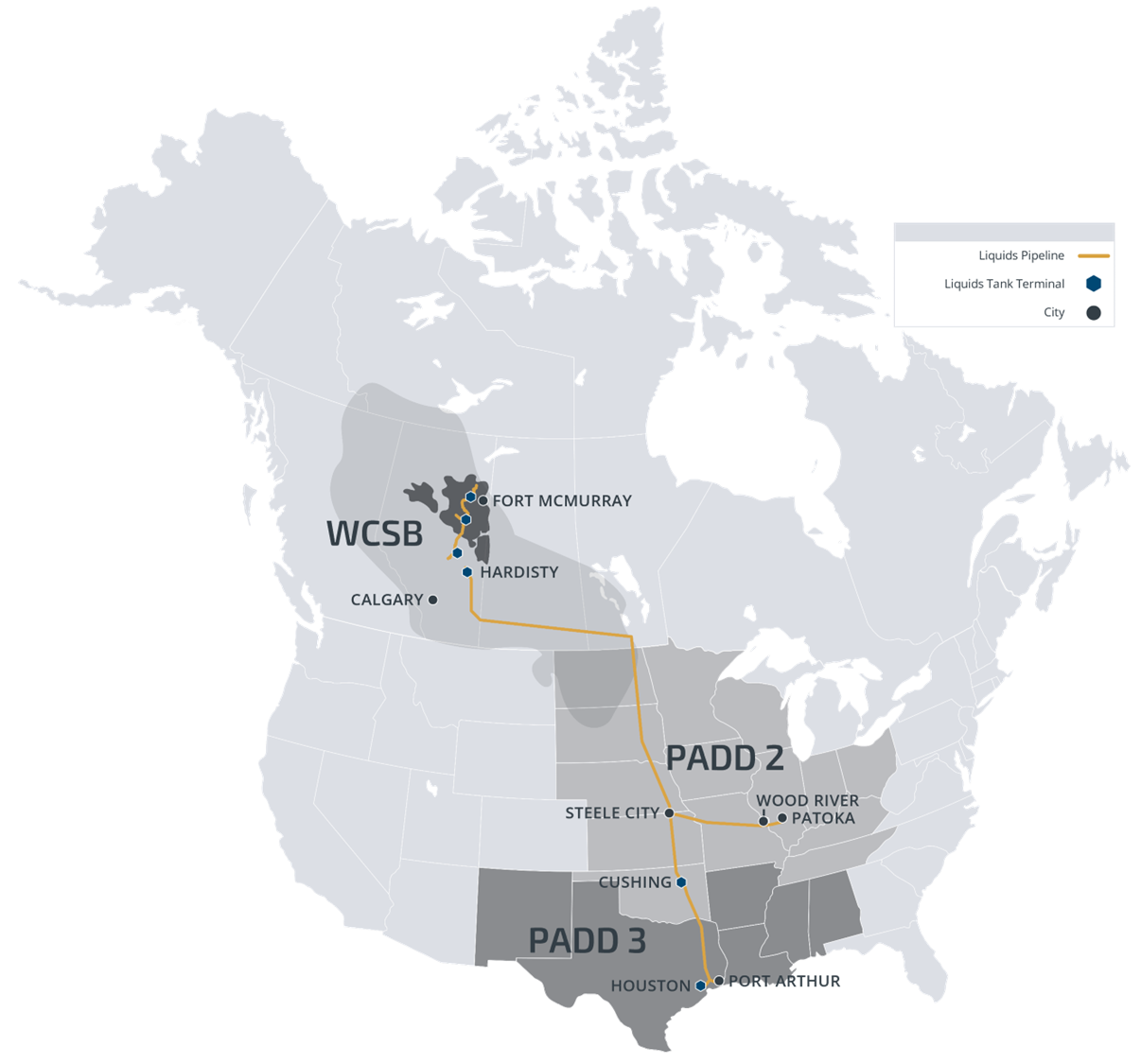
Spanning 4,900 km (3,045 miles), South Bow's network of pipelines is uniquely and strategically positioned, connecting stable crude oil production in the WCSB to world-class refineries markets located in the U.S. Midwest in PADD 2 and the Gulf Coast in PADD 3.
South Bow's pipeline assets provide pipeline transportation services to customers predominantly supported by long-term contracts with fixed monthly payments that are linked to contracted throughput volumes, providing certainty and generating stable earnings over the contract term.
These long-term contracts provide for the recovery of development costs, with operating and maintenance costs primarily recovered through a variable flow-through toll. This contracting profile generally insulates South Bow's business against market fluctuations and commodity price volatility and is expected to provide South Bow with a stable source of cash flow to support its capital allocation priorities, including paying a sustainable dividend and funding the Company's growth initiatives.
Revenues from South Bow's pipelines are generated mainly from providing customers with firm capacity arrangements to transport crude oil. The performance obligation in these contracts is the reservation of a specified amount of transportation capacity of crude oil on a monthly basis. Revenues earned from these
South Bow Corporation 2025 Annual Information Form | 11
arrangements are recognized ratably over the term of the contract regardless of the actual amount of crude oil that is transported. With the exception of South Bow's Marketing business, South Bow does not take ownership of the crude oil that it transports under these transportation contracts.
Uncontracted pipeline capacity is offered to the market on a monthly uncommitted basis and also through periodic open seasons, in accordance with regulatory requirements, which provides opportunities for South Bow to generate incremental earnings.
South Bow has an interest in the following pipelines:
| Pipeline | Length | Description | Ownership | ||||||||
| Keystone | 4,327 km (2,689 mi) | Transports crude oil from Hardisty, Alberta to U.S. markets at Wood River and Patoka, Illinois, Cushing, Oklahoma, and the U.S. Gulf Coast. | 100.0% | ||||||||
| Marketlink | — | Transports crude oil from Cushing, Oklahoma to the U.S. Gulf Coast on facilities that form part of Keystone. | 100.0% | ||||||||
| Grand Rapids | 460 km (286 mi) | Transports crude oil from the producing area northwest of Fort McMurray, Alberta to the Edmonton/Heartland, Alberta market region. | 50.0% | ||||||||
| White Spruce | 72 km (45 mi) | Transports crude oil from Canadian Natural Resources Limited's Horizon facility in northeast Alberta to the Grand Rapids Pipeline System. | 100.0% | ||||||||
Blackrod Lateral | 25 km (16 mi) | Transports crude oil from IPC's Blackrod SAGD facility to the Grand Rapids Pipeline System. | 100.0% | ||||||||
| McMillan North Lateral | 25 km (16 mi) | Natural gas pipeline providing natural gas supply to IPC's Blackrod SAGD facility. | 100.0% | ||||||||
| HoustonLink | 15 km (9 mi) | Connects Keystone and Marketlink to ONEOK, Inc.'s ("ONEOK") East Houston terminal. ONEOK operates the HoustonLink Pipeline. | 50.0% | ||||||||
| Port Neches | 6 km (4 mi) | Transports crude oil from Keystone and other liquids terminals in the Port Arthur, Texas area to Motiva Enterprises LLC's ("Motiva") terminal in Port Neches, Texas. | 74.9% | ||||||||
Keystone Pipeline System
Keystone
Keystone is a 4,327‑km (2,689‑mi), 30- to 36‑inch crude oil pipeline system, traversing three Canadian provinces and eight U.S. states. Keystone safely transports crude oil exported from western Canada to various delivery points in the U.S. Midwest and Gulf Coast. In 2025, Keystone delivered approximately 584,000 bbl/d of crude oil from Alberta, Canada to U.S. markets. Because Keystone operates in Canada and the U.S., South Bow is subject to the common carrier obligations imposed by the CER and the FERC, respectively.
Keystone has negotiated a fixed-variable rate toll structure with its shippers, providing South Bow with long-term certainty of cash flows. Recovery of the initial capital investment was fixed on a long-term committed basis, while actual operating, maintenance, and administrative costs are recovered through the variable toll. Keystone is required through its common carrier obligations to make six per cent of its capacity readily available to uncommitted spot shippers. Spot tolls can be adjusted to reflect market indicators to maintain competitiveness and are offered on a monthly basis.
Keystone was built out over four phases as follows:
Phase 1 (2007): 2,988‑km (1,857-mi) section from Hardisty, Alberta, to Steele City, Nebraska, and onward to Wood River and Patoka, Illinois (Wood River / Patoka Leg) where it delivers to mid-continent refineries and the Patoka trading hub. Phase 1 commenced operations in June 2010.
Phase 2 (2011) (Cushing Extension): 479‑km (298-mi) section from Steele City, Nebraska, to Cushing, Oklahoma, for delivery into the Cushing trading hub. Phase 2 commenced operations in 2011.
Phase 3 (2014) (Gulf Coast Extension): 782‑km (486-mi) section from Cushing, Oklahoma, to Nederland, Port Arthur, and Sour Lake, Texas, providing access to the U.S. Gulf Coast refining market. Phase 3 commenced operations in 2014.
South Bow Corporation 2025 Annual Information Form | 12
Phase 4 (2016) (Houston Lateral): 78‑km (48-mi) Houston Lateral to Houston, Texas, enabling deliveries to South Bow's Houston Tank Terminal and other refineries, trading hubs, and export terminals. Phase 4 commenced operations in 2016.
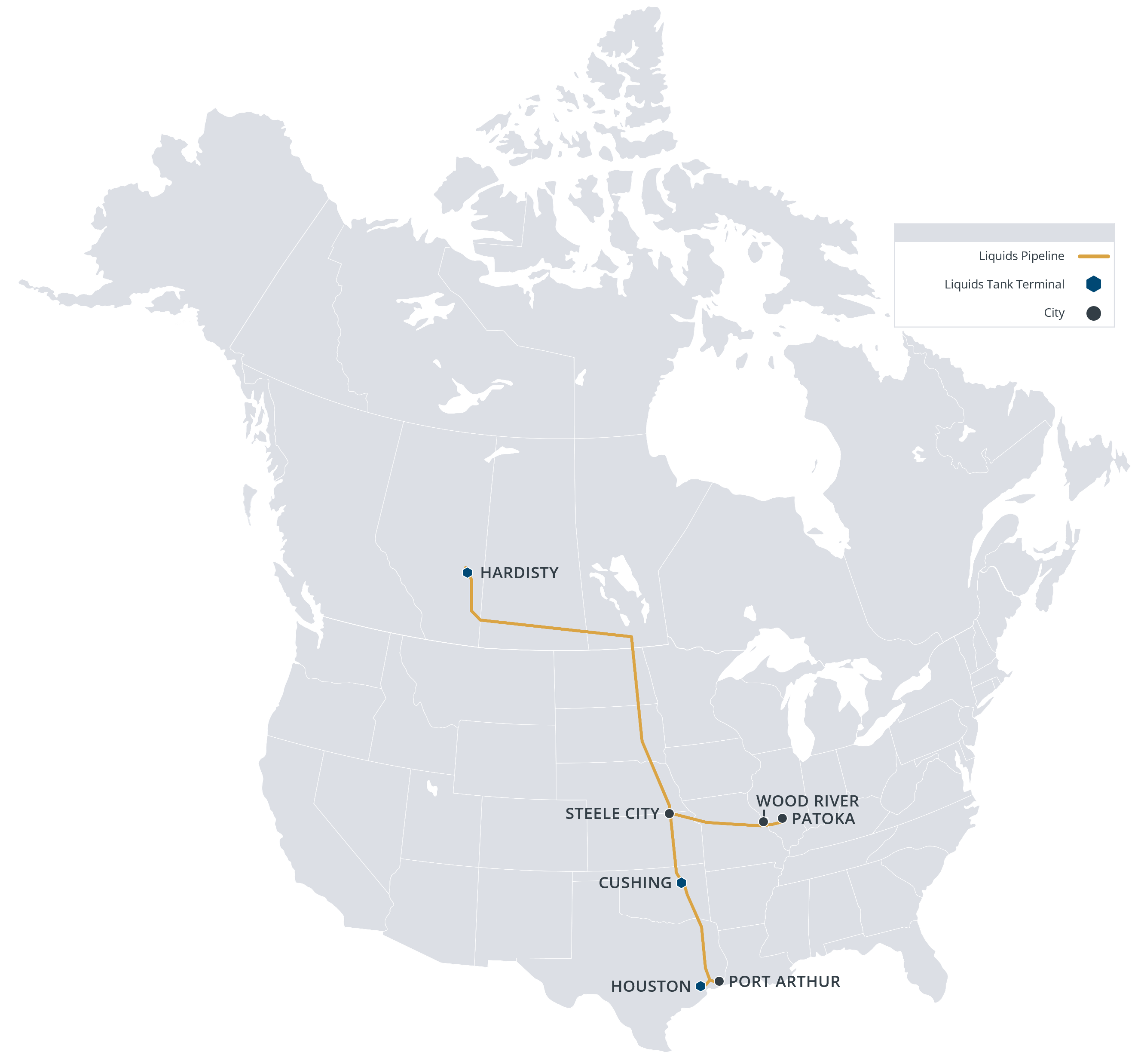
Keystone's competitive rates, premium service offering, connectivity, and long-term supply source resilience has positioned the asset as the premier WCSB egress pipe for shippers over the near and long term.
Keystone Transportation Service Agreements
Keystone is supported by 585,000 bbl/d of committed contracts and 540,000 bbl/d of those commitments are with shippers who are either rated investment grade by at least one of S&P or Moody's or whose parent entity is rated investment grade by at least one of S&P or Moody's.
South Bow Corporation 2025 Annual Information Form | 13
Credit Profile as of December 31, 2025 | Volume-weighted Term Remaining (years) | Contract Volume (bbl/d) | ||||||
| Investment Grade | 6 | 540,000 | ||||||
| Non-investment Grade / Not Rated / Unrated | 5 | 45,000 | ||||||
| Total Contracted Volumes | 6 | 585,000 | ||||||
With a volume-weighted remaining contract term of approximately six years as of December 31, 2025, South Bow expects earnings stability through the medium term. In addition, Keystone transportation services agreements ("TSAs") include renewal provisions, which provide customers with an option to extend their contract term. Contract terms may be extended by up to 10 years at rates established at the time of re-contracting. Force majeure clauses within the Keystone TSAs require customers to continue payment of fixed tolls for an initial three-month period during which volumes are not shipped. Customers accrue transportation services for unshipped volumes through make-up rights.
South Bow is positioned to execute on a high-quality set of growth opportunities, which is expected to further strengthen its competitive position in advance of re-contracting for the long term. Keystone has the most direct path with the shortest transit times from Hardisty, Alberta, to the U.S. Gulf Coast, providing it with an inherent competitive advantage. South Bow is focused on identifying, progressing, and executing on growth opportunities, which include leveraging existing infrastructure, to expand or extend its premium corridor to add incremental market connections. For these reasons, South Bow believes it will be able to successfully compete for contracts over the long term.
Marketlink
The Marketlink pipeline system ("Marketlink") provides crude oil transportation services from Cushing, Oklahoma to the U.S. Gulf Coast, through its lease of capacity on the U.S. Gulf Coast segment of Keystone1. Marketlink's lease payments are calculated in accordance with the lease and based on its proportional share of U.S. Gulf Coast capacity.
Marketlink is complementary to Keystone as it enables increased utilization of U.S. Gulf Coast segment capacity while ensuring Keystone customers maintain their right to capacity, and through the lease, reduces the operating costs for all Keystone customers, enabling South Bow to offer its customers a more competitive toll. Marketlink is regulated by FERC and operates as a common carrier pipeline, requiring South Bow to make 10 per cent of capacity available to new shippers if nominations exceed capacity. Marketlink has been granted approval by FERC to charge market-based rates.
Through its use of U.S. Gulf Coast segment capacity, Marketlink provides a connection to multiple terminals, refineries and marine export facilities in both the Houston and Port Arthur, Texas markets.
Port Neches Link
South Bow owns a 74.9 per cent interest in Port Neches Link, a joint venture with Motiva. The 6‑km (4-mi), 36-inch, pipeline is located in a heavily congested area of energy infrastructure, enabling last-mile connectivity for Keystone and Marketlink shippers to Motiva's 640,000 bbl/d Port Arthur refinery—North America's largest refinery. The Port Neches pipeline also includes facilities that connect additional liquids terminals in the Port Arthur area to Motiva's refinery. The Port Neches Link pipeline is a common carrier pipeline regulated by the Railroad Commission of Texas.
HoustonLink
South Bow owns a 50 per cent interest in HoustonLink, a joint venture with Magellan Midstream Partners L.P., an affiliate of ONEOK. The 15‑km (9-mi), 24-inch, pipeline provides a connection between Keystone, Marketlink, and ONEOK's East Houston terminal. HoustonLink is a common carrier pipeline regulated by the Railroad Commission of Texas. ONEOK is the operator of HoustonLink.
1 The U.S. Gulf Coast segment of Keystone includes the Gulf Coast Extension and Houston Lateral.
South Bow Corporation 2025 Annual Information Form | 14
Terminal Assets
To facilitate the delivery of its customers' products to key markets, South Bow owns and operates approximately 7.7 MMbbl of crude oil storage at facilities located in Alberta, Oklahoma, and Texas. These assets play an important role in the operations and competitiveness of South Bow's liquids pipelines network and provide South Bow with the opportunity to generate incremental revenue by leasing tank space to customers, providing them with market optionality. Contractual arrangements associated with storage are typically fixed-fee, term contracts.
| Tank Terminal | Capacity (MMbbl) | Type of Storage | ||||||
| Hardisty | 2.2 | Operational / Contract | ||||||
| Cushing | 3.3 | Operational / Contract | ||||||
| Houston | 1.4 | Operational / Contract | ||||||
| MacKay, House River & Heartland | 0.8 | Operational | ||||||
| Total Capacity | 7.7 | |||||||
Marketing
South Bow's Marketing business provides customers with a variety of crude oil marketing services, including transportation, storage, and logistics, primarily through the purchase and sale of physical crude oil. This business contracts for capacity on South Bow's assets as well as third-party owned pipelines and tank terminals. The Marketing business periodically engages in hedging activities to minimize commodity risk exposure by utilizing financial instruments and derivative contracts.
Intra-Alberta & Other
South Bow currently owns and operates four intra-Alberta pipelines as shown on the map below. South Bow's intra-Alberta pipelines are regulated by the Alberta Energy Regulator ("AER").
Grand Rapids Pipeline System
Jointly owned by South Bow and PetroChina Canada Ltd., with a 50 per cent interest each, the 460‑km (286-mi), 20-inch Grand Rapids Pipeline System plays a key role in connecting oil sands production to terminals in the Edmonton and Heartland refining and marketing region. The Grand Rapids Pipeline System was placed into service in August 2017, supported by a 25-year committed contract. The pipeline provides connectivity to westbound and eastbound ex-Alberta pipelines.
White Spruce Pipeline System
The 72‑km (45-mi), 20-inch White Spruce Pipeline System provides transportation and market access for growing volumes of crude oil produced in Alberta's oil sands region. White Spruce is designed to transport crude oil produced at Canadian Natural Resources Limited's Horizon Oil Sands Facility in northeast Alberta to the Grand Rapids Pipeline System. White Spruce was placed into service in May 2019, supported by a 25-year committed contract.
Blackrod Connection Project
The Blackrod Connection Project provides both liquids and natural gas transportation infrastructure to support IPC's Blackrod SAGD facility. The Blackrod Connection Project consists of the 25‑km (16‑mi), 16‑inch McMillan North lateral, which provides natural gas transportation service to IPC's Blackrod SAGD facility, and the 25‑km (16‑mi), 12‑inch Blackrod lateral, which provides crude oil transportation service from IPC's Blackrod SAGD facility to the Grand Rapids Pipeline System. The McMillan North lateral was placed into service on September 1, 2025 and the Blackrod lateral was placed into service on March 1, 2026. The Blackrod Connection Project was underpinned by multi-decade committed contracts.
South Bow Corporation 2025 Annual Information Form | 15
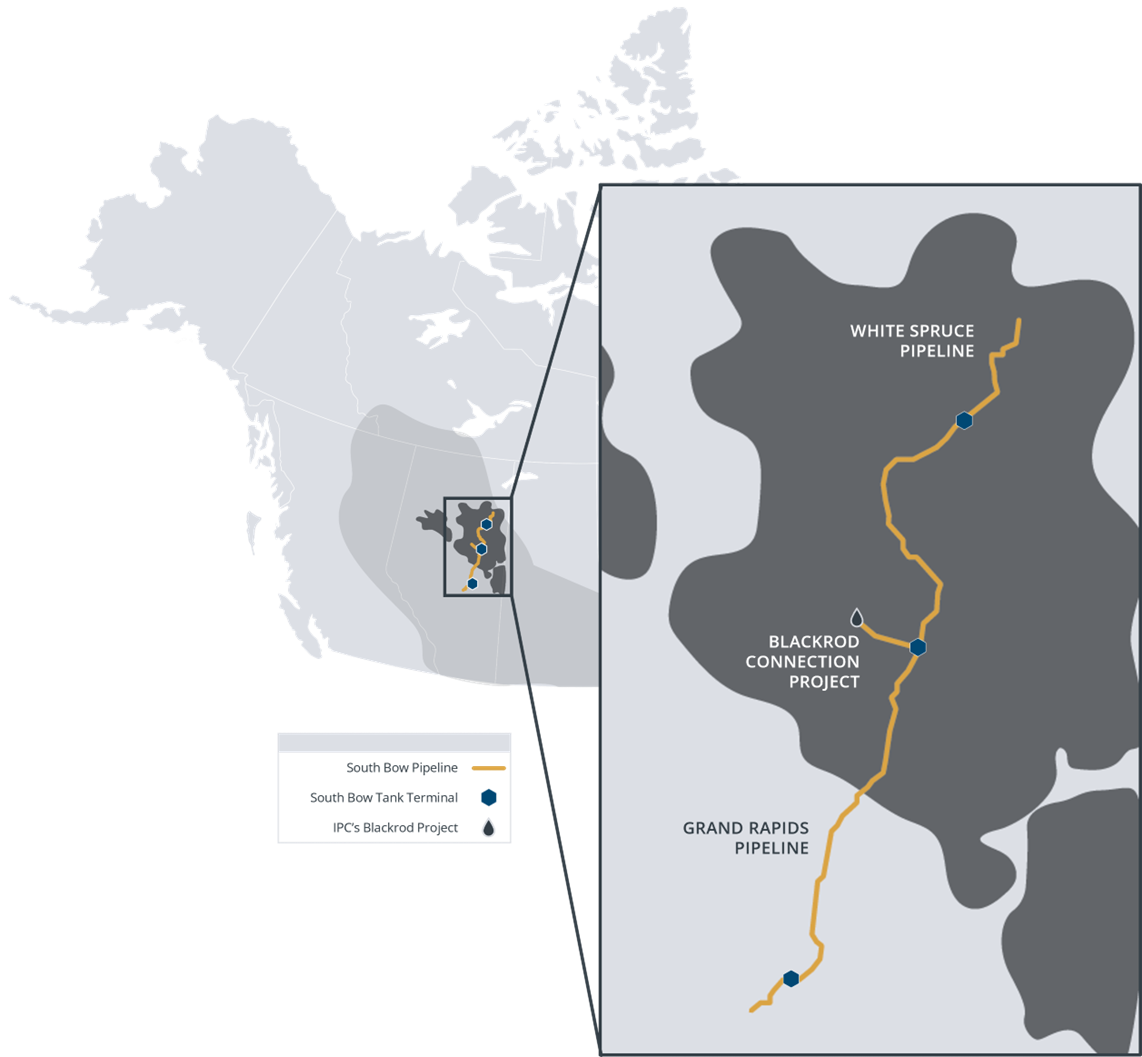
Regulation of South Bow
Canada
The CER regulates the terms and conditions of service, including rates, construction, abandonment, and operation of the Canadian portion of Keystone. The CER subjects liquids pipelines to common carrier obligations. The rates for transportation service on Keystone are calculated in accordance with a methodology agreed to in TSAs between Keystone and its customers, as approved by the CER.
The AER regulates South Bow's Intra-Alberta pipelines and matters related to rates and services by the Alberta Utilities Commission ("AUC"). Rates and services are regulated on a complaint basis.
Rate-regulated accounting is not applicable to South Bow's regulators' decisions regarding operations, and tolls on South Bow's pipeline systems generally do not have an impact on timing of recognition of revenues and expenses.
South Bow Corporation 2025 Annual Information Form | 16
United States
In the U.S., regulated interstate liquids pipelines are subject to the federal authority of the FERC, PHMSA, and various U.S. state authorities. These entities regulate the construction, operation, and abandonment of pipeline infrastructure.
The FERC regulates the transportation service of South Bow's liquids pipeline systems and oversees the reasonableness of its tolls. The location and construction of pipeline facilities are regulated by the specific state regulator in which the pipeline facilities are located.
PHMSA, an agency of the U.S. Department of Transportation, oversees safety for pipeline construction, operation, and maintenance, including for the U.S. portion of Keystone.
Liquids pipeline projects that cross federal lands or waters of the U.S. require additional federal permits.
Cross-border Regulation
Liquids pipelines that cross the international border between Canada and the U.S., such as Keystone, are subject to cross-border regulation. South Bow's cross-border activities subject it to regulatory matters, including import and export licenses, tariffs, Canadian and U.S. customs and tax issues, and toxic substance certifications. Such regulations include the Short Supply Controls of the Export Administration Act, the USMCA, and the Toxic Substances Control Act. Keystone obtained a Presidential Permit for the construction and operation of Keystone.
Business Environment
Dynamic shifts in geopolitical events, government policy changes, and various macroeconomic factors continue to impact global crude oil supply and demand fundamentals. While the upstream sector remains focused on balancing capital discipline and growth, South Bow still expects crude oil demand to increase this decade. Global energy demand is expected to increase through 2050, driven by world population growth and economic expansion. South Bow believes that North America's crude oil supply, inclusive of the WCSB, is critical to supporting this future demand and that North American crude oil production will remain a robust and important part of the energy mix for decades to come.
Strategic Priorities
South Bow's assets are strategically positioned to provide competitive and secure transportation solutions for growing WCSB and U.S. crude oil supplies to the U.S. Midwest and Gulf Coast. Supported by long-term contracts that generate stable earnings and carry minimal commodity price or volumetric risk, South Bow represents a differentiated investment opportunity, delivering a total return profile that includes a strong and sustainable dividend and profitable growth.
South Bow's long-term strategy is to remain financially strong, low-risk, and resilient, with a scalable and diversified portfolio that delivers safe, reliable, and competitive market solutions. This strategy is supported by a strong safety culture and a commitment to asset integrity and reliability.
Through disciplined capital allocation, South Bow seeks to preserve optionality and maximize total return for shareholders over the long term. The Company's capital allocation priorities include:
•paying a sustainable dividend;
•strengthening the Company's investment-grade financial position by lowering its net debt-to-normalized EBITDA2 ratio to 4.0 times over the medium term; and
•leveraging existing infrastructure within South Bow's strategic corridor to offer customers competitive connections, enhanced optionality, and value chain expansions.
2 Non-GAAP ratio that does not have standardized meanings under GAAP and may not be comparable to measures presented by other entities. See "Specified Financial Measures" of this AIF.
South Bow Corporation 2025 Annual Information Form | 17
Customer Profile
South Bow's customers are highly creditworthy counterparties, consisting of vertically integrated companies, refiners, producers, and marketers, with 90 per cent of South Bow's annual revenue exposure to investment-grade counterparties. South Bow's long-life liquids infrastructure and long-term contract profile aligns with the durable nature of its producer and refiner customers.
The following table provides a breakdown of South Bow's revenue by customer type for the periods indicated.
Year Ended | |||||||||||
| Customer Type | December 31, 2025 1 | December 31, 2024 1 | December 31, 2023 1 | ||||||||
Vertically Integrated (Producer & Refiner) | 46 | % | 44 | % | 43 | % | |||||
| Refiner | 47 | % | 45 | % | 49 | % | |||||
| Producer | 6 | % | 6 | % | 6 | % | |||||
| Marketer | 1 | % | 5 | % | 2 | % | |||||
1.Excludes "Other revenues".
Supply Outlook
Canada
Canada has the world's third-largest crude oil reserves, with over 160 billion barrels of proven and economically recoverable oil.3 Canada's crude oil reserves are made up of conventional, unconventional, and oil sands reserves, with the predominance of the reserves attributable to the oil sands within the WCSB, which has a reserve life index of greater than 50 years. Production from the WCSB, which is the main supply source for South Bow's assets, was approximately 5.0 MMbbl/d in 2025 and is expected to grow by over 0.5 MMbbl/d by 2030.4 The oil sands makeup the majority of Canadian crude oil production with 3.5 MMbbl/d in 2025.6 The oil sands are considered a world-class supply source given their decades-long reserve life, low base production decline, low sustaining capital requirements, and continuously improving cost and environmental performance. South Bow believes that its assets are well-positioned to capture such production growth from the WCSB.
United States
The United States is one of the largest crude oil-producing countries in the world, with production exceeding 13.5 MMbbl/d in 2025.5 The majority of continental U.S. crude oil production is in the form of light tight oil from the Permian, Williston, Eagle Ford, and Niobrara resource plays or basins. U.S. refineries have been optimized through significant capital investments to refine a mix of light and heavy crude oils to produce an optimized refined products slate. With South Bow's Keystone Pipeline's connection to key refining and export markets, South Bow believes its assets are well-positioned to continue to attract barrels that aggregate at the Cushing, Oklahoma supply hub and utilize Marketlink to reach the U.S. Gulf Coast.
Demand Outlook
Global energy demand is forecasted to increase through 2050,6 driven by global population and economic growth. South Bow expects that crude oil will continue to play a vital role in helping the world meet its energy needs for decades to come.
The United States is the primary source of crude oil demand in North America, with refining capacity of 18 MMbbl/d.7 Canada's heavy crude oil production is of strategic importance to the U.S. refining industry. South Bow's assets serve the U.S. Midwest and Gulf Coast refining markets, PADD 2 and PADD 3, respectively. PADD 2 represents 23 per cent (4 MMbbl/d) and PADD 3 represents 54 per cent (10 MMbbl/d) or, in aggregate, 77 per cent (14 MMbbl/d) of U.S. refining capacity.7 Many PADD 2 and PADD 3 refineries are large-scale, complex facilities, with deep conversion capacity for heavy crude oil reached through significant
3 Source: Alberta Energy Regulator (2025).
4 Source: Wood Mackenzie (2025).
5 Source: U.S. Energy Information Administration (2025).
6 Source: International Energy Agency, World Energy Outlook 2025.
7 Source: Wood Mackenzie (2025).
South Bow Corporation 2025 Annual Information Form | 18
capital investments. These markets are expected to increase their domestic market share and remain globally competitive for decades to come due to their access to low-cost Canadian heavy and U.S. light crude oil, as well as their proximity to abundant low-cost natural gas supply, positioning them to be among the most profitable refineries in the world.
While domestic consumption makes up the majority of current North American crude oil demand, exports are expected to grow, increasing their proportion of North American crude oil demand out past the end of the decade, driven by growth in emerging markets. Crude oil export from the U.S. Gulf Coast, a market served by South Bow's pipelines, is expected to grow through 2030.7
Competitive Conditions
Competition among liquids pipelines is based primarily on transportation charges, access to producing regions, and demand for crude oil by end users. Existing third-party owned pipelines in the vicinity of South Bow's operations expose South Bow to competition based on their ability to provide crude oil transportation into similar or different markets. In areas where new infrastructure is being built or has been built to accommodate new or increased production or changing product flows, South Bow faces competition, as well as risk that egress capacity may be unconstrained until production grows sufficiently or pipelines are retired. Further delays in production growth, higher-than-anticipated production declines, or lower-than-expected demand for crude oil, could exacerbate these risks; however, South Bow believes that its contract terms, tenor, and structure of its integrated business model, combined with expected crude oil supply and demand fundamentals, should mitigate these risks.
Marketlink serves markets with heightened competition, and, as a result, has been granted market-based rate authority by the FERC. South Bow is able to use Marketlink's market-based rates authority as a tool to attract volumes.
Crude oil pipelines, which generally offer the lowest cost of transportation, may also face competition from other forms of transportation, such as truck, rail, and barge. Although these alternative forms of transportation typically have higher costs and are more carbon intensive, they may be able to provide access to alternative markets, whereby a higher realized price may justify the higher transportation cost.
South Bow also faces competition with respect to its ancillary services, such as storage at terminals. South Bow's ability to offer competitive rates and attractive service attributes are necessary to compete in these markets.
Companies that compete with South Bow include Enbridge Inc., Gibson Energy Inc., Inter Pipeline Ltd., Trans Mountain Corporation, Keyera Corp., Pembina Pipeline Corporation, Plains All American Pipeline, L.P., Energy Transfer LP, and Enterprise Products Partners L.P, among many others.
Economic Cycles and Seasonality
South Bow's annual revenues are based on contracted and uncontracted transportation service, ancillary services, as well as marketing activities. Quarter-over-quarter revenues and earnings may be affected by a number of factors, which include but are not limited to:
•regulatory and government policy decisions;
•newly constructed assets being placed in-service;
•acquisitions and divestitures;
•demand for uncontracted transportation services;
•marketing activities and commodity prices;
•developments outside of the normal course of operations;
•certain fair value adjustments;
•weather; and
South Bow Corporation 2025 Annual Information Form | 19
•planned and unplanned outages.
The long-term contract profile supporting South Bow's business model provides stable tolls for customers and stable revenues for South Bow. The cyclical nature of commodity prices may influence the pace at which customers expand their operations. This can impact the rate of project growth in the liquids industry, the value of services as contracts expire, and the timing for the demand of transportation services and/or new liquids infrastructure.
Economic Dependence
For the year ended December 31, 2025 three major customers accounted for $634 million, $323 million, and $183 million in revenues, respectively, each representing more than 10 per cent of total revenues from contracts with customers (2024 – three major customers accounted for $630 million, $322 million, and $175 million, respectively; 2023 – four major customers: $635 million, $308 million, $174 million, and $167 million, respectively), or in aggregate, $1.14 billion or approximately 57 per cent of total revenues from contracts with customers (2024 – three customers: $1.127 billion or approximately 53 per cent; 2023 – four customers: $1.284 billion or approximately 64 per cent). See Note 6, Revenues of the 2025 Annual Financial Statements.
Changes to Contracts
The markets served by Marketlink are competitive, requiring South Bow to develop and offer services with attractive attributes at cost competitive levels. South Bow has been recently successful in attracting and retaining customers on Marketlink; however, adverse changes in market circumstances may result in customers with renewal options electing not to renew. Marketlink has certain contracts that are set to expire in 2026.
Health, Safety, Sustainability, Environmental Protection, and Social Policies
Safety, Environment and Operations Committee
South Bow established the Safety, Environment and Operations Committee of South Bow's board of directors (the "Board") to oversee operational risk, major project execution risk, occupational and process safety, sustainability, security of personnel and electronic data, environmental and climate change-related risks, as well as monitoring the development and implementation of systems, programs and policies relating to health, safety, sustainability, and environmental ("HSSE") matters through regular reporting from Management. The committee reviews, monitors, and reports on:
•Performance and activities of South Bow on HSSE matters, including: compliance with applicable and proposed legislation, regulations, and orders; conformance with industry standards; people's health, safety and security; process safety; asset reliability; operational risk management and asset integrity plans and programs; and emergency response plans and programs.
•Execution of major projects with significant cost, new technology to South Bow, or significant stakeholder complexity.
•Whether South Bow's operational systems, programs, and policies are being appropriately developed and effectively implemented.
•Actions and initiatives undertaken by South Bow to prevent, mitigate, and manage risks, including climate change-related risks and cybersecurity-related risks, which may have the potential to adversely impact South Bow's assets, operations, activities, plans, strategies, or reputation, or prevent loss or injury to South Bow's employees and its assets or operations from malicious acts, natural disasters, or other crises situations.
•Critical incidents respecting South Bow's assets or operations involving: a fatality or a life-threatening injury to a person; any pipeline ruptures resulting in significant property damage or loss of product; whistleblower events; or any incidents involving personnel and public safety, property damage, environmental damage, or physical security that have the potential to severely and adversely impact South Bow's reputation or business continuity.
South Bow Corporation 2025 Annual Information Form | 20
•Regulatory audits, findings, orders, reports, and/or recommendations issued by or to South Bow together with Management's response.
•Sustainability matters, including social, environmental, and climate change-related risks and opportunities, as well as related public disclosures.
The Safety, Environment and Operations Committee also maintains oversight of significant and complex capital and system improvement projects, including the monitoring of prescribed performance criteria. The Safety, Environment and Operations Committee hosts regular sessions, as part of its formal committee meetings, with members of senior Management to receive status, cost, and notable updates on certain of these capital projects. Management also provides periodic written updates to the Safety, Environment and Operations Committee throughout the year.
The Safety, Environment and Operations Committee also receives updates on any specific areas of operational and construction risk management review being conducted by Management and the results and corrective action plans resulting from internal and third-party audits. Generally, the Safety, Environment and Operations Committee or the Chair of the Safety, Environment and Operations Committee tours one of South Bow's existing assets or projects under development as part of its responsibility to monitor and review South Bow's HSSE practices. All South Bow board members are invited to attend site tours.
Health, Safety, and Asset Integrity
Operational Management System
South Bow uses an integrated operational management system ("OMS") that establishes a framework for managing risks and is used to capture, organize, document, monitor, and improve its related policies, standards, and procedures. South Bow's OMS leverages industry consensus standards and incorporates applicable regulatory requirements. The OMS governs health, safety, environment, and operational integrity matters for all of South Bow's assets across Canada and the U.S. throughout their lifecycle. The OMS is assessed through periodic audits and evaluations and is continually improved through a structured and systematic process.
Safety Management Program
The safety of South Bow's employees, contractors, and the public, and the integrity of the Company's assets are an enduring core value. All assets were and will continue to be designed, constructed, commissioned, operated, and maintained with full consideration given to safety and integrity, and will be placed into service only after all necessary requirements, both regulatory and internal, have been satisfied.
South Bow is committed to protecting the health and safety of all individuals involved in its activities and consistently seeks to deliver effective programs that:
•reduce the human and financial impact of illness and injury;
•ensure fitness for work;
•strengthen worker resiliency;
•build organizational capacity by focusing on individual well-being, health education, leader support, and improved working conditions to sustain a productive workforce;
•increase mental well-being awareness;
•provide various health and wellness supports and training to employees and leaders;
•measure the success of programs; and
•foster a positive safety culture by embracing human and organizational performance, which emphasizes understanding the systemic factors contributing to workplace incidents unlike traditional models that often pinpoint human error as the primary cause of such events.
South Bow Corporation 2025 Annual Information Form | 21
Emergency Management Program
South Bow has implemented an Emergency Management Program to provide a consistent and comprehensive approach to emergency preparedness, business continuity, and emergency response within the organization. South Bow has also implemented standard emergency response protocols which align to the Incident Command System. To maintain a high level of readiness, South Bow utilizes a common organizational framework for emergency response and provides initial and ongoing response training for all relevant personnel. South Bow believes it has the physical resources required to manage a response of any size or scope and works closely with industry-leading response contractors, while maintaining a fleet of company-owned response equipment located in strategic caches along its system footprint. South Bow's business maintains multi-layer response plans that support site-specific planning and industry best practices to support a coordinated and effective response. South Bow routinely exercises these plans and holds realistic drills, often in collaboration with local response agencies and communities, to hone the skills of its personnel and test its protocols to ensure it is prepared for an incident. If South Bow responds to an actual incident, it hosts meaningful after-action assessments to support a culture of continuous learning and improvement.
Incident Management
South Bow has an incident management process in place to collect learnings from minor events that would not receive a formal investigation as part of the Emergency Management Program, and incorporate the learnings into procedures and work practices. Process safety events are classified based on the potential to escalate from a minor incident to more severe, or a repetitive pattern of small-scale incidents. High-potential process safety events are reviewed by leadership, driving sustainable improvements.
Pipeline and Facility Integrity
An integral component of South Bow's safety values and commitments is its focus on pipeline and facility integrity, which is critical to managing the loss of containment risk that can have drastic consequences on life, property, and the environment. South Bow maintains a core pipeline integrity team with subject matter expertise to ensure that it is positioned to proactively respond to emerging integrity threats along its asset base. South Bow also fosters a culture of continuous learning and improvement, which seeks to develop new technologies, while reviewing, adjusting, and implementing program advancements.
South Bow expects pipeline integrity expenditures to fluctuate based on the results of ongoing risk assessments conducted on its pipeline systems and evaluations of information obtained from recent inspections, incidents, and maintenance activities. Pipeline and facility integrity expenditures are primarily recovered through South Bow's flow-through tolling mechanism. Spending associated with process safety and integrity will be used to minimize risk to employees, contractors, the public, equipment, and the surrounding environment, and also prevent disruptions to serving the energy needs of South Bow's customers.
Environmental Risk, Compliance, and Liabilities
Through the implementation of its OMS, South Bow proactively and systematically manages environmental hazards and risks throughout the lifecycle of its assets. South Bow's primary sources of risk related to the environment include:
•changing regulations and requirements, coupled with increased costs related to impacts on the environment;
•product releases, including crude oil, natural gas, and diluent, which may cause harm to the environment (land, water, and air);
•use, storage, and disposal of chemicals and hazardous materials; and
•natural disasters and other catastrophic events that may impact South Bow's operations.
South Bow's assets are subject to federal, state, provincial, and local environmental statutes and regulations governing environmental protection, including air and greenhouse gas ("GHG") emissions, water quality, species at risk, wastewater discharges, and waste management. Monitoring and reporting programs for
South Bow Corporation 2025 Annual Information Form | 22
environmental performance in day-to-day operations and project development, as well as inspections and assessments, are designed to provide assurance that environmental and regulatory standards are met.
Operating South Bow's assets requires obtaining and complying with a wide variety of environmental regulations, licenses, permits, and other approvals and requirements. Failure to comply could result in administrative, civil, or criminal penalties, remedial requirements, or orders affecting future operations. The OMS includes requirements for South Bow to continually monitor its facilities for compliance with all material legal and regulatory environmental requirements across all jurisdictions where it operates. South Bow routinely monitors proposed changes to environmental policy, legislation, and regulation. Where the risks are uncertain or have the potential to affect South Bow's ability to effectively operate its business, South Bow comments on proposals independently or through industry associations.
Other than orders and claims relating to the MP-171 and MP-14 incidents, South Bow is not aware of any material outstanding orders, claims, or lawsuits against it related to releasing or discharging any material into the environment or in connection with environmental protection. The Separation Agreement contains an indemnity under which TC Energy agreed to indemnify South Bow from certain liabilities associated with the MP-14 incident.
Compliance obligations can result in significant costs associated with installing and maintaining pollution controls, fines, and administrative, civil, or criminal penalties resulting from any failure to comply, and potential limitations on operations. Remediation obligations can result in significant costs associated with the investigation and remediation of contaminated properties, and with damage claims arising from the contamination of properties. The timing and complete extent of future expenditures related to environmental matters is difficult to estimate accurately because:
•environmental laws and regulations and their interpretations and enforcement change;
•new claims can be brought against South Bow's existing or discontinued assets;
•South Bow's pollution control and clean-up cost estimates may change, especially when its current estimates are based on preliminary site investigations or agreements;
•new contaminated sites may be found or what South Bow knows about existing sites could change; and
•where there is potentially more than one responsible party involved in litigation, South Bow cannot estimate its joint and several liability with certainty.
Social Policies
South Bow's governance practices comply with the NYSE standards for U.S. companies in all significant respects, despite not being required to comply with most of the governance listing standards of the NYSE as a non-U.S. issuer. As a foreign private issuer, however, South Bow must disclose how its governance practices differ from those followed by U.S. companies that are subject to the NYSE standards. South Bow's governance practices do not significantly differ from those required to be followed by U.S. domestic issuers under the NYSE's listing standards. A summary of South Bow's governance practices compared to U.S. standards can be found on its website at www.southbow.com.
Code of Business Ethics
South Bow has adopted a Code of Business Ethics ("COBE"), which applies to all employees, officers, directors, and contractors of South Bow and its wholly owned subsidiaries and operated entities in countries where it conducts business, with the exception of independently operated entities whose corporate governance documents meet or exceed South Bow's requirements. Annual COBE training is provided to all employees and contingent workforce contractors, and all employees (including executive officers), directors, and contingent workforce contractors are required to certify their compliance with COBE annually.
South Bow Corporation 2025 Annual Information Form | 23
Avoiding Bribery and Corruption Program
South Bow has also adopted an Avoiding Bribery and Corruption Program, which includes an Avoiding Bribery and Corruption Policy, annual training included as part of annual COBE training, a supplier and contractor due diligence review process, and auditing of certain types of transactions.
Stakeholder Engagement
South Bow is proud of the relationships it has built with stakeholders and rightsholders across Canada and the U.S. and believes that these relationships are critical to its success. South Bow's approach to engagement with Indigenous groups, landowners, and other stakeholders who may be affected by South Bow's activities is guided by a principled approach that considers the foundations of respect, trust, and transparency. South Bow strives to listen, provide accurate information, and respond to interests in a prompt and consistent manner.
South Bow acknowledges the unique rights of Indigenous Peoples and seeks to listen and understand in order to incorporate their traditional and local knowledge in project design and planning. South Bow seeks to establish partnerships and collaborate by supporting community-driven development and initiatives that contribute to the well-being and sustainability of Indigenous communities.
South Bow also employs programs that direct how it engages with other stakeholders including landowners, communities, and governments. South Bow works to understand and mitigate the complexity of sustainability issues and the interconnectivity of these issues as they relate to its business. These matters are of great importance to Indigenous groups and stakeholders and have an impact on South Bow's ability to build and operate energy infrastructure.
Specialized Skill and Knowledge
All aspects of South Bow's business require specialized skills and knowledge. Such skills and knowledge include the areas of pipeline and facility design, engineering, construction, and operations; energy market fundamentals; law and regulation; and commercial operations and negotiations. South Bow relies upon Management, employees and various consultants for such expertise in addition to new hires as they are required for the operation and management of South Bow's business. South Bow is committed to enabling opportunities for employees to develop and maintain the necessary skills and knowledge required to effectively perform their roles with South Bow.
Employees
As of December 31, 2025, South Bow and its subsidiaries had a total of approximately 536 employees. The Board evaluates the expertise and skills required to meet South Bow's goals on an ongoing basis.
DESCRIPTION OF CAPITAL STRUCTURE
Share Capital
As of December 31, 2025, South Bow is authorized to issue: (a) an unlimited number of common shares; and (b) first preferred shares and second preferred shares in an amount not to exceed, in aggregate, 20 per cent of the number of issued and outstanding common shares of South Bow. As of December 31, 2025, 208,250,512 common shares of South Bow were issued and outstanding and no first or second preferred shares were issued and outstanding.
Common Shares
The common shares of South Bow entitle the holders to one vote per share at all meetings of South Bow's shareholders, except meetings at which only holders of another specified class of shares are entitled to vote, and, subject to the rights, privileges, restrictions, and conditions attaching to the first preferred shares and the second preferred shares, whether as a class or a series, and to any other class or series of shares of South Bow which rank prior to the common shares, entitle the holders to receive: (a) dividends if, as, and when declared by the Board out of the assets of South Bow properly applicable to the payment of the dividends in such amount and payable at such times and at such place or places as the Board may from
South Bow Corporation 2025 Annual Information Form | 24
time to time determine; and (b) the remaining property of South Bow upon a liquidation, dissolution, or winding up of South Bow.
Shareholder Rights Plan
South Bow has a shareholder rights plan (the "Rights Plan") which was adopted in connection with the Spinoff. The Rights Plan was adopted to ensure that to the extent possible, the Board has adequate time to identify, develop, and negotiate value-enhancing alternatives, if considered appropriate, to any unsolicited bid for the common shares of South Bow, and that shareholders of South Bow are treated fairly in connection with any unsolicited take-over bid. The Rights Plan creates a right that attaches to each issued common share of South Bow. Until the separation time, which typically occurs at the time of an unsolicited take-over bid, whereby a person acquires or attempts to acquire 20 per cent or more of common shares of South Bow, the rights are not separable from the common shares, are not exercisable, and no separate rights certificates are issued. Each right entitles the holder, other than the 20 per cent acquirer, from and after the separation time, and before certain expiration times, to subscribe for, or purchase, additional common shares or shares of any class or series of South Bow's preferred equity, as applicable, at a substantial discount to the market price of such securities. The Board may waive the application of the Rights Plan in certain circumstances. The Rights Plan was approved at the special meeting of TC shareholders held to approve the Spinoff on June 4, 2024 and must be reconfirmed by South Bow's shareholders every three years. Shareholders will be asked to reconfirm, and if applicable, approve certain amendments to the Rights Plan at the 2027 annual general meeting of shareholders. If the Rights Plan is not reconfirmed by South Bow shareholders every three years, the Rights Plan will terminate. A copy of the Rights Plan was filed under South Bow's SEDAR+ profile at www.sedarplus.ca on October 1, 2024, and is also available in South Bow's SEC filings at www.sec.gov.
First Preferred Shares
Subject to certain limitations, the Board may, from time to time, issue first preferred shares of South Bow in one or more series, and determine for any such series, its designation, number of shares (subject to the limit described below), and respective rights, privileges, restrictions, and conditions. The first preferred shares as a class have, among others, the provisions described below.
The first preferred shares of each series rank on a parity with the first preferred shares of every other series, and are entitled to preference over the common shares, the second preferred shares, and any other shares ranking junior to the first preferred shares with respect to the payment of dividends, the repayment of capital, and the distribution of assets of South Bow in the event of its liquidation, dissolution, or winding up.
Except as provided by the CBCA, the holders of the first preferred shares will not have any voting rights, nor will they be entitled to receive notice of or to attend meetings of South Bow's shareholders. The holders of any particular series of first preferred shares will, if the directors so determine prior to the issuance of such series, be entitled to such voting rights as may be determined by the Board if South Bow fails to pay dividends on that series of first preferred shares for any period as may be so determined by the Board. South Bow currently does not intend to issue any first preferred shares with voting rights, and any issuances of first preferred shares are expected to be made only in connection with corporate financings. South Bow does not intend to use first preferred shares or second preferred shares as a defensive tactic to block a take-over bid.
The provisions attaching to the first preferred shares as a class may be modified, amended, or varied only with the approval of the holders of the first preferred shares as a class. Any such approval to be given by the holders of the first preferred shares may be given by the affirmative vote of the holders of not less than 66 and 2/3 per cent of the first preferred shares represented and voted at a meeting or adjourned meeting of such holders.
The aggregate number of first preferred shares and second preferred shares outstanding may not exceed 20 per cent of the aggregate number of the then outstanding common shares of South Bow.
Second Preferred Shares
The rights, privileges, restrictions, and conditions attaching to the second preferred shares of South Bow are substantially identical to those attaching to the first preferred shares of South Bow, except that the second
South Bow Corporation 2025 Annual Information Form | 25
preferred shares rank junior to the first preferred shares with respect to the payment of dividends, repayment of capital, and the distribution of assets of South Bow in the event of a liquidation, dissolution, or winding up of South Bow.
Options to Purchase Common Shares
As of December 31, 2025, South Bow had an aggregate of 571,847 Stock Options outstanding, each entitling the holder thereof to acquire one common share of South Bow, subject to and in accordance with the terms thereof. Pursuant to the Spinoff, certain South Bow employees exchanged their stock options of TC Energy for Stock Options governed by the Stock Option Plan. The executive officers and employees of South Bow owned, in aggregate, 585,257 stock options of TC Energy, which were exchanged for 1,251,950 Stock Options pursuant to the Spinoff. Other than Stock Options issued in exchange for stock options of TC Energy pursuant to the Spinoff, South Bow does not expect to issue Stock Options as part of its long-term incentive program. As of December 31, 2025, the following table sets forth information with respect to the Stock Options issued pursuant to the Spinoff:
| Group | Number of Stock Options | Exercise Price per Stock Option1 | Expiry Dates | ||||||||
Non-employee Directors (0 Total) | — | — | — | ||||||||
Executive Officers (8 Total) | 571,847 | C$26.49 to C$35.09 | Feb. 19, 2027 to Feb. 16, 2030 | ||||||||
| Employees | — | — | — | ||||||||
1.For purposes of the exchange of TC Energy stock options for Stock Options pursuant to the Plan of Arrangement, the exercise price of each such Stock Option is equal to the original exercise price of the TC Energy stock option, exchanged therefor divided by the applicable exchange ratio (rounded up to the nearest whole cent).
Revolving Credit Facility
The Revolving Credit Facility was amended and restated on October 3, 2025 and provides for aggregate commitments of C$2.0 billion (or the equivalent amount in U.S. dollars). South Bow is, however, entitled, at any time and from time to time, to increase the commitments available under the Revolving Credit Facility and the maximum principal amount of the Revolving Credit Facility up to an additional C$500 million (or the equivalent amount in U.S. dollars) by adding additional financial institutions as lenders, or by increasing the commitments of existing lenders with the consent of such additional financial institutions and increasing lenders, or any combination thereof, subject to customary uncommitted accordion provisions.
The Revolving Credit Facility matures on October 1, 2029, (the "Revolving Credit Facility Maturity Date");however, South Bow may request an extension of the Revolving Credit Facility Maturity Date to a date not later than four years after the date of such extension. If the requisite majority of lenders agree to any requested extension, the Revolving Credit Facility Maturity Date of the agreeing lenders will be extended, and the Revolving Credit Facility Maturity Date of any non-extending lenders shall not be extended.
The Revolving Credit Facility is guaranteed by HoldCo, U.S. LiquidsCo, and Canadian LiquidsCo and certain restricted subsidiaries. South Bow has also guaranteed the Revolving Credit Facility.
In addition to customary negative and affirmative covenants, the credit agreement in respect of the Revolving Credit Facility contains financial covenants which provide that: (a) South Bow's consolidated net debt-to-capitalization ratio cannot exceed 65 per cent; and (b) South Bow's interest coverage ratio cannot be less than 2.50:1.00, in each case, tested quarterly as of the last date of each fiscal quarter on a trailing-four fiscal quarter basis.
Notes
On August 28, 2024, U.S. LiquidsCo and Canadian LiquidsCo issued the following notes for approximately $5.8 billion U.S. dollar-equivalent in aggregate principal amount (the "Notes") pursuant to the Initial Notes Offering:
•$700 million in aggregate principal amount of 4.911 per cent senior unsecured notes that will mature on September 1, 2027 (the "2027 Notes"); $1,000 million in aggregate principal amount of 5.026 per cent senior unsecured notes that will mature on October 1, 2029 (the "2029 Notes");
South Bow Corporation 2025 Annual Information Form | 26
$1,250 million in aggregate principal amount of 5.584 per cent senior unsecured notes that will mature on October 1, 2034 (the "2034 Notes"); and $700 million in aggregate principal amount of 6.176 per cent senior unsecured notes that will mature on October 1, 2054 (the "2054 Notes"), issued by U.S. LiquidsCo.
•C$450 million in aggregate principal amount of 4.323 per cent senior unsecured notes that will mature on February 1, 2030 (the "2030 Notes"); C$500 million in aggregate principal amount of 4.616 per cent senior unsecured notes that will mature on February 1, 2032 (the "2032 Notes"); and C$500 million in aggregate principal amount of 4.933 per cent senior unsecured notes that will mature on February 1, 2035 (the "2035 Notes") issued by Canadian LiquidsCo. The 2027 Notes, 2029 Notes, 2034 Notes, 2054 Notes, 2030 Notes, 2032 Notes and 2035 Notes are, collectively, the "Senior Notes".
•$450 million in aggregate principal amount of 7.625 per cent junior subordinated notes that will mature on March 1, 2055 (the "Series 1 Notes") and $650 million in aggregate principal amount of 7.500 per cent junior subordinated notes that will mature on March 1, 2055 (the "Series 2 Notes" and, together with the Series 1 Notes, the "Junior Subordinated Notes"), issued by Canadian LiquidsCo.
The net proceeds of the Initial Notes Offering were released to South Bow upon the completion of the Spinoff and were used to repay indebtedness owed by South Bow and its subsidiaries to the Former Parent and its subsidiaries.
In accordance with their obligations under registration rights agreements entered into by U.S. LiquidsCo and Canadian LiquidsCo, as applicable, with the initial purchasers of the 2027 Notes, 2029 Notes, 2034 Notes, 2054 Notes, and Junior Subordinated Notes (collectively, the "Initial Notes"), U.S. LiquidsCo and Canadian LiquidsCo each filed a prospectus with the Alberta Securities Commission ("ASC") and a registration statement on Form F-10 and Form S-4 with the SEC in July 2025, pursuant to which offers (the "Exchange Offers") were made to exchange the Initial Notes for notes on substantially identical terms to the Initial Notes (collectively, the "New Notes" and respectively, the "New 2027 Notes", the "New 2029 Notes", the "New 2034 Notes", the "New 2054 Notes", and the "New Junior Subordinated Notes"). The New Notes differ from the Initial Notes in that they are registered under the United States Securities Act of 1933, are not subject to restrictions on transfer, do not contain certain provisions relating to additional interest, and do not provide their holders with registration rights.
Upon the expiry of the Exchange Offers, substantially all of the Initial Notes were subsequently exchanged for the New Notes. No proceeds were realized by South Bow as a result of the issuance of the New Notes under the Exchange Offers. As a result of the Exchange Offers, each of U.S. LiquidsCo and Canadian LiquidsCo became reporting issuers or the equivalent in Canada and the United States.
The 2030 Notes, 2032 Notes, and 2035 Notes were not registered with the SEC or otherwise, as they are subject to different registration requirements.
References herein to the 2027 Notes, 2029 Notes, 2034 Notes, 2054 Notes, and Junior Subordinated Notes after the completion of the Exchange Offers are references to the New 2027 Notes, the New 2029 Notes, the New 2034 Notes, the New 2054 Notes, and the New Junior Subordinated Notes.
Senior Notes
The Senior Notes are the applicable issuer's senior unsecured obligations and rank equal in right of payment with all the applicable issuer's existing and future senior indebtedness. The Senior Notes rank senior in right of payment to all of the applicable issuer's future indebtedness that is expressly subordinated in right of payment to the notes (including the Junior Subordinated Notes). The Senior Notes are effectively subordinated to all of the applicable issuer's future secured indebtedness, to the extent of the value of the assets securing that indebtedness. In addition, the Senior Notes are subordinated to all existing and future indebtedness and other liabilities of the applicable issuer's subsidiaries, which are distinct legal entities having no obligation to pay any amounts in respect of the notes or to make funds available for such purpose.
South Bow Corporation 2025 Annual Information Form | 27
Each of HoldCo, Canadian LiquidsCo (in respect of the 2027 Notes, the 2029 Notes, the 2034 Notes, and the 2054 Notes only), and U.S. LiquidsCo (in respect of the 2030 Notes, the 2032 Notes, and the 2035 Notes only), and South Bow in respect of all of the Senior Notes, fully and unconditionally guaranteed, on a senior unsecured basis, the Senior Notes (the "Senior Notes Guarantees"). The Senior Notes Guarantees rank senior in right of payment to all of the indebtedness of such guarantors that is expressly subordinated in right of payment to the Senior Notes Guarantees (including, the Junior Subordinated Notes and guarantees in respect thereto), rank equal in right of payment to the prior payment in full of the existing and future indebtedness of such guarantors that is not so subordinated and are effectively subordinated to any secured indebtedness of such guarantors, to the extent of the value of the assets securing such indebtedness. In addition, the Senior Notes Guarantees are structurally subordinated to all existing and future indebtedness and other liabilities of such guarantors' subsidiaries that do not guarantee the Senior Notes.
The indentures governing the Senior Notes limit South Bow's ability to:
•create liens without equally and ratably securing the notes; and
•engage in certain sale and leaseback transactions.
Such indentures also limit South Bow's ability to consolidate, merge, or transfer all or substantially all of its assets.
The Senior Notes, Senior Notes Guarantees, and the applicable indentures do not limit the amount of senior indebtedness that South Bow may incur or the amount of other indebtedness or liabilities that South Bow or its subsidiaries may incur, and do not contain any financial or other similar restrictive covenants.
Junior Subordinated Notes
The Junior Subordinated Notes are unsecured and rank junior and subordinate in right of payment to the prior payment in full of Canadian LiquidsCo's existing and future senior indebtedness (including the Senior Notes). The Junior Subordinated Notes rank equal in right of payment with any unsecured subordinate indebtedness that Canadian LiquidsCo may incur from time to time if the terms of such indebtedness provide that it ranks equal with the Junior Subordinated Notes in right of payment. In addition, the Junior Subordinated Notes are structurally subordinated to all existing and future indebtedness and other liabilities of Canadian LiquidsCo's subsidiaries that do not guarantee the Junior Subordinated Notes. The Junior Subordinated Notes rank senior to Canadian LiquidsCo's common shares and preferred shares as to the distribution of Canadian LiquidsCo's assets in the event of Canadian LiquidsCo's bankruptcy or insolvency.
Each of Holdco, U.S. LiquidsCo, and South Bow, fully and unconditionally guaranteed, on a subordinate unsecured basis, the Junior Subordinated Notes (the "Junior Subordinated Notes Guarantees"). The Junior Subordinated Notes Guarantees are unsecured and rank junior and subordinate in right of payment to the prior payment in full of such guarantors' existing and future senior indebtedness (including, the Senior Notes and guarantees in respect thereto). The Junior Subordinated Notes Guarantees rank equal in right of payment with any unsecured subordinate indebtedness that such guarantors may incur from time to time if the terms of such indebtedness provide that it ranks equal with the Junior Subordinated Notes Guarantees in right of payment. In addition, the Junior Subordinated Notes Guarantees are structurally subordinated to all existing and future indebtedness and other liabilities of such guarantors' subsidiaries that do not guarantee the Junior Subordinated Notes. The Junior Subordinated Notes Guarantees rank senior to such guarantors' common shares and preferred shares as to the distribution of such guarantors' assets in the event of their bankruptcy or insolvency.
The Junior Subordinated Notes, the Junior Subordinated Notes Guarantees, and the applicable indenture do not limit the amount of senior indebtedness that South Bow may incur or the amount of other indebtedness or liabilities that South Bow or its subsidiaries may incur, and do not contain any financial or other similar restrictive covenants.
South Bow Corporation 2025 Annual Information Form | 28
DIVIDENDS AND DISTRIBUTIONS
The declaration of dividends is at the sole discretion of South Bow's board of directors, provided that certain provisions of South Bow's Revolving Credit Facility can restrict South Bow's ability to declare and pay dividends or make distributions under certain circumstances. The dividends declared by South Bow are set out in the "Dividends" section of the 2025 Annual MD&A, which is incorporated by reference herein. Any future payment of dividends will depend, among other things, upon South Bow's earnings, capital requirements, and operating and financial condition.
The following table shows the amounts and timing of dividends per share declared by South Bow.
| $/share | 2025 | 2024 | 2023 | ||||||||
| January | — | ||||||||||
| February | — | ||||||||||
| March | 0.50 | ||||||||||
| April | — | ||||||||||
| May | 0.50 | ||||||||||
| June | — | ||||||||||
| July | — | ||||||||||
| August | 0.50 | ||||||||||
| September | — | ||||||||||
October 1 | — | — | |||||||||
| November | 0.50 | 0.50 | |||||||||
| December | — | — | |||||||||
| Total | 2.00 | 0.50 | |||||||||
1.The Spinoff was completed on October 1, 2024.
MARKET FOR SECURITIES
Trading Prices and Volumes
No common shares of South Bow were issued prior to the completion of the Spinoff. The common shares of South Bow are listed on the TSX and NYSE under the trading symbol "SOBO". The following table sets forth on a monthly basis, the high and low market prices, market closing prices, and trading volumes for the common shares of South Bow for the year ended December 31, 2025.
| TSX | NYSE | |||||||||||||||||||||||||
| High | Low | Close | Volume | High | Low | Close | Volume | |||||||||||||||||||
| (C$) | (C$) | (C$) | (# of shares) | ($) | ($) | ($) | (# of shares) | |||||||||||||||||||
| January | 36.32 | 32.62 | 34.78 | 31,933,194 | 25.34 | 22.67 | 23.90 | 15,749,855 | ||||||||||||||||||
| February | 38.81 | 33.40 | 38.50 | 17,858,647 | 26.90 | 22.77 | 26.63 | 10,096,248 | ||||||||||||||||||
| March | 39.57 | 33.88 | 36.76 | 46,651,270 | 27.60 | 23.62 | 25.52 | 27,009,826 | ||||||||||||||||||
| April | 37.26 | 30.00 | 34.05 | 36,450,170 | 25.99 | 21.16 | 24.69 | 22,068,912 | ||||||||||||||||||
| May | 37.52 | 34.27 | 35.57 | 15,378,181 | 26.86 | 24.51 | 26.00 | 12,874,785 | ||||||||||||||||||
| June | 37.45 | 34.36 | 35.35 | 43,718,403 | 27.50 | 25.12 | 25.91 | 23,725,882 | ||||||||||||||||||
| July | 37.24 | 34.58 | 36.39 | 23,108,443 | 27.13 | 25.38 | 26.26 | 12,564,813 | ||||||||||||||||||
| August | 39.11 | 35.63 | 38.06 | 14,659,716 | 28.22 | 25.85 | 27.74 | 11,441,431 | ||||||||||||||||||
| September | 40.54 | 37.66 | 39.38 | 30,502,912 | 29.09 | 27.3 | 28.29 | 20,038,956 | ||||||||||||||||||
| October | 40.72 | 35.77 | 36.38 | 28,070,684 | 29.19 | 25.72 | 25.93 | 18,238,979 | ||||||||||||||||||
| November | 39.49 | 35.28 | 38.43 | 15,015,523 | 28.11 | 25.02 | 27.56 | 15,781,864 | ||||||||||||||||||
| December | 39.01 | 37.17 | 37.75 | 22,925,587 | 28.72 | 27.00 | 27.47 | 21,418,578 | ||||||||||||||||||
1.Source: FactSet Research Systems Inc.
South Bow Corporation 2025 Annual Information Form | 29
Prior Sales
During the year ended December 31, 2025, no securities have been issued by South Bow that are outstanding but not listed or quoted on a marketplace.
CREDIT RATINGS
South Bow has been assigned an issuer credit rating of BBB- (Stable) by S&P, Baa3 (Stable) by Moody's, and BBB- (Stable) by Fitch. The following table sets out the current credit ratings assigned to those outstanding classes of securities of South Bow and certain of its subsidiaries, which have been rated by S&P, Moody's, and Fitch:
| S&P | Moody's | Fitch | |||||||||
| South Bow Corporation | BBB- (Stable) | Baa3 (Stable) | BBB- (Stable) | ||||||||
U.S. LiquidsCo | |||||||||||
Senior Notes | BBB- (Stable) | Baa3 (Stable) | BBB- (Stable) | ||||||||
Canadian LiquidsCo | |||||||||||
Senior Notes | BBB- (Stable) | Baa3 (Stable) | BBB- (Stable) | ||||||||
Junior Subordinated Notes | BB (Stable) | Ba1 (Stable) | BB (Stable) | ||||||||
The issuer ratings address the overall credit strength of South Bow, without consideration for security, ranking of security, or ranking of any particular indebtedness. Credit ratings on long-term debt securities are intended to provide investors with an independent measure of credit quality of any issue of debt securities. The credit ratings assigned by the rating agencies are not recommendations to buy, sell, or hold the Senior Notes, Junior Subordinated Notes, or other securities of South Bow and may be subject to revision or withdrawal at any time by the applicable credit rating organization.
S&P's issuer credit ratings range from AAA to D, representing the range from highest to lowest quality of creditworthiness. Ratings from AA to CCC may be modified by the addition of a plus (+) or minus (-) sign to show relative standing within the major rating categories. A rating of BBB- by S&P is within the fourth-highest of 10 rating categories. A BBB rating indicates the obligor's capacity to meet its financial commitment is adequate; however, the obligation is more subject to the adverse effects of changes in circumstances and economic conditions than obligations in higher-rated categories.
S&P's credit ratings on long-term debt securities range from AAA to D, representing the range of such securities rated from highest to lowest quality of creditworthiness. Ratings from AA to CCC may be modified by the addition of a plus (+) or minus (-) sign to show relative standing within the major rating categories. A rating of BBB- is in the fourth-highest of 10 rating categories and indicates these obligations exhibit adequate protection parameters. However, adverse economic conditions or changing circumstances are more likely to lead to a weakened capacity of the obligor to meet its financial commitment on the obligation. The BB rating assigned to the Junior Subordinated Notes is within the fifth-highest of 10 categories. Obligations rated BB, B, CCC, CC, and C are regarded as having significant speculative characteristics, with BB indicating the least degree of speculation and C indicating the highest. While such obligations will likely have some quality and protective characteristics, these may be outweighed by large uncertainties or major exposures to adverse conditions. A BB rating indicates that the obligation is less vulnerable to non-payment than other speculative issues; however, it faces major ongoing uncertainties or exposure to adverse business, financial, or economic conditions, which could lead to the issuer's inadequate capacity to meet its financial commitment on the obligation. S&P's stable outlook indicates that the ratings are not likely to change (generally up to two years).
Moody's issuer and long-term debt securities credit ratings range from Aaa to C, representing the range from highest to lowest quality of creditworthiness. For rating categories Aa through Caa, Moody's appends the numerical modifiers 1, 2, or 3 to each generic rating classification. Modifier 1 indicates that the obligation ranks at the higher end of its generic rating category, modifier 2 indicates a mid-range ranking, and modifier 3 indicates a ranking at the lower end of that generic rating category. A rating of Baa3 by Moody's is within the fourth-highest of nine categories. Obligations rated Baa are judged to be medium-grade and are subject to moderate credit risk, and as such, may possess certain speculative characteristics. The Ba1 rating assigned to the Junior Subordinated Notes is within the fifth-highest of nine categories.
South Bow Corporation 2025 Annual Information Form | 30
Obligations rated Ba are judged to have speculative elements and are subject to substantial credit risk. A Moody's rating outlook is an opinion regarding the likely rating direction over the medium term. A stable outlook indicates that the rating is not likely to change over the medium term.
Fitch's issuer and long-term debt securities credit ratings range from AAA to BBB (investment grade) and BB to D (speculative grade), representing the range from highest to lowest quality of creditworthiness. The terms "investment grade" and "speculative grade" are market conventions and do not imply any recommendation or endorsement of a specific security for investment purposes. Investment-grade categories indicate relatively low-to-moderate credit risk, while ratings in the speculative categories signal either a higher level of credit risk or that a default has already occurred. For rating categories AA through CCC, Fitch appends a plus (+) or minus (-) to sign to indicate relative differences of probability of default or recovery for issues.
A rating of BBB- by Fitch is within the fourth-highest of 10 categories. A BBB rating indicates that expectations of default risk are currently low and that the capacity for payment of financial commitments is considered adequate; however, adverse business or economic conditions are more likely to impair this capacity. The BB rating assigned to the Junior Subordinated Notes is within the fifth-highest of 10 categories. A BB rating indicates an elevated vulnerability to default risk, particularly in the event of adverse changes in business or economic conditions over time; however, business or financial flexibility exists that supports the servicing of financial commitments. Fitch's ratings outlooks indicate the direction a rating is likely to move over a one- to two-year period. A stable outlook indicates that the rating is not likely to change over a one- to two-year period.
South Bow has paid customary fees to S&P, Moody's, and Fitch in connection with the abovementioned credit ratings. South Bow did not make any payments to S&P, Moody's, or Fitch in respect of any service unrelated to the provision of such credit ratings during the last two years.
PRINCIPAL SHAREHOLDERS
To the knowledge of South Bow, there is no person or company that beneficially owns, directly or indirectly, or exercises control or direction over, common shares of South Bow carrying more than 10 per cent of the voting rights attached to the common shares of South Bow.
DIRECTORS AND EXECUTIVE OFFICERS
As at the date of this AIF, the directors and executive officers of South Bow, as a group, beneficially own, control or direct, directly or indirectly, an aggregate of 359,643 common shares of South Bow, representing approximately 0.17 per cent of the issued and outstanding common shares of South Bow.
Directors
The following table sets forth the name of each of the individuals who serve as a director of South Bow, together with their jurisdiction of residence and their principal occupations or employment during the past five years. Each director holds office until the next annual meeting or until their successor is either elected or appointed, unless: (a) their office is earlier vacated in accordance with the articles of South Bow; or (b) they become disqualified to act as a director.
South Bow Corporation 2025 Annual Information Form | 31
Name and Province or State and Country of Residence 1 | Principal Occupation or Employment for the Last Five Years | ||||
Harold (Hal) N. Kvisle Alberta, Canada | Corporate Director. Mr. Kvisle currently serves as Board Chair for ARC Resources Ltd. (oil and gas, exploration and production). Previously, he also served as a director for Finning International Inc. (construction equipment) and as a director of Cenovus Energy Inc. (oil and gas, integrated). | ||||
Chansoo Joung Wyoming, United States | Corporate Director. Mr. Joung currently serves as a director for APA Corporation (oil and gas, exploration and production). Previously, he served as a director for Magellan Midstream Partners, L.P. (pipeline operator). | ||||
George Lewis Ontario, Canada | Corporate Director. Mr. Lewis currently serves as a director and Chair of the Risk Committee for Legal & General Group Plc (insurer and asset manager). He also serves as a director and Chair of the Investment Committee for the Ontario Teachers' Pension Plan (pension fund), as a director and Chair of the Audit Committee for the AOG Group (private European-based investment company), and as a director and Chair of the Compensation and Human Resources Committee of James Richardson and Sons, Limited (family holding company). Previously, he served as a director and Chair of the Audit and Risk Committee for Ontario Power Generation Inc. (nuclear and hydroelectric generation), as a director and Chair of the Audit Committee of Enbridge Income Fund Holdings Inc. (energy infrastructure), and as a director of Cenovus Energy Inc. (oil and gas, integrated). | ||||
Leonard Mallett Texas, United States | Corporate Director. Mr. Mallett currently serves as a director for Archrock, Inc. (energy infrastructure), and is a Principal Advisor to Bluebonnet Infrastructure (natural gas midstream infrastructure). Previously, he served as a director and Executive Vice President, Chief Operating Officer, and Interim Chief Executive Officer of Summit Midstream GP, LLC (midstream provider of natural gas, oil, and water gathering services). | ||||
Robert (Bob) G. Phillips Texas, United States | Corporate Director. Mr. Phillips is the former founder, Chairman, and Chief Executive Officer of Crestwood Equity Partners LP (oil and natural gas pipelines and storage and related facilities), acquired by Energy Transfer LP in 2023. Mr. Phillips currently serves as a director and Chair of the Personnel and Remuneration Committee of Enstor Gas Storage LLC (natural gas storage)_and as a director of Western Midstream Partners (natural gas gathering and processing). | ||||
Sonya Reed Texas, United States | Corporate Director. Ms. Reed currently serves as a director and Chair of the Compensation Committee for DNOW Inc. (downstream energy and industrial products distributor). Previously, she was the Senior Vice President and Chief Human Resources Officer of Phillips 66 (oil and gas, integrated). | ||||
Shannon Ryhorchuk Alberta, Canada | Corporate Director. Ms. Ryhorchuk currently serves as a director and Chair of the Finance, Audit and Risk Committee at Canadian Partnership Against Cancer, and as a director and Chair of the Finance and Audit Committee at WINS (Women in Need Society). She is a former Partner of PricewaterhouseCoopers LLP ("PwC") (audit and assurance services). | ||||
Mary Pat Salomone Florida, United States | Corporate Director. Ms. Salomone currently serves as a director for TC Energy. Previously, she served as a director for Intertape Polymer Group (manufacturing) and Herc Rentals (rental equipment). | ||||
Frances M. Vallejo Texas, United States | Corporate Director. Ms. Vallejo currently serves as a director for Expro Group Holdings N.V. (energy services) and as a director and Chair of the Governance and Social Responsibility Committee of Coterra Energy Inc. (oil and gas, exploration and production). Previously, she served as a director of Crestwood Equity Partners LP. | ||||
Bevin Wirzba Alberta, Canada | Mr. Wirzba currently serves as President and Chief Executive Officer ("CEO") of South Bow. Previously, he served as Executive Vice-President and President, Liquids Pipelines of TC Energy. | ||||
Don Wishart British Columbia, Canada | Corporate Director. Mr. Wishart previously served as a director and Chairman of Bruce Power (electrical energy producer) and as a director for Shawcor Ltd. (material sciences). | ||||
1.The information as to province or state and country of residence and principal occupation has been furnished by the respective directors individually.
Cease Trade Orders, Bankruptcies, Penalties, or Sanctions
To the knowledge of South Bow, no director or executive officer of South Bow is, as at the date of this AIF, or was, within 10 years before the date of this AIF, a director, CEO or Chief Financial Officer ("CFO") of any company (including South Bow), that: (a) was subject to a cease trade or similar order or an order that denied the relevant company access to any exemption under the securities legislation, for a period of more than 30 consecutive days; or (b) was subject to a cease trade or similar order or an order that denied the relevant company access to any exemption under the securities legislation that was issued after the director or executive officer ceased to be a director, CEO, or CFO and which resulted from an event that occurred while that person was acting in the capacity as director, CEO, or CFO.
To the knowledge of South Bow, no director or executive officer of South Bow, or a shareholder holding a sufficient number of securities of South Bow to affect materially the control of South Bow: (a) is, as at the date of this AIF, or has been within 10 years before the date of this AIF, a director or executive officer of any company (including South Bow) that, while that person was acting in that capacity, or within a year of that
South Bow Corporation 2025 Annual Information Form | 32
person ceasing to act in that capacity, became bankrupt, made a proposal under any legislation relating to bankruptcy or insolvency or was subject to or instituted any proceedings, arrangement, or compromise with creditors or had a receiver, receiver manager, or trustee appointed to hold its assets; or (b) has, within 10 years before the date of this AIF, become bankrupt, made a proposal under any legislation relating to bankruptcy or insolvency, or become subject to or instituted any proceedings, arrangement, or compromise with creditors, or had a receiver, receiver manager, or trustee appointed to hold the assets of the director, executive officer, or shareholder.
To the knowledge of South Bow, no director, or executive officer of South Bow, or a shareholder holding a sufficient number of securities of South Bow to affect materially the control of South Bow, has been subject to: (a) any penalties or sanctions imposed by a court relating to securities legislation or by a securities regulatory authority or has entered into a settlement agreement with a securities regulatory authority; or (b) any other penalties or sanctions imposed by a court or regulatory body that would likely be considered important to a reasonable investor in making an investment decision.
Conflicts of Interest
Certain of the directors and executive officers of South Bow are officers and directors of, or are associated with, other public and private companies, including TC Energy. Such associations may give rise to conflicts of interest with South Bow from time to time. To the extent that conflicts of interest arise, such conflicts will be resolved in accordance with the provisions of the CBCA and South Bow's policies governing directors and executive officers, as further described in this AIF under Social Policies – Code of Business Ethics.
SOUTH BOW BOARD COMMITTEES
South Bow has four standing committees of the Board: the Audit Committee, the Governance and Risk Committee, the Human Resources Committee, and the Safety, Environment and Operations Committee. Mr. Wirzba, as President and CEO of South Bow, and Mr. Kvisle, as Board Chair of South Bow, are not members of any Board committees but are invited to attend committee meetings as required. The voting members of each of these committees, as of the date of this AIF, are identified below. Information about the Audit Committee can be found in this AIF under the heading Audit Committee.
Director | Audit Committee | Governance and Risk Committee | Human Resources Committee | Safety, Environment and Operations Committee | ||||||||||
Harold (Hal) N. Kvisle | ||||||||||||||
Chansoo Joung | x | x | ||||||||||||
George Lewis | x | Chair | ||||||||||||
Leonard Mallett | x | x | ||||||||||||
Robert (Bob) G. Phillips | x | x | ||||||||||||
Sonya Reed | x | Chair | ||||||||||||
Shannon Ryhorchuk | Chair | x | ||||||||||||
Mary Pat Salomone | x | x | ||||||||||||
Frances M. Vallejo | x | x | ||||||||||||
Don Wishart | x | Chair | ||||||||||||
Audit Committee
Overview
South Bow's Audit Committee is responsible for assisting the Board in overseeing the integrity of South Bow's financial statements and South Bow's compliance with legal and regulatory requirements. The Audit Committee is also responsible for overseeing and monitoring the accounting and reporting process and the process, performance, and independence of South Bow's external auditors.
Audit Committee Charter
The Board adopted a charter of the Audit Committee substantially in the form attached as Appendix A to this AIF.
South Bow Corporation 2025 Annual Information Form | 33
Composition of the Audit Committee and Independence
The Audit Committee consists of Shannon Ryhorchuk (Chair), Chansoo Joung, George Lewis, and Frances M. Vallejo. National Instrument 52‑110 Audit Committees (“NI 52-110”) provides that a member of an audit committee is "independent" if the member has no direct or indirect material relationship with South Bow, which could, in the view of South Bow's board of directors, reasonably interfere with the exercise of the member's independent judgment. All members of the Audit Committee are "independent" directors under the requirements of NI 52‑110, Rule 10A‑3 under the U.S. Exchange Act, and Section 303A of the NYSE Listed Company Manual.
Relevant Education and Experience
NI 52‑110 provides that an individual is "financially literate" if he or she has the ability to read and understand a set of financial statements that present a breadth and level of complexity of accounting issues that are generally comparable to the breadth and complexity of the issues that can reasonably be expected to be raised by the Company's financial statements. All of the members of the Audit Committee are "financially literate" under the requirements of NI 52‑110, and the NYSE Listed Company Manual, and all of the members of the Audit Committee are considered to be "audit committee financial experts" as that term is used in the U.S. Exchange Act.
The following is a description of the education and experience of each member of the Audit Committee that is relevant to the performance of his or her responsibilities as a member of the Audit Committee.
Shannon Ryhorchuk (Chair)
Ms. Ryhorchuk was a Partner of PwC where she specialized in providing audit and assurance services. Ms. Ryhorchuk holds the distinction of being the former leader of PwC Canada's National Independence Office and a member of PwC's Global Network Independence leadership team. She also served as the Managing Partner of the Calgary Assurance Practice from 2011 to 2017 and was a member of PwC Canada's National Assurance Leadership Team. Ms. Ryhorchuk holds a Bachelor of Commerce from the University of Saskatchewan and is a Chartered Professional Accountant (CPA) and Chartered Accountant (CA). She is a Fellow of the Institute of Chartered Professional Accountants and has earned the ICD.D designation from the Institute of Corporate Directors.
Chansoo Joung
Mr. Joung has served as a director of APA Corporation since February 2011 and is Chair of its Audit Committee. From 2005 to 2015, Mr. Joung worked first as a Partner and then as a Senior Advisor at Warburg Pincus LLC, where he managed investments across the energy and clean energy sectors. From 1987 to 2004, he held increasingly senior positions at Goldman Sachs & Co., culminating his 17-year career there as Head of the Americas Energy and Power investment banking group. Mr. Joung has a Master of Business Administration from Dartmouth College.
George Lewis
Mr. Lewis was a member of the Royal Bank of Canada ("RBC") Group Executive Board from 2007 until 2015, with responsibility for RBC's wealth, asset management, and insurance segments. He joined RBC in 1986, serving in various financial and wealth management roles. Mr. Lewis earned a Bachelor of Commerce degree from Trinity College at the University of Toronto and a Master of Business Administration from Harvard University. He is a Fellow of the Institute of Chartered Accountants (FCA) and a CFA Charterholder.
Frances M. Vallejo
Ms. Vallejo is a former executive officer of ConocoPhillips where she began her career in 1987. She served as Vice President of Corporate Planning and Development from 2015 until 2016 and as Vice President and Treasurer from 2008 until 2015. Prior to 2008, she served as General Manager of Corporate Planning and Budgets, Vice President of Upstream Planning and Portfolio Management, Assistant Treasurer, Manager of Strategic Transactions, and in other finance roles. Ms. Vallejo holds a Master of Business Administration from Rice University, where she was named a Jones Scholar, and holds the NACD Directorship Certification.
South Bow Corporation 2025 Annual Information Form | 34
Pre-approval Policies and Procedures
The Audit Committee maintains a pre-approval policy with respect to permitted non-audit services and audit services. For non-audit service engagements of up to five per cent of the total fees paid by the Company and its subsidiaries to the external auditor during the fiscal year in which the non-audit services are provided, approval of the Chair of the Audit Committee is required, and the Audit Committee is to be informed of the engagement at the next scheduled Audit Committee meeting. For all non-audit service engagements of an amount higher than five per cent of the total fees paid by the Company and its subsidiaries to the external auditor during the fiscal year in which the non-audit services are provided, pre-approval of the Audit Committee is required.
Audit Fees, Audit-related Fees, Tax Fees, and Other Fees
The following table lists the fees paid to KPMG LLP by category, for 2024 and 2025:
C$ | Description of Fee Category | 2025* | 2024 | ||||||||
Audit fees | Represents the aggregate fees for audit services. | 3,655,722 | 1,790,500 | ||||||||
Audit-related fees | Represents the aggregate fees for assurance and related services by the Company’s auditors that are reasonably related to the performance of the audit or review of the Company’s financial statements and are not included under “Audit Fees” | — | — | ||||||||
Tax fees | Represents the aggregate fees for professional services rendered by the Company’s auditors for tax compliance, tax advice, and tax planning. | 193,450 | — | ||||||||
Other fees | Represents the aggregate fees for products and services provided by the Company’s auditors other than those services reported under “Audit Fees”, “Audit-related Fees”, and “Tax Fees”. | 86,350 | — | ||||||||
| Total | 3,935,522 | 1,790,500 | |||||||||
*Includes the difference in amount disclosed for prior year and the actual final billing.
RISK FACTORS
The risks set out below are not an exhaustive list and should not be taken as a complete summary or description of all of the risks associated with South Bow's business and its industry generally. Any of the following risks could materially and adversely affect South Bow's business, financial condition, or results of operations. Additional risks and uncertainties not currently known to South Bow or those it currently views to be immaterial may also materially and adversely affect South Bow's business, financial condition, or results of operations.
Risks Relating to the Business of South Bow
Risks Relating to Operating Liquids Pipelines
The transportation of crude oil involves numerous risks, which if materialized may result in incidents or otherwise adversely affect the business, financial condition, and results of operations of South Bow. There are a variety of hazards and operating risks inherent in the transportation and storage of crude oil, including: releases; underperformance or failure of equipment, pipelines and facilities (including as a result of internal or external corrosion, cracking, third-party damage, material defects, operator error, or outside forces) information systems or processes; the compromise of information and control systems; the performance of equipment at levels below those originally intended (whether due to misuse, ordinary course "wear and tear", unexpected degradation or design, construction, or manufacturing defects); failure to maintain adequate supplies of spare parts; labour disputes; disputes with interconnected facilities; operational disruptions, including force majeure events, which may prevent the full utilization of the liquids pipeline systems; and catastrophic events, including, but not limited to, natural disasters, fires, floods, droughts, explosions, earthquakes, acts of terrorism and sabotage, cybersecurity breaches, and other similar events, many of which are beyond the control of South Bow and all of which could result in damage
South Bow Corporation 2025 Annual Information Form | 35
to assets, related spills, or other environmental issues and operational disruptions. South Bow may also be exposed, from time to time, to other operational risks in addition to the foregoing.
The occurrence or continuance of any of the risks described above could result in serious injury and loss of human life, significant damage to property and natural resources, environmental pollution, significant reputational damage to South Bow and its business, impairment or suspension of operations, fines or other regulatory penalties, costs associated with responding to an investigation or enforcement action brought by a governmental agency, and suspension or revocation of regulatory approvals or imposition of new requirements, any of which could materially adversely affect South Bow's business, financial condition, or results of operations. For sections of any of the liquids pipelines that are located near populated areas, including residential areas, commercial business centres, industrial sites, and other public gathering areas, the level of damage resulting from these risks may be greater.
Risks Relating to Crude Oil Supply and Demand
South Bow's liquids pipelines, terminals and other assets and facilities, including the availability of expansion opportunities, depend in part on continued production of crude oil in the markets that they serve. Without development of crude oil reserves, production will decline over time as reserves are depleted. Producers in areas served by South Bow may not be successful in exploring for and developing additional reserves or their costs of doing so may become uneconomic. Commodity prices and tax incentives may not remain at levels that encourage producers to explore for and develop additional reserves or produce existing reserves, which may lead to non-renewal or modification of transportation contracts as they expire. South Bow's business also depends in part on the levels of demand for crude oil in the markets in which the liquids pipelines, terminals, and other facilities deliver or provide service. Decreases in the supply of or demand for crude oil could adversely impact the utilization of South Bow's assets. Changes in supply and demand for crude oil could also adversely impact the price of crude oil that producers receive for their product, which may result in a commensurate reduction in South Bow's revenues, earnings, and cash flows.
Given that crude oil is a global commodity, demand can also be significantly influenced by global market conditions, particularly in key consumption markets such as the U.S. and Asia, domestic and foreign political conditions, and governmental or regulatory actions (including restrictions or tariffs on the import or export of crude oil). Decreases in demand for crude oil, whether at a global level or in geographic areas South Bow's assets serve, can negatively affect South Bow's business, financial condition, and results of operations.
Economic disruptions, such as those which occurred during the COVID‑19 pandemic, or conditions in the business environment generally, such as declining or sustained low commodity prices, supply disruptions, or higher development or production costs, could result in a slowing of supply to South Bow's liquids pipelines, terminals, and other assets. Also, sustained lower demand for hydrocarbons, or changes in the regulatory environment or applicable governmental policies, including in relation to climate change or other environmental concerns, may have a negative impact on the supply of crude oil and other products. In recent years, a number of initiatives and regulatory changes relating to reducing GHG emissions have been undertaken by federal, provincial, state, and municipal governments and crude oil and gas industry participants. In addition, public concern about the potential risks posed by climate change has resulted in increased demand for energy efficiency and a transition to energy provided from renewable energy sources rather than fossil fuels, fuel-efficient alternatives, and pursuit of other technologies to reduce GHG emissions, such as carbon capture and sequestration. There has been, and may be further intensification of these trends, if and to the extent that federal, provincial, state, and/or municipal governments enact further energy and environmental policies related to climate change.
Each of the foregoing could negatively impact South Bow's business directly, as well as its customers, which in turn could negatively impact South Bow's prospects for new contracts, renewals of existing contracts, or the ability of South Bow's customers to honour their contractual commitments. Furthermore, such unfavourable conditions may compound the adverse effects of larger disruptions such as geopolitical conditions and global pandemics.
South Bow Corporation 2025 Annual Information Form | 36
South Bow cannot predict the impact of future economic conditions, fuel conservation measures, alternative fuel requirements, governmental regulation, or technological advances in fuel economy and energy generation devices, all of which could reduce the development of and/or demand for South Bow's services.
Risks Relating to the Competitive Industry
Competition is a factor affecting South Bow's existing businesses and its ability to secure new project opportunities. To the extent that any current or future pipeline system or other form of transportation (such as truck, rail, or barge) that delivers crude oil into or from the markets that South Bow serves, at rates or service attributes more desirable than those provided by South Bow, it may result in unutilized capacity. Likewise, to the extent that competing terminals or other storage options offer services at rates or service attributes more desirable than South Bow, it may result in reduced demand for South Bow's services. If capacity on South Bow's assets remains unused, its ability to re-contract for expiring capacity at favourable rates or otherwise retain existing customers could be impaired. Additionally, competition from alternative energy sources may have an adverse effect on the demand for, and production of, the liquids transported and stored by South Bow, which may reduce the demand for South Bow's services. Competition in all of South Bow's businesses, including competition for growth and business opportunities, could have a negative impact on its business, financial condition, or results of operations.
Reliance on Principal Customers
South Bow transports and stores crude oil for several large customers within its areas of operations. A limited number of major customers have in the past, and may in the future continue to account for a significant portion of South Bow's revenue. For the year ended December 31, 2025, three major customers accounted for $634 million, $323 million, and $183 million, respectively, in revenues, each representing more than 10 per cent of total revenues from contracts with customers. See Business of South Bow – Customer Profile. If, for any reason, any of such parties are unable to perform their obligations under the various agreements with South Bow, or if any of such parties terminate or do not renew their contractual arrangements with South Bow on favourable terms, its business, financial condition, and results of operations could be adversely affected.
Reliance on Other Facilities and Third-party Services
Certain of South Bow's terminals and pipelines are dependent upon their interconnections with other terminals and pipelines and facilities owned and operated by third parties to reach end markets. Risks may be created as a result of differences in pressures; specifications or capacities which affect operations; planned and unplanned outages or curtailments at third-party facilities that restrict deliveries; and measurement and component balancing errors affecting product deliveries. South Bow is unable to control operations, events, decisions, regulatory actions, or public perceptions with respect to third-party assets and facilities, making the mitigation of these risks challenging. Although South Bow employs strategies to assist in mitigating these risks, including having multiple connections, service arrangements, or transportation alternatives available in order to provide flexibility during curtailments or interruptions, there is no assurance such strategies will be effective. Where such alternatives are not available or are not effective, South Bow's operations may be significantly affected.
Risks Relating to Accessing Capital Markets
From time to time, South Bow may need to access the capital markets to obtain long-term and short-term financing. South Bow's access to, and the availability of, financing on acceptable terms and conditions in the future will be impacted by many factors, including South Bow's business prospects and financial performance, its credit ratings, the liquidity of the overall capital markets, and the state of the economy. South Bow is not able to provide assurance that it will have access to the capital markets at the times and in the amounts needed or on terms acceptable to it.
Risks Relating to Changes in Tax Laws and Regulations
South Bow operates in both Canada and the United States, which have differing tax laws and tax rates. South Bow's tax reporting is supported by tax laws in the countries in which it operates and the application of tax treaties between the countries in which it operates.
South Bow Corporation 2025 Annual Information Form | 37
Tax laws, regulations, and administrative practices in various jurisdictions may be subject to significant change, with or without notice, due to economic, political, and other conditions, and significant judgment is required in evaluating and estimating South Bow's provision and accruals for these taxes. Such changes could have a material adverse effect on the business, financial condition, and results of operations of South Bow. South Bow's income tax reporting is subject to audit by tax authorities in the countries in which it operates. South Bow's effective tax rate may change from year to year, based on: (a) changes in the mix of activities and income earned among the different jurisdictions in which it operates; (b) changes in tax laws in these jurisdictions; (c) changes in the tax treaties between the countries in which it operates; (d) changes in its eligibility for benefits under those tax treaties; and (e) changes in the estimated values of deferred tax assets and liabilities, which could result in a substantial increase in the effective tax rate on all or a portion of its income.
Risks Relating to Leases and Rights-of-way Access
Certain of South Bow's assets and associated infrastructure are located on lands leased or licensed from third parties and such leases and licenses may need to be renewed from time to time. If leases or licenses are unable to be renewed on terms acceptable to South Bow, it could result in additional costs or impacts to operations related to such leases or licenses. Certain of South Bow's leases include provisions to mitigate against such adverse outcomes. Successful development of new pipelines or extensions to existing pipelines depends in part on securing leases, easements, rights-of-way, permits, and/or licenses from landowners or governmental authorities allowing access for such purposes. The process of securing rights-of-way or similar access is becoming more complex, particularly in more densely populated, environmentally sensitive, and other areas. The inability to secure such rights-of-way or similar access could adversely affect South Bow's business, financial condition, and results of operations.
Throughput Risks
South Bow's pipeline revenue is based on a variety of transportation arrangements. As a result, certain pipeline revenue is dependent upon throughput levels of crude oil. Future throughput will be dependent upon the activities of producers operating in service areas as they relate to exploiting their existing reserve bases and exploring for and developing additional reserves, and technological improvements leading to increased recovery rates. Without reserve additions, or expansion of the service areas, volumes on such pipelines would decline over time as reserves are depleted. As crude oil reserves are depleted, production costs may increase relative to the value of the remaining reserves in place, causing producers to shut-in production or seek out lower-cost alternatives for transportation. If, as a result, revenue collected by South Bow decreases, South Bow's business, financial condition, and results of operations could be adversely affected.
Customer Contracts
Throughput on South Bow's pipelines is governed by transportation contracts or tolling arrangements of varying durations with a range of shippers. Any material default by counterparties under such contracts or any expiration or early termination of such contracts or tolling arrangements without renewal or replacement on favourable terms, to the extent material, may have an adverse effect on South Bow's business and results of operations. Certain Keystone contracts expire in 2031. There is no guarantee that any of the contracts that South Bow currently has in place will be renewed at the end of their term, including on terms favourable to South Bow, or replaced with other contracts on favourable terms in the event of early termination.
Risks Relating to South Bow's Reputation with Key Stakeholders
Reputational risk is the risk that potential market events or events specific to South Bow, or other factors, could result in the deterioration of South Bow's reputation with key stakeholders, including Indigenous Peoples and governmental authorities. The potential for harming South Bow's reputation exists in every business decision of South Bow and all risks can have an impact on reputation, which, in turn, can negatively impact South Bow's business. Reputational risk cannot be managed in isolation from other forms of risk. Credit, market, operational, insurance, liquidity, regulatory, legal, and technology risks, among others, must all be managed effectively to safeguard South Bow's reputation. South Bow's reputation could also be impacted by the actions and activities of other companies operating in the energy industry, particularly
South Bow Corporation 2025 Annual Information Form | 38
other energy infrastructure providers, over which South Bow has no control. In particular, South Bow's reputation could be adversely impacted by negative publicity related to pipeline incidents, unpopular expansion plans or new projects and due to opposition from organizations opposed to pipeline and fossil fuel energy development. Further, South Bow's reputation could be negatively impacted by changing public attitudes towards climate change and the perceived causes thereof, including the role played by companies in the industry in which South Bow operates. Public opinion may be influenced by certain media and special interest groups' negative portrayal of the industry in which South Bow operates as well as their opposition to future development projects. Negative impacts from a compromised reputation, whether as a result of South Bow's actions or otherwise, could adversely affect South Bow's business, financial condition, and results of operations and reduce South Bow's access to capital.
Risks Relating to the Impact of Non-governmental Organizations on South Bow's Operations
South Bow's operations will at times be subject to public opposition which could expose it to the risk of higher costs, delays, or even project cancellations due to increasing pressure on governments and regulatory bodies by special interest groups, including Indigenous groups, landowners, environmental interest groups (including those opposed to oil and gas production and transportation operations), and other non-governmental organizations, blockades, legal or regulatory actions or challenges, increased regulatory oversight, reduced support of the federal, provincial, state, or municipal governments, and delays in, challenges to, or the suspension or revocation of, regulatory approvals, permits, or land access agreements. There is no guarantee that South Bow will be able to satisfy the concerns of governmental agencies, courts, and non-governmental organizations and attempting to address such concerns may require South Bow to incur significant costs and/or delay its operating activities, which could adversely affect South Bow's business, financial condition, and results of operations.
Risks Relating to Regulatory Regimes
South Bow and its liquids pipelines are subject to regulation and oversight by various legislative and regulatory authorities, including the CER, FERC, AER, AUC, PHMSA, Railroad Commission of Texas, ASC, and SEC. Regulatory actions taken by these legislators or agencies have the potential to adversely affect the business, financial condition, and results of operations of South Bow. Regulation affects most aspects of South Bow's business and extends to such matters as: (a) the integrity, safety, and security of facilities and operations; (b) the acquisition, extension, disposition, or abandonment of services or facilities; (c) reporting and information posting requirements; and (d) the maintenance of accounts and records.
Should South Bow fail to comply with any applicable statutes, rules, regulations, or orders of such regulatory authorities, South Bow could be subject to substantial penalties and fines and potential suspension or revocation of permits. Furthermore, new laws or regulations, or different interpretations of existing laws or regulations, including unexpected policy changes, applicable to South Bow or its liquids pipelines could have a material adverse impact on the business, financial condition, and results of operations of South Bow.
Risks Relating to Health, Safety, Sustainability, and Environmental Laws and Regulations
The operations of South Bow are subject to federal, state, provincial, and municipal laws and regulations, as well as other obligations, relating to sustainability and the protection or preservation of the environment (including with respect to climate change), natural resources, and human health and safety. Such laws, regulations, and obligations affect many aspects of South Bow's present and future operations, and generally require South Bow to obtain and comply with various environmental registrations, licenses, permits, inspections, and other approvals. Liability under such laws and regulations may be incurred without regard to fault for the remediation of contaminated areas. Private parties, including the owners of properties through which South Bow's liquids pipelines pass, may also have the right to pursue legal actions to enforce compliance, as well as to seek damages for non-compliance with such laws and regulations or for personal injury or property damage.
Failure to comply with these laws and regulations may also expose South Bow to civil, criminal, and administrative fines, penalties and/or interruptions in operations that could impact the business, financial condition, and results of operations of South Bow. For example, if an accidental release of crude oil or other hazardous substances occurs at or from any of its liquids pipelines or connected facilities or systems, South Bow may experience significant operational disruptions and may be required to incur a significant amount
South Bow Corporation 2025 Annual Information Form | 39
of costs in order to clean up or otherwise respond to the leak, release, or spill, pay government penalties, address natural resource damage, compensate for human exposure, property damage, or economic loss, install costly pollution control equipment, operate at a reduced capacity and/or operating pressure, or undertake a combination of these and other measures. The resulting costs and liabilities could materially adversely affect South Bow's business, financial condition, and results of operations.
An environmental incident could have lasting reputational impacts to South Bow and could impact its ability to work with various stakeholders. In addition to the cost of remediation activities (to the extent not covered by insurance), environmental incidents may lead to an increased cost of operating and insuring the liquids pipelines, thereby adversely impacting South Bow's business, financial condition and results of operations.
South Bow cannot ensure that existing HSSE laws and regulations will not be revised or that new laws or regulations (including those relating to GHG emissions) will not be adopted or become applicable to its business. There can be no assurance as to the amount or timing of future expenditures for environmental compliance or remediation, and actual future expenditures may be different from the amounts currently anticipated. Revised or additional laws or regulations that result in increased compliance costs or additional operating restrictions could have a material adverse effect on South Bow's business, financial condition and results of operations.
In particular, certain federal, provincial and/or state governments have made combatting climate change arising from GHG emissions a priority and have undertaken and may continue to undertake various regulatory initiatives that could curtail crude oil production and transportation. Potential examples include laws, rules, executive orders, or regulations relating to the permitting of pipeline infrastructure and further restrictions on GHG emissions from oil and gas facilities. Any new laws, executive orders, regulations, or changes to or interpretations of existing laws or regulations, adverse to South Bow could have a material adverse effect on its business, financial condition and results of operations.
Decommissioning, Abandonment, and Reclamation Costs
South Bow is responsible for compliance with all applicable laws and regulations regarding the decommissioning, abandonment, and reclamation of South Bow's facilities and pipelines at the end of their economic life. In Canada, the CER requires pipeline companies under its jurisdiction to have a set-aside mechanism in place to adequately fund pipeline abandonment. These costs are estimated and approved by the CER, and subject to periodic changes. To meet this requirement, South Bow collects an abandonment surcharge from customers that funds a trust held exclusively for the purpose of abandonment. South Bow may, in the future, be required by applicable laws or regulations to post security or establish and fund one or more decommissioning, abandonment, and reclamation reserve funds in other jurisdictions to provide for payment of future decommissioning, abandonment, and reclamation costs, which among other things may impact South Bow's ability to execute its business plan.
Risks Relating to Regulations Governing the Safety and Integrity of South Bow's Liquids Pipelines
South Bow and its liquids pipelines are subject to extensive laws and regulations related to pipeline safety and integrity at the federal, provincial and state levels. There are, for example, regulations issued by PHMSA and by the CER for pipeline operators in the areas of design, operations, integrity testing, repairs, qualification and training, emergency response, control room management, and public awareness. South Bow expects the costs of compliance with these regulations, including integrity management rules, will be substantial. The majority of compliance costs relate to pipeline integrity testing and repairs and reconfirmation of the maximum allowable operating pressure on South Bow's liquids pipelines. South Bow plans to continue its integrity testing programs to assess and maintain the integrity of its existing and future liquids pipelines as required by PHMSA and CER rules. Repairs or upgrades deemed necessary to address results of integrity assessments and other testing and/or ensure the continued safe and reliable operation of South Bow's liquids pipelines and related facilities could cause South Bow to incur significant and unanticipated capital and operating expenditures. Such expenditures will vary depending on the number of repairs determined to be necessary as a result of integrity assessments and other testing. South Bow also expects to increase expenditures in the future to comply with PHMSA and CER regulations.
Further, additional laws and regulations that may be enacted in the future or a new interpretation of existing laws and regulations could significantly increase the amount of these expenditures. Pipeline safety
South Bow Corporation 2025 Annual Information Form | 40
regulations or changes to such regulations may require additional leak detection, reporting, the replacement of some of South Bow's liquids pipeline segments, the addition of monitoring equipment, and more frequent monitoring and inspection or testing of its pipeline facilities. Repair, remediation, and preventative or mitigating actions may require significant capital and operating expenditures. Pipeline safety regulation has increased over time and existing obligations may increase with new proposed rules that are currently under consideration. In the U.S., the reauthorization of the U.S. Pipeline Safety Act could further expand PHMSA's current rule-making agenda and statutory authority in certain areas, including those related to pipeline leak detection and repair and inspection and maintenance requirements for idled pipelines. There can be no assurance as to the amount or timing of future expenditures for pipeline safety and integrity regulation, and actual future expenditures may be different from the amounts South Bow currently anticipates. Revised or additional regulations that result in increased compliance costs or additional operating restrictions, particularly if those costs are not deemed by regulators to be fully recoverable from customers, could have a material adverse effect on South Bow's business, financial condition and results of operations.
Risks Relating to Expansion of Existing Assets and Construction of New Assets
South Bow may undertake construction projects to expand its existing assets and to construct new assets. New growth projects generally will be subject to, among other things: the receipt of regulatory approvals; feasibility and cost analyses; funding availability; industry, market, and demand conditions; inflation; availability of labour, material, and equipment; Indigenous and other stakeholder consultation; environmental considerations; performance of third parties; acts of civil disobedience, terrorism, or sabotage; weather conditions; and costs of engineering and other third-party services. These and a variety of other factors outside of South Bow's control, such as difficulties or delays in obtaining rights-of-way and permits or other regulatory approvals may cause delays in, or cancellations of, South Bow's construction projects. Regulatory authorities may modify their permitting policies in ways that disadvantage South Bow's construction projects and may also expand existing regulatory requirements, including through increased Indigenous and other stakeholder consultation requirements. Such factors can be exacerbated by, among other things, political and public opposition to South Bow's projects, including as a consequence of, or relating to, sustainability-related considerations and operational incidents involving energy infrastructure providers. Inclement weather, natural disasters, and delays in performance and underperformance by third-party contractors may result in increased costs or delays in construction. In addition, South Bow may experience increasing costs for construction materials. Significant increases in costs of construction materials, cost overruns, or delays, or South Bow's inability to obtain a required permit or right-of-way, could have a material adverse effect on South Bow's return on investment, results of operations, and cash flows, and could result in project cancellations or limit South Bow's ability to pursue other growth opportunities.
The success of such assets is, to some extent, dependent on the effectiveness of the business relationship and decision-making among South Bow and other joint owners. It may not be possible for South Bow to obtain the required levels of approval from co-owners of facilities for future proposals for capital expenditures, which may adversely affect South Bow's ability to expand or improve its existing facilities. Further, if a joint owner were to become insolvent, regulators may require South Bow to assume such joint owner's obligations and South Bow may face operational challenges during any insolvency proceedings, resulting in additional costs. Such events could impact operations or cash flows of these assets or cause them to not operate as South Bow expects, which could in turn, have a negative impact on South Bow's business, financial condition, and results of operations.
In addition, agreements for joint ownership often contain restrictions on transferring an interest in a facility, including consent requirements and rights of first refusal. Such provisions may restrict South Bow's ability to transfer its interests in facilities or to acquire a joint venture owner's interest in facilities and may also restrict South Bow's ability to maximize the value of a sale of its interest. Shareholders are further advised that the Spinoff has triggered certain rights of first refusal, rights of first offer, and other pre-emptive rights of purchase in respect of South Bow's assets, rights, and interests. See Risks Relating to Pre-emptive Rights.
Risks Relating to Regulation of Tolls, Tariffs, and Services
South Bow's U.S. liquids pipelines are subject to regulation by various federal regulatory agencies, including the FERC under the U.S. Interstate Commerce Act. The U.S. Interstate Commerce Act requires that tariff rates
South Bow Corporation 2025 Annual Information Form | 41
and terms and conditions of service for liquids pipelines be just and reasonable and not unduly discriminatory. South Bow is also subject to the Pipeline Safety Regulations of the U.S. Department of Transportation.
For South Bow's liquids pipelines subject to FERC regulation under the U.S. Interstate Commerce Act, shippers may protest South Bow's pipeline tariff filings or file complaints against its existing rates or complaints alleging that South Bow is engaging in discriminatory behaviour. The FERC can also investigate on its own initiative. Pursuant to such an investigation, the FERC could issue orders restricting South Bow's ability to set rates or, at the outcome of a hearing, order reparation payments to complaining shippers for up to two years prior to the complaint.
South Bow routinely monitors the public filings and proceedings of other parties with the FERC and other regulatory agencies in an effort to identify issues that could potentially impact its business. Under certain circumstances South Bow may choose to intervene in such third-party proceedings in order to express its support for, or opposition to, various issues raised by the parties to such proceedings. Despite such efforts, South Bow can provide no assurance that the FERC and other agencies that regulate its business will not issue future orders or declarations that increase its costs or otherwise adversely affect South Bow's business, financial condition, and results of operations.
South Bow's Canadian liquids pipelines are subject to regulation by the CER and by provincial authorities. Under the Canadian Energy Regulator Act, the CER could investigate the tariff rates or the terms and conditions of service relating to a jurisdictional pipeline on its own initiative upon the filing of a toll or tariff application, or upon the filing of a written complaint. If the CER found the rates or terms of service relating to such pipeline to be unjust and unreasonable or unjustly discriminatory, the CER could require South Bow to change its rates, provide access to other shippers, or change its terms of service. A provincial authority such as the AER could, on the application of a customer or other interested party, investigate the tariff rates or South Bow's terms and conditions of service relating to its provincially regulated pipelines. If it found South Bow's rates or terms of service to be contrary to statutory requirements, the AER or other applicable provincial authority could impose conditions it considers appropriate. A provincial authority could declare a pipeline to be a common carrier pipeline, and require South Bow to change its rates, provide access to other shippers, or otherwise alter its terms of service. Any reduction in South Bow's tariff rates would result in lower revenue.
Risks Relating to Cross-border Regulation
Keystone crosses the international border between Canada and the U.S. and is subject to cross-border regulation. South Bow's cross border activities subject it to regulatory matters, including import and export licenses, tariffs, Canadian and U.S. customs and tax issues, and toxic substance certifications. Such regulations include the Short Supply Controls of the Export Administration Act, the USMCA, and the Toxic Substances Control Act. Violations of these licensing, tariff, and tax reporting requirements could result in the imposition of significant administrative, civil, and criminal penalties. Changes to these licensing, tariff, and tax reporting requirements could result in increased costs or otherwise adversely affect South Bow's business, financial condition, and results of operations. Furthermore, the Presidential Permit applicable to Keystone that allows cross-border movements of crude oil may be revoked or terminated at any time.
Risks Relating to Hedging Activities
South Bow enters into pipeline and storage terminal capacity contracts as well as crude oil purchase and sale agreements. South Bow fixes a portion of the exposure on these contracts by entering into financial instruments as a hedge to manage price volatility, interest rate, and foreign exchange risks. These hedging arrangements expose South Bow to risks which may cause financial loss and there is no guarantee that such hedging arrangements will generate profits or mitigate the market risks associated with South Bow's business. Further, such hedging arrangements may limit the benefit South Bow would otherwise receive due to favourable changes in commodity prices, interest rates, and foreign exchange rates.
Additionally, the U.S. Federal Trade Commission, the FERC, and the U.S. Commodity Futures Trading Commission hold statutory authority to monitor certain segments of the physical and futures energy commodities markets. These agencies have imposed broad regulations prohibiting fraud and manipulation of such markets. Regarding South Bow's physical purchases and sales of crude oil and any related hedging
South Bow Corporation 2025 Annual Information Form | 42
activities that it undertakes, South Bow is required to observe the market-related regulations enforced by these agencies, which hold substantial enforcement authority. South Bow's purchases and sales may also be subject to certain reporting and other requirements. Additionally, to the extent that South Bow enters into transportation contracts with pipelines that are subject to FERC regulation, South Bow is subject to FERC requirements related to the use of such capacity. Any failure on South Bow's part to comply with the regulations and policies of the FERC, the U.S. Federal Trade Commission, or the U.S. Commodity Futures Trading Commission could result in the imposition of civil and criminal penalties. Failure to comply with such regulations, as interpreted and enforced, could have a material adverse effect on South Bow's business, financial condition, and results of operations.
Risks Relating to Issuer Ratings
South Bow has been assigned an issuer rating of BBB- (Stable) by S&P, Baa3 (Stable) by Moody's, and BBB- (Stable) by Fitch. Credit ratings are not a recommendation to buy, hold, or sell securities. A rating is not a comment on the market price of a security nor is it an assessment of ownership, given various investment objectives. There can be no assurance that such ratings will remain in effect for any given period of time and ratings may be upgraded, downgraded, placed under review, confirmed, and discontinued by an applicable credit ratings agency at any time. South Bow's credit ratings and any real or anticipated changes in such credit ratings may affect the market value of South Bow's securities, South Bow's ability to obtain short-term and long-term financing, amounts of insurance capacity available, and the cost at which South Bow can access the capital and insurance markets.
Counterparty Credit Risk
South Bow has exposure to counterparty credit risk in a number of areas, including cash and cash equivalents; accounts receivable and certain contractual recoveries; available-for-sale assets; and fair value of derivative assets. At times, South Bow's counterparties may endure financial challenges resulting from commodity price and market volatility, economic instability, and political or regulatory changes. In addition to actively monitoring these situations, there are a number of factors that reduce South Bow's counterparty credit risk exposure in the event of default, including: (a) contractual rights and remedies together with the utilization of contractually-based financial assurances; (b) the competitive position of its assets and the demand for its services; and (c) potential recovery of unpaid amounts through bankruptcy and similar proceedings. South Bow reviews financial assets carried at amortized cost for impairment using the lifetime expected loss of the financial asset at initial recognition and throughout the life of the financial asset. South Bow uses historical credit loss and recovery data, adjusted for its judgment regarding current economic and credit conditions, along with reasonable and supportable forecasts to determine any impairment, which is recognized in plant operating costs and other. South Bow has significant credit and performance exposure to financial institutions that hold cash deposits. South Bow may, in the future, have significant credit and performance exposure to any financial institutions that provide committed credit lines and letters of credit to help manage South Bow's exposure to counterparties and provide liquidity in commodity, foreign exchange, and interest rate derivative markets. South Bow's current portfolio of financial sector exposure consists primarily of highly-rated investment-grade, systemically important financial institutions and it is expected that any future committed credit lines and letters of credit will be with financial institutions having similar characteristics.
Risks Relating to Climate Change
Climate change is a systemic risk that presents both physical and transition risks. Climate change and its associated impacts may increase South Bow's exposure to, and magnitude of, other risks identified herein. South Bow's business, financial condition, results of operations, cash flows, reputation, access to and cost of capital or insurance, business plans, or strategy may all be materially adversely impacted as a result of climate change and its associated impacts.
Physical Risks
Climate-related physical risks as a result of changing and more extreme weather can damage South Bow's assets and affect the safety and reliability of its operations. Climate-related physical risks may be acute or chronic. Acute physical risks are those that are event-driven, including increased frequency and severity of
South Bow Corporation 2025 Annual Information Form | 43
extreme weather events. Chronic physical risks are longer-term shifts in climate patterns, such as long-term changes in precipitation patterns or sustained higher temperatures.
South Bow's liquids pipelines may be exposed to potential damage or other negative impacts from events of this nature, which could result in reduced revenue from business disruption or reduced capacity and may also lead to increased costs due to repairs and required adaptation measures. Such events may also result in loss of life or injury or damage to property and the environment.
Transition Risks
Climate-related transition risks relate to the transition to a lower-emissions economy, which may increase South Bow's cost of operations, impact its business plans, and influence stakeholder decisions about South Bow, each of which could adversely impact South Bow's reputation, strategic plan, business, financial condition and results of operations.
Foreign and domestic governments continue to evaluate and implement policy, legislation, and regulations regarding reduction of GHG emissions, adaptation to climate change, transition to a lower-carbon economy, and disclosure of climate-related matters. Such policies, laws, and regulations vary at the federal, state, provincial, and municipal levels in which South Bow operates and are continually evolving. International multilateral agreements, the obligations adopted thereunder, increasing physical impacts of climate change, changing political and public opinion, and legal challenges concerning the adequacy of climate-related policy and compliance therewith brought against governments and corporations, among other factors, may accelerate the implementation of these measures. Efforts to regulate or restrict GHG emissions could negatively impact demand for the products South Bow transports on its liquids pipelines. In addition, there has been an increase in climate and related litigation and regulatory proceedings, including climate-related disclosure, litigation and regulatory proceeding against governments and energy companies. There is no assurance that South Bow will not be impacted by similar litigation. Many jurisdictions are either increasing the stringency of existing, or introducing new, legislation or public policy to address climate change and reduce GHG emissions.
Risks Relating to Foreign Exchange Rates
South Bow uses U.S. dollars as the reporting currency for its financial statements. Since certain of South Bow's businesses generate earnings in Canadian dollars, changes in the value of the U.S. dollar against the Canadian dollar will directly affect South Bow's earnings. South Bow may manage its foreign exchange risk using foreign exchange derivatives and may hedge a portion of its net investment in operations with Canadian dollar-denominated debt, cross-currency interest rate swaps, and foreign exchange options, as appropriate.
Risks Relating to Cyber-attacks
South Bow's business is dependent upon information systems and other digital technologies for controlling the liquids pipeline systems, processing transactions, and summarizing and reporting the results of operations. The secure processing, maintenance, and transmission of information is critical to South Bow's operations. Furthermore, South Bow and some of its counterparties collect and store sensitive data in the ordinary course of business, including personal information, as well as proprietary business information concerning South Bow and its suppliers, investors and other stakeholders.
Cybersecurity risks have increased in recent years as a result of the proliferation of new technologies and the increased sophistication of cyber-attacks and data security breaches, including in connection with the increasing use of artificial intelligence ("AI"), as well as due to international and domestic political factors, including geopolitical tensions, armed hostilities, war, civil unrest, sabotage, and terrorism. Human error can also contribute to a cyber-incident, and cyber-attacks can be internal or external and occur at any point in South Bow's supply chain. Because of the critical nature of South Bow's infrastructure and South Bow's use of information systems and other digital technologies to control the liquids pipeline systems, South Bow faces a heightened risk of cyber-attacks. Cyber-threat actors have attacked and threatened to attack energy infrastructure, and various government agencies have increasingly stressed that these attacks are targeting critical infrastructure, and are increasing in sophistication, magnitude, and frequency. The U.S. government has issued public warnings indicating that pipelines and other infrastructure assets might be specific targets of terrorist organizations or "cyber-sabotage" events.
South Bow Corporation 2025 Annual Information Form | 44
New cybersecurity legislation, regulations and orders have been recently implemented or proposed resulting in additional actual and anticipated regulatory oversight and compliance requirements, which will require significant internal and external resources. South Bow cannot predict the potential impact to its business of potential future legislation, regulations, or orders relating to cybersecurity.
South Bow's information systems or those of service providers or other counterparties may become the target of cyber-attacks or security breaches which could compromise its data and systems, affect its ability to correctly record, process and report transactions, result in the loss of information, or cause operational disruption or incidents, including the improper operation of its assets, potentially resulting in delays in the delivery or availability of customers' products, cause contamination or degradation of the products South Bow transports, stores and distributes, cause damage to South Bow's liquids pipeline systems and facilities, as well as the facilities of its customers, or cause releases of hydrocarbon products for which South Bow could be held liable, all of which could result in personal safety incidents and materially adversely affect South Bow's reputation, business, operations, or financial results. As a result of a cyber-attack or security breach, South Bow could also be liable under laws that protect the privacy of personal information, be subject to regulatory action, fines, or penalties, incur additional costs for remediation, litigation, breach of contract or indemnity claims, or other costs, all of which could materially adversely affect South Bow's reputation, business, financial condition and results of operations.
In addition, a cyber-attack could occur and persist for an extended period without detection. Any investigation of a cyber-attack or other security incident may be inherently unpredictable, and it would take time before the completion of any investigation and availability of full and reliable information. During such time, South Bow may not know the extent of the harm or how best to remediate it, and certain errors or actions could be repeated or compounded before they are discovered and remediated, all or any of which could further increase the costs and consequences of a cyber-attack or other security incident, and South Bow's remediation efforts may not be successful. The inability to implement, maintain, and upgrade adequate safeguards could materially and adversely affect South Bow's business, financial condition and results of operations. As cyber-attacks continue to evolve, South Bow may be required to expend significant additional resources to continue to modify or enhance its protective measures or to investigate and remediate any information security vulnerabilities.
Furthermore, media reports about a cyber-attack or other significant security incident affecting South Bow or its liquids pipelines, whether accurate or not, or, under certain circumstances, South Bow's failure to make adequate or timely disclosures to the public, law enforcement, other regulatory agencies, or affected individuals following any such event, whether due to delayed discovery or otherwise, could negatively impact South Bow's operating results and result in other negative consequences, including damage to South Bow's reputation or competitiveness, harm to its relationships with customers, partners, suppliers, and other third parties, interruption to its management, remediation, or increased protection costs, significant litigation or regulatory action, fines or penalties, all of which could materially adversely affect South Bow's business, financial condition and results of operations.
Risks Relating to Artificial Intelligence and Technology
South Bow increasingly relies on software, analytics, and automation technologies, including AI, to support its operations. While AI offers efficiency and insight, it also introduces potential risks. These include errors or biases in AI algorithms, cybersecurity vulnerabilities, reliance on third-party AI platforms, regulatory or legal scrutiny, and evolving industry standards for the ethical and responsible use of AI. Any failure or limitation in AI systems could disrupt operations, compromise operations and safety, or result in reputational, regulatory, or financial consequences.
Risks Relating to Insurance Coverage
South Bow's insurance program may not cover all operational risks and costs and may not provide sufficient coverage in the event of a claim. South Bow will not maintain insurance coverage against all potential losses and could suffer losses for uninsurable or uninsured risks or in amounts in excess of existing insurance coverage. Losses in excess of South Bow's insurance coverage could have a material adverse effect on its business, financial condition and results of operations.
South Bow Corporation 2025 Annual Information Form | 45
Changes in the insurance markets subsequent to certain hurricanes and other natural disasters, as well as the introduction of climate-related policies, have made it more difficult and more expensive to obtain certain types of coverage. The occurrence of an event that is not fully covered by insurance, or failure by one or more of South Bow's insurers to honour its coverage commitments for an insured event, could have a material adverse effect on South Bow's business, financial condition and results of operations. Insurance companies may reduce the insurance capacity they are willing to offer or may demand significantly higher premiums or deductibles to cover South Bow's assets. If significant changes in the number or financial solvency of insurance underwriters for the energy industry occur, South Bow may be unable to obtain and maintain adequate insurance at a reasonable cost. There is no assurance that South Bow's insurers will renew their insurance coverage on acceptable terms, if at all, or that South Bow will be able to arrange for adequate alternative coverage in the event of non-renewal. The unavailability of full insurance coverage to cover events in which South Bow suffers significant losses could have a material adverse effect on South Bow's business, financial condition and results of operations.
Talent Risk
The future success of South Bow will depend largely upon the performance of key officers, employees, and consultants who have advanced the Company to its current stage of development and contributed to its potential for future growth. The market for qualified talent has become increasingly competitive, with shortages of qualified talent relative to the number of available opportunities being experienced in all markets where South Bow will continue its operations. The ability to remain competitive by offering higher compensation packages and programs for growth and development of personnel, with a view to retaining existing talent and attracting new talent, will become increasingly important to South Bow and its operations in the current climate. Any prolonged inability to retain key individuals, or to attract and retain new talent as South Bow grows, could have a material adverse effect upon South Bow's growth potential and prospects. The costs associated with retaining and recruiting key individuals and a skilled workforce could adversely affect South Bow's business, financial condition and results of operations.
Risks of Legal Proceedings
South Bow may be subject to regulatory investigations, claims, lawsuits, and other proceedings in the ordinary course of its business, as a result of its status as a publicly traded company and because of its liquids pipelines business. Litigation related to environmental and climate change-related matters, as well as environmental, social and governance disclosure, is on the rise. TC Energy and South Bow have been subject to, and South Bow may in the future be subject to, litigation incidental to its business. The occurrence and outcome of any legal proceedings cannot be predicted with any reasonable degree of certainty due to the inherently uncertain nature of litigation, including the effects of discovery of new evidence or advancement of new legal theories, the difficulty of predicting decisions of judges and juries, and the possibility that decisions may be reversed on appeal. Defense and settlement costs of legal claims can be substantial, even with respect to claims that are determined to have little or no merit.
Litigation may be costly and time-consuming and can divert the attention of Management and key personnel away from day-to-day business operations. South Bow may, from time to time, be subject to legal proceedings or the threat of legal proceedings. If South Bow were to be unsuccessful in defending any material claims against it, or unable to settle such claims on a satisfactory basis, it may be faced with significant monetary damages, injunctive relief, specific performance, or other negative impacts that could have a material adverse effect on South Bow's business and financial condition. South Bow may also be required to change its operating practices in response to any such legal proceedings. To the extent South Bow is involved in any active litigation, the outcome of such matters may not be determinable, and it may not be possible to accurately predict the outcome or quantum of any such proceedings at a given time.
Risks Relating to Indigenous Claims and Consultation Obligations
Indigenous Peoples in Canada have constitutionally protected aboriginal and treaty rights in Canada under Section 35 of the Constitution Act. The successful assertion of Indigenous title or other Indigenous rights claims may have an adverse effect on western Canadian crude oil production and may result in reduced demand for South Bow's assets and infrastructure that service those areas, which could have a material adverse effect on South Bow's business, financial condition and results of operations.
South Bow Corporation 2025 Annual Information Form | 46
The interpretation of aboriginal and treaty rights is evolving and government policy (including the requirements that are imposed on industry) continues to change. In Canada, the federal and provincial governments have a duty to consult and, where appropriate, accommodate Indigenous Peoples where the interests of the Indigenous Peoples may be affected by a government action or decision. The consultation processes and expectations of parties involved can vary considerably from project to project (and from community to community), which can contribute to process uncertainty, increased costs, delay in receiving required approvals, and potentially, an inability to secure the required approvals for some projects. The scope of the duty to consult by federal and provincial governments is fact-dependent; however, has been broadening in recent years and is expected to continue to increase in the future. If a government or regulatory body determines that the duty to consult has not been appropriately discharged relative to the issuance of regulatory approvals required by South Bow, the issuance of such approvals may be delayed or denied, thereby impacting South Bow's Canadian operations.
Additionally, the Government of Canada has introduced legislation to implement the United Nations Declaration on the Rights of Indigenous Peoples. Certain provincial governments have enacted similar legislation. The adoption of such laws is expected to continue to add uncertainty to the ability of entities operating in the Canadian oil and gas industry to execute on major resource development and infrastructure projects, including, among other projects, pipelines.
In the U.S., certain of South Bow's operations may cross land that has historically been apportioned to various Native American tribes, who may exercise significant jurisdiction and sovereignty over their lands. Native American groups may also have certain treaty rights and rights to consultation on projects that may affect such lands. South Bow's operations may be impacted to the extent these Native American and First Nations governments are found to have and choose to act upon such jurisdiction over lands where South Bow operates.
Risks of Loss of Foreign Private Issuer Status
South Bow is a "foreign private issuer", as such term is defined under the U.S. Exchange Act, and is not subject to the same requirements that are imposed upon U.S. domestic issuers. As a foreign private issuer, South Bow is exempt from certain of the provisions of U.S. federal securities laws. However, if South Bow were to lose its status as a foreign private issuer, South Bow would be required to comply with the same U.S. federal securities laws that apply to U.S. companies, in addition to its obligations as a reporting issuer in Canada. The regulatory and compliance costs to South Bow under securities laws as a U.S. domestic issuer will be significantly more than the costs incurred as a Canadian foreign private issuer. Compliance with these additional regulatory and reporting requirements under U.S. securities laws would require Management to devote substantial time and resources to comply with new regulatory requirements. Further, if South Bow were not a foreign private issuer, it would not be eligible to use foreign issuer forms and would be required to file periodic and current reports, proxy statements, and registration statements with the SEC that comply with the requirements applicable to U.S. domestic issuer reporting companies, which are generally more detailed and extensive than the forms available to a foreign private issuer using the multijurisdictional disclosure system forms and could increase the cost of accessing the capital markets compared to if South Bow continued to be a foreign private issuer. In addition, South Bow may lose the ability to rely upon exemptions from NYSE corporate governance requirements that are available to foreign private issuers, which may further increase South Bow's costs of compliance.
South Bow would lose its status as a foreign private issuer if more than 50 per cent of South Bow's outstanding voting securities are directly or indirectly held of record by U.S. holders as of the end of South Bow's second fiscal quarter and any one of the following is true: (a) the majority of South Bow's directors or executive officers are U.S. citizens or residents; (b) more than 50 per cent of South Bow's assets are located in the U.S.; or (c) South Bow's business is administered principally in the U.S. Because a majority of South Bow's directors and executive officers are U.S. citizens or residents and South Bow's business is principally administered in the U.S., South Bow's status as a foreign private issuer will primarily depend on changes in South Bow's share ownership, over which South Bow has no control.
South Bow Corporation 2025 Annual Information Form | 47
Risks Relating to Internal Controls over Financial Reporting
South Bow is responsible for establishing and maintaining effective internal control over financial reporting ("ICFR"), which is a process designed to provide reasonable assurance regarding the reliability of financial reporting and the preparation of financial statements for external purposes in accordance with applicable GAAP. In April 2025, South Bow implemented a new enterprise resource planning ("ERP") system and accordingly, the Company modified a number of internal controls. Because South Bow is a relatively new public company and is implementing new financial control and management systems (including the new ERP system), one or more deficiencies in ICFR may result and ICFR may not prevent or detect misstatements. Also, projections of any evaluation of effectiveness to future periods are subject to risk that controls may become inadequate because of changes in conditions, or that the degree of compliance with the policies or procedures may deteriorate. If management is unable to certify the effectiveness of its internal controls or if material weaknesses or deficiencies in South Bow's internal controls are identified, South Bow could be subject to regulatory scrutiny and a loss of public confidence, which could harm South Bow's business and cause a decline in the trading price or value of the common shares or debt securities of South Bow. South Bow does not expect that its disclosure controls and procedures ("DC&P") and ICFR will prevent all error or fraud. A control system, no matter how well-designed and implemented, can provide only reasonable, not absolute, assurance that the control system's objectives will be met. Further, the design of a control system must reflect the fact that there are reasonable constraints, and the benefits of controls must be considered relative to their costs. Due to the inherent limitations in all control systems, no evaluation of controls can provide absolute assurance that all control issues within an organization are detected. The inherent limitations include the realities that judgments in decision-making can be faulty, and that breakdowns can occur because of simple errors or mistakes. Controls can also be circumvented by individual acts of certain persons, by collusion of two or more people or by management override of the controls. Due to the inherent limitations in cost-effective control systems, misstatements due to error or fraud may occur and may not be detected in a timely manner, or at all. If South Bow cannot provide reliable financial reports or prevent fraud, South Bow's reputation and operating results could be materially adversely affected, which could also cause investors to lose confidence in South Bow's reported financial information.
Risks Relating to Remediation of Material Weakness in Internal Controls
South Bow is required by applicable laws to establish and maintain effective ICFR and DC&P, including under the Sarbanes-Oxley Act of 2002 ("SOX"). Under SOX requirements, South Bow must furnish a report by management on, among other things, the effectiveness of its ICFR. This assessment includes disclosure of any material weaknesses identified by management in the Company’s ICFR. Under standards established by the SEC, a material weakness is a deficiency or combination of deficiencies in ICFR and exists when the design or operation of a control does not allow management or personnel, in the normal course of performing their assigned functions, to prevent or detect misstatements on a timely basis. If a material weakness is identified, there is a possibility that a material misstatement in annual or interim consolidated financial statements will not be prevented or detected and corrected on a timely basis.
As more fully disclosed in South Bow’s MD&A for the year ended December 31, 2025, South Bow had a material weakness in its ICFR due to the aggregation of related deficiencies in respect of general information technology controls, and as a result, the Company’s DC&P and ICFR were not effective as of December 31, 2025. As a result, a reasonable possibility exists that material misstatements in the Company’s financial statements will not be prevented or detected on a timely basis because of the material weakness. With oversight of the Audit Committee of the Board, Management evaluated South Bow's control environment and has been designing and executing a remediation plan to address the material weakness and enhance South Bow's internal control environment. See Accounting Matters on page 26 of the 2025 MD&A under the subheadings, "Disclosure Controls and Procedures" and "Management's Report on Internal Control over Financial Reporting".
South Bow Corporation 2025 Annual Information Form | 48
Compliance with SOX necessitates that South Bow incur substantial expense, train employees and expend significant management efforts, all of which diverts corporate resources from the business of South Bow. Notwithstanding these efforts, South Bow may not be able to remediate the material weakness identified to date, or any future material weaknesses that may be identified, or complete its evaluation, testing and remediation in a timely manner. Therefore, the Company’s independent auditors may issue further adverse reports if it is not satisfied with the level at which South Bow’s controls are designed, documented or operating. In addition, South Bow cannot provide assurance that there will not be additional material weaknesses and deficiencies in the future.
If South Bow is unable to remediate the known material weakness, or if it identifies additional material weaknesses or deficiencies, it may be unable to produce accurate and timely financial statements in conformity with GAAP, which could lead to investors losing confidence in the Company’s financial disclosures. An inability to produce accurate and timely financial statements may trigger an event of default under its credit and/or other debt agreements, have a material adverse effect on the trading price or value of the common shares and debt securities of South Bow, result in the Company being unable to comply with applicable securities laws and stock exchange listing requirements, or could restrict its future access to capital markets.
Risks Relating to Proposed and Recently Enacted Tax Legislation in the United States and Canada
Changes to applicable tax laws in Canada and the US (which changes may have retroactive or prospective application) could adversely affect South Bow.
South Bow is subject to the examination of its tax returns and other tax matters by tax authorities. While South Bow believes that its tax filings positions are appropriate and supportable, it is possible that tax authorities may successfully challenge South Bow's interpretations of tax legislation which may result in non-compliance or re-assessment or affect South Bow's estimate of current and future income taxes, and have an adverse effect on the business, financial condition and results of operations of South Bow.
Inflation Risk
The general rate of inflation impacts the economies and business environments in which South Bow operates. Increased inflation and any economic conditions resulting from governmental attempts to reduce inflation, such as the imposition of higher interest rates or wage and price controls, may increase costs related to South Bow's business and negatively impact levels of demand for South Bow's services and cost of inputs, which could have a material adverse effect on South Bow's business, financial condition and results of operations. Higher interest rates as a result of inflation could also negatively impact South Bow's borrowing costs, which could have a material adverse effect on South Bow's business, financial condition and results of operations.
Geopolitical Conflicts and Other Risks
Geopolitical conflicts and issues, and other factors continue to impact global markets and cause general economic uncertainty, the impact of which may have a significant adverse effect on South Bow's business, financial condition, and results of operations.
These concerns regarding general global economic conditions, fluctuations in interest and foreign exchange rates, stock market volatility, geopolitical conflicts and issues have contributed to increased economic uncertainty and diminished expectations for the global economy. This global economic uncertainty may have a material adverse effect on South Bow's business, financial condition and results of operations.
The current U.S. – Canada tariff environment remains highly dynamic and uncertain. Executive action and legislative or regulatory changes by the U.S. administration could materially impact South Bow's operations and financial condition. In March 2025, the United States imposed a series of tariffs on goods imported from Canada and other countries, triggering a de facto global trade war, and prompting Canada and several other trading partners to implement retaliatory measures. Since then, tariff policies have continued to evolve, creating ongoing uncertainty regarding Canada-U.S. trade and U.S. support for existing trade agreements.
Concerns over global economic conditions may also have the effect of heightening many of the other risks described herein, including, but not limited to, risks relating to fluctuations in the market price of crude oil,
South Bow Corporation 2025 Annual Information Form | 49
the terms and availability of financing, cost overruns, geopolitical concerns, counterparty risk, and changes in law, policies, or regulatory requirements.
Risks Relating to Changing Demand for Petroleum Products
Fuel conservation measures, alternative fuel requirements, increasing consumer demand for alternatives to oil and natural gas, and technological advances in fuel economy and renewable energy generation systems could reduce the demand for oil and natural gas. In recent years, certain jurisdictions have implemented policies or incentives to decrease the use of fossil fuels and encourage the use of renewable fuel alternatives, which may lessen the demand for petroleum products and put downward pressure on commodity prices. Advancements in energy-efficient products have a similar effect on the demand for oil and natural gas products. South Bow cannot predict the impact of changing demand for oil and natural gas products, and any major changes may have a material adverse effect on South Bow's business, financial condition, results of operations, and cash flows by decreasing South Bow's profitability, increasing its costs, limiting its access to capital, and decreasing the value of its assets.
Risks Relating to Unforeseen Disruptions and Dislocations
Events such as natural disasters, war, riots, or civil unrest can severely disrupt recovery efforts in affected regions. This may have a material adverse impact on South Bow, its customers, and their operations. Other risks include terrorist attacks, public health crises (such as epidemics, pandemics, or new infectious diseases), trade and infrastructure disruptions, civil disobedience, national emergencies, acts of war, and technological attacks. These events can create volatility and disrupt supply chains, operations, workforce mobility, and financial markets. Such disruptions may lead to a significant decline in economic activity in Canada and globally, reduce demand for oil and natural gas, and affect interest rates, credit ratings, inflation, and overall business conditions. These factors could negatively impact South Bow's reputation, business, financial condition, and operations, and may worsen other risks identified herein.
Risks Relating to the Securities of South Bow
Risks Relating to Stability of Stock Price and Availability of a Continuing Public Market
The market price of the common shares of South Bow may in the future be subject to significant fluctuations as a result of many factors, some of which will be beyond South Bow's control. Among the factors that could affect South Bow's share price in the future are:
•quarterly variations in South Bow's results of operations;
•changes in market valuations of similar companies and stock market price and volume fluctuations, generally;
•changes in earnings estimates or the publication of reports by analysts;
•speculation in the press or investment community about South Bow's business or the liquids pipeline industry generally;
•strategic actions by South Bow or its competitors such as commercial initiatives, acquisitions, divestitures, or restructurings;
•a thin trading market for the common shares of South Bow may develop, which could make it somewhat illiquid;
•regulatory developments;
•additions or departures of key personnel;
•the impact of the Rights Plan on the market price of South Bow's common shares;
•the price of crude oil;
•general market conditions; and
South Bow Corporation 2025 Annual Information Form | 50
•domestic and international economic, political, market, and currency factors unrelated to South Bow's performance.
The stock markets have experienced extreme volatility that has sometimes been unrelated to the operating performance of individual companies. These broad market fluctuations may adversely affect the trading price of common shares of South Bow.
Additionally, there is no guarantee of a continuing public market to resell the common shares of South Bow. South Bow will not be able to provide assurance that an active and liquid public market for the common shares of South Bow will continue to exist.
Risks Relating to Dividends
The amount of future cash dividends paid by South Bow, if any, will be subject to the discretion of the Board and may vary depending on a variety of factors and conditions existing from time to time, including, among other things, fluctuations in commodity prices, production levels, capital expenditure requirements, debt service requirements and debt levels, operating costs, royalty burdens, foreign exchange rates, restrictions under contracts on the payment of dividends, and the satisfaction of the liquidity and solvency tests imposed by applicable corporate law for the declaration and payment of dividends. See Dividends and Distributions. Depending on these and various other factors, many of which will be beyond the control of South Bow, future cash dividends could be reduced or suspended entirely.
The market value of the common shares of South Bow may deteriorate if cash dividends are reduced or suspended. Furthermore, the future treatment of dividends for tax purposes will be subject to the nature and composition of dividends paid by South Bow and potential legislative and regulatory changes. Dividends may be reduced during periods of lower funds from operations, which result from lower commodity prices and any decision by South Bow to finance capital expenditures using cash generated from operating activities.
To the extent that external sources of capital, including capital in exchange for the issuance of additional common shares of South Bow, become limited or unavailable, the ability of South Bow to make necessary capital investments will be impaired. To the extent that South Bow is required to use funds from operations to finance capital expenditures or property acquisitions, the cash available for dividends may be reduced.
Risks Relating to the Spinoff
Transition Services Risks
TC Energy and South Bow have provided each other, on a transitional basis, certain services to facilitate the orderly transfer of the Liquids Pipelines business to South Bow. Though South Bow has materially exited the Transition Services Agreement, any remaining services may require South Bow to divert its resources from its business, which in turn may negatively impact its business, financial condition, and results of operations.
South Bow will need to provide internally or obtain from unaffiliated third parties the remaining services it currently receives from TC Energy or from third parties pursuant to agreements with third parties, notwithstanding and further to the provision of transitional services and facilities by TC Energy and its affiliates to South Bow and its affiliates pursuant to the Transition Services Agreement. South Bow may be unable to replace these remaining services in a timely manner or on terms and conditions as favourable as those received from TC Energy or as favourable as TC Energy receives from third parties. South Bow may be unable to successfully establish the infrastructure or implement the changes necessary to operate independently or may incur additional costs. If South Bow fails to obtain the remaining services necessary to operate effectively or if it incurs greater costs in obtaining these remaining services, South Bow's business, financial condition and results of operations may be adversely affected.
Tax Treatment of Spinoff
The Canadian tax ruling received from the Canada Revenue Agency in respect of the Spinoff requires, among other things, that the transfer of the “Transferred Property” complies with all requirements of the public company "butterfly" rules in Section 55 of the Tax Act. Although the Spinoff was structured to comply with these rules, there are certain requirements of these rules that depend on events occurring following the Spinoff or that may not be within the control of South Bow. For example, under Section 55 of the Tax
South Bow Corporation 2025 Annual Information Form | 51
Act, TC Energy and/or South Bow will recognize a taxable gain on the transfer by TC Energy of the Transferred Property if: (a) a "specified shareholder" were to exist and such "specified shareholder" disposes of TC Energy or South Bow shares (or property that derives 10 per cent or more of its fair market value from such shares or property substituted therefor) to an unrelated person or partnership as part of the series of transactions, which includes the transfer by TC Energy of the Transferred Property; (b) there is an acquisition of control of TC Energy or of South Bow that is part of the series of transactions that includes the transfer by TC Energy of the Transferred Property; (c) a person unrelated to South Bow acquires in the aggregate (generally otherwise than in the ordinary course of operations of South Bow), as part of the series of transactions that includes the transfer by TC Energy of the Transferred Property, property acquired on the transfer by TC Energy that has a fair market value greater than 10 per cent of the fair market value of all property received by South Bow in the Spinoff; (d) a person unrelated to TC Energy acquires in the aggregate (generally otherwise than in the ordinary course of operations of TC Energy), as part of the series of transactions that includes the transfer by TC Energy of the Transferred Property, property retained by TC Energy in the Spinoff that has a fair market value greater than 10 per cent of the fair market value of all property retained by TC Energy in the Spinoff; or (e) certain persons acquire shares of TC Energy (other than in specified permitted transactions) in contemplation of, and as part of the series of transactions that includes, the transfer by TC Energy of the Transferred Property. If any of the above events were to occur and to cause the Spinoff to be taxable to South Bow under Section 55 of the Tax Act, TC Energy or South Bow, as applicable, and in some cases both TC Energy and South Bow, may be liable for a substantial amount of tax. In addition, if such an event were due to an act of South Bow (or one of its respective affiliates), or an omission by South Bow to act, South Bow would generally be required to indemnify TC Energy for taxes under the Tax Matters Agreement.
Similarly, TC Energy has received the U.S. tax ruling from the Internal Revenue Service ("IRS") on certain issues relating to the qualification of the Spinoff as generally tax-free under Sections 368(a)(1)(D) and 355(a), and related provisions of the U.S. Internal Revenue Code of 1986 (the "U.S. Tax Ruling"). In addition, as a condition to the Spinoff, TC Energy received an opinion from White & Case LLP, satisfactory to the board of directors of TC Energy, regarding certain U.S. federal income tax matters relating to the Spinoff. The validity of the U.S. Tax Ruling and the opinion of White & Case LLP is based on disclosure of the pertinent facts associated with the Spinoff and representations made to the IRS by TC Energy and South Bow. If any of the facts, assumptions, representations, or undertakings described therein are incorrect or not otherwise satisfied, or to the extent that certain additional transactions are entered into and/or executed by TC Energy or South Bow that are not fully disclosed in the U.S. Tax Ruling, the IRS can, to the extent such deviations from the disclosed facts, assumptions, or undertakings impact the tax treatment of the transaction, retroactively revoke or require modification of the U.S. Tax Ruling. Furthermore, notwithstanding the U.S. Tax Ruling or the opinion of White & Case LLP, there can be no assurance that the IRS will not assert, or that a court would not sustain, a position contrary to one or more of the conclusions in the U.S. Tax Ruling or such opinion. Accordingly, the IRS could determine that the Spinoff should be treated as a taxable transaction if it determines that any of these facts, assumptions, representations, or undertakings is not correct or has been violated or, if a modification is required, such modification may impact the scope of the conclusions in the U.S. Tax Ruling (to the extent such deviations were determinative to the treatment of the transaction as tax-free). Accordingly, there can be no assurance that the intended U.S. tax treatment will be achieved.
Under the expected terms of the Tax Matters Agreement, TC Energy and South Bow are generally required to indemnify the other party against any additional taxes and related amounts resulting from: (a) an acquisition of all or a portion of their respective equity securities or assets, whether by merger or otherwise (and regardless of whether they participated in or otherwise facilitated the acquisition); (b) other actions or failures to act; or (c) any inaccuracy or breach of their respective representations, covenants, or undertakings contained in any of the separation-related agreements and documents or in any documents relating to the tax rulings and/or the opinion(s) of tax advisors. Any such indemnity obligations, including the obligation to indemnify the other party for taxes resulting from the Spinoff and certain related transactions not qualifying as tax-free, could be material.
Post-closing Restrictions on South Bow
To preserve the intended tax treatment of the Spinoff, for a period of time following the Spinoff, South Bow may be prohibited, except in specific circumstances, from taking or failing to take certain actions, including:
South Bow Corporation 2025 Annual Information Form | 52
•material dispositions of its stock or assets, whether by merger or otherwise;
•issuances of equity securities beyond certain thresholds;
•repurchases of shares of its capital stock;
•ceasing to actively conduct certain aspects of its businesses; and/or
•taking or failing to take any other action that would jeopardize the intended tax treatment of the Spinoff and certain related transactions.
The foregoing restrictions may limit, for a period of time, the ability of South Bow to pursue certain strategic transactions or other transactions that it believes to be in the best interests of its shareholders or that might increase the value of its business. In addition, depending on the circumstances, South Bow may be required to indemnify TC Energy for taxes and certain related amounts resulting from the Spinoff and certain related transactions not qualifying for the intended tax treatment, which could have a substantial negative impact on South Bow's liquidity. See Indemnification Obligations Following Spinoff.
Indemnification Obligations Following Spinoff
Pursuant to the Tax Matters Agreement, South Bow agreed to a number of representations, warranties, and covenants, including an obligation to indemnify and hold harmless TC Energy against any loss suffered or incurred resulting from, or in connection with, a breach of certain tax-related covenants. In addition, under the terms of the Separation Agreement, subject to certain exceptions, South Bow has generally agreed to indemnify TC Energy and its affiliates from and against any liabilities that are primarily attributed to the Liquids Pipelines business, whether arising or accruing at, prior to or after completion of the Spinoff and whether the facts on which such liability is based occurred at, prior to or after completion of the Spinoff. South Bow has also agreed to indemnify TC Energy with respect to non-performance of its obligations under the Separation Agreement. Any indemnification claim against South Bow could be substantial, may not be able to be satisfied and may have a material adverse effect upon South Bow.
Risks Relating to Accessing Capital Markets
From time to time, South Bow may need to access the capital markets to obtain long-term and short-term financing. South Bow's access to, and the availability of, financing on acceptable terms and conditions in the future will be impacted by many factors, including South Bow's business prospects and financial performance, its credit ratings, the liquidity of the overall capital markets, and the state of the economy. South Bow is not able to provide assurance that it will have access to the capital markets at the times and in the amounts needed or on terms acceptable to it.
Risks Relating to Operating as Standalone Entity
Upon completion of the Spinoff, South Bow became an independent, publicly traded company. The operating history of TC Energy in respect of the Liquids Pipelines business cannot be regarded as the operating history of South Bow. The ability of South Bow to raise capital, satisfy its obligations, and provide a return to its shareholders will be dependent on future performance. It will not be able to rely on the capital resources and cash flows of TC Energy. Further, as the Spinoff separated the ownership and operation of the Liquids Pipelines business from TC Energy's other business units, the Spinoff has resulted in reduced diversification which, in turn, increases South Bow's net exposure to risks associated with its specific assets and operating environment.
Risks Relating to Pre-emptive Rights
Certain of South Bow's assets, rights and interests, some of which may be material to its business, are subject to rights of first refusal, rights of first offer, and other pre-emptive rights of purchase that were triggered by the Spinoff. In such event, third parties would be entitled to acquire the applicable assets, rights, and interests on the terms set forth in the applicable agreement between South Bow and the third party. Any such exercise of such rights could have a negative impact on South Bow's business, financial condition, and results of operations.
South Bow Corporation 2025 Annual Information Form | 53
PROMOTER
Under applicable Canadian securities laws, TC Energy may be considered a promoter of South Bow in that it took the initiative in founding South Bow for the purpose of implementing the Spinoff.
South Bow acquired its assets from TC Energy pursuant to the Spinoff. As consideration for the acquisition of such assets, South Bow issued the promissory note (the "Note") payable to TC Energy in the aggregate principal amount of C$6.558 billion. The value of the Note was determined through the equitable allocation of the pre-Spinoff value of TC Energy's debt as determined by, among other things, an assessment of assets and liabilities to be transferred to South Bow pursuant to the Spinoff, an allocation of then current income tax payable, an allocation of transaction costs related to the Arrangement Agreement, and appropriate capital structures. The Note was repaid in full on the effective date of the Spinoff. Subsequent to the completion of the Spinoff, South Bow made a payment to TC Energy in the amount of C$31.8 million to adjust the cash balances of both companies as at the effective date of the Spinoff to the agreed upon amounts pursuant to the Separation Agreement.
As of the date of this AIF, and upon completion of the Spinoff, TC Energy does not beneficially own, control or direct, directly or indirectly, any voting or other equity securities of South Bow or its subsidiaries.
See General Development of the Business—Spinoff Transaction for additional details regarding the Spinoff and the related contractual arrangements between South Bow and its Former Parent.
LEGAL PROCEEDINGS AND REGULATORY ACTIONS
There were no: (i) penalties or sanctions imposed against South Bow by a court relating to securities legislation or by a security regulatory authority during the most recently completed financial year; (ii) other penalties or sanctions imposed by a court or regulatory body against South Bow that would likely be considered important to a reasonable investor in making an investment decision, except in respect of the MP-171 and MP-14 incidents (see General Development of the Business – Keystone); or (iii) settlement agreements we entered into before a court relating to securities legislation or with a securities regulatory authority during our most recently completed financial year.
There are no legal proceedings to which South Bow is a party, or in respect of which any of South Bow's property was the subject of, which is or will be material to South Bow, and South Bow is not aware of any such legal proceedings that are contemplated.
INTEREST OF MANAGEMENT AND OTHERS IN MATERIAL TRANSACTIONS
Except as set forth elsewhere in this AIF, none of the directors or executive officers of South Bow, nor any associate or affiliate of any of the foregoing persons, has or has had any material interest in any past transaction within the three years before the date of this AIF, or any proposed transaction, that has materially affected or would materially affect South Bow or any of the entities that are subsidiaries of South Bow.
AUDITORS, TRANSFER AGENT, AND REGISTRARS
KPMG LLP, Chartered Professional Accountants, of 2200, 240 4th Avenue S.W., Calgary, Alberta, T2P 4H4, is the auditor of South Bow.
The transfer agent and registrar for the common shares of South Bow is Computershare Investor Services Inc. at its principal offices in Calgary, Alberta, and Toronto, Ontario.
MATERIAL CONTRACTS
The Separation Agreement, as described in General Development of the Business, is a material contract of South Bow, other than contracts entered into in the ordinary course of business. A copy of the Separation Agreement is available under South Bow's SEDAR+ profile at www.sedarplus.ca.
South Bow Corporation 2025 Annual Information Form | 54
INTEREST OF EXPERTS
KPMG LLP, Chartered Professional Accountants, is South Bow's independent auditor and such firm has issued its report of independent registered public accounting firm dated March 13, 2026 with respect to the South Bow 2025 Annual Financial Statements. KPMG LLP confirmed that they are independent within the meaning of the relevant rules and related interpretations prescribed by the relevant professional bodies in Canada and any applicable legislation or regulations and also that they are independent accountants with respect to South Bow under all relevant U.S. professional and regulatory standards.
ADDITIONAL INFORMATION
Additional information relating to South Bow may be found under South Bow's SEDAR+ profile at www.sedarplus.ca. Additional information, including directors' and executive officers' remuneration and indebtedness, principal holders of South Bow's securities, and securities authorized for issuance under equity compensation plans, as applicable, will be contained in South Bow's management information circular to be filed in connection with its upcoming meeting of shareholders and will be available on South Bow's website at www.southbow.com, under South Bow's SEDAR+ profile at www.sedarplus.ca, and in its filings with the SEC at www.sec.gov.
Additional financial information is contained in the 2025 Annual Financial Statements and the 2025 Annual MD&A which have been filed under South Bow's SEDAR+ profile at www.sedarplus.ca.
GLOSSARY
The following is a glossary of certain terms used in this AIF:
"2024 Annual Financial Statements" means the audited annual financial statements of South Bow as at and for the year ended December 31, 2024 and the related notes thereto, and the report of independent registered public accounting firm thereon;
"2025 Annual Financial Statements" means the audited annual financial statements of South Bow as at and for the year ended December 31, 2025 and the related notes thereto, and the report of independent registered public accounting firm thereon;
"AER" means the Alberta Energy Regulator;
"Arrangement Agreement" means the arrangement agreement dated April 10, 2024, between TC Energy, South Bow, and South Bow Pipelines Ltd., as it may be amended, supplemented, restated, or otherwise modified from time to time in accordance with its terms, which provides for, among other things, the terms of the Spinoff;
"ASC" means the Alberta Securities Commission;
"bbl" means barrel(s) of crude oil;
"bbl/d" means barrel(s) per day;
"CER" means the Canada Energy Regulator;
"Emergency Management Program" means the emergency management program that South Bow has implemented to provide a consistent and comprehensive approach to emergency preparedness, business continuity, and emergency response within South Bow;
"FERC" means the U.S. Federal Energy Regulatory Commission;
"Fitch" means Fitch Ratings Inc.;
"GHG" means greenhouse gas;
"HSSE" means health, safety, sustainability, and environment;
"IRS" means the U.S. Internal Revenue Service;
South Bow Corporation 2025 Annual Information Form | 55
"MMbbl" means millions of barrels;
"MMbbl/d" means millions of barrels per day;
"Moody's" means Moody's Ratings, a division of Moody's Investors Service, Inc.;
"NAFTA" means the North American Free Trade Agreement;
"NI 52-110" means National Instrument 52-110 –Audit Committees;
"NYSE" means the New York Stock Exchange;
"PHMSA" means the U.S. Pipeline and Hazardous Materials Safety Administration;
"SEC" means the U.S. Securities and Exchange Commission;
"Stock Option" means an option to purchase a common share of South Bow at a particular exercise price pursuant to the South Bow Stock Option Plan;
"Stock Option Plan" means the stock option plan of South Bow pursuant to the Plan of Arrangement;
"S&P" means S&P Global Ratings, a division of S&P Global Inc.;
"Tax Act" means the Income Tax Act (Canada), as amended;
"Transferred Property" means all of the issued and outstanding common shares of South Bow Pipelines Ltd. held by TC Energy immediately prior to the time of completion of the Spinoff;
"TSX" means the Toronto Stock Exchange;
"U.S. Exchange Act" means United States Securities Exchange Act of 1934, as amended;
"USMCA" means the United States-Mexico-Canada Agreement; and
"WCSB" means the Western Canadian Sedimentary Basin.
South Bow Corporation 2025 Annual Information Form | 56
APPENDIX A – CHARTER OF THE SOUTH BOW AUDIT COMMITTEE
1. Purpose
The Audit Committee shall assist the Board of Directors (the “Board”) of South Bow Corporation (the “Company”), in overseeing and monitoring, among other things, the:
•Company's financial accounting and reporting process;
•integrity of the financial statements;
•Company's internal control over financial reporting;
•external financial audit process;
•compliance by the Company with legal and regulatory requirements; and
•independence and performance of the Company's internal and external auditor.
To fulfill its purpose, the Audit Committee has been delegated certain authorities by the Board that it may exercise on behalf of the Board.
2. Roles And Responsibilities
I. Appointment of The Company's External Auditor
Subject to confirmation by the external auditor of their compliance with Canadian and U.S. regulatory registration requirements, the Audit Committee shall recommend to the Board the appointment of the external auditor, such appointment to be confirmed by the Company's shareholders at each annual meeting. The Audit Committee shall also recommend to the Board the compensation to be paid to the external auditor for audit services. The Audit Committee shall also be directly responsible for the oversight of the work of the external auditor (including resolution of disagreements between management and the external auditor regarding financial reporting) for the purpose of preparing or issuing an audit report or related work. The external auditor shall report directly to the Audit Committee.
The Audit Committee shall review and approve the audit plan of the external auditor. The Audit Committee shall also receive periodic reports from the external auditor regarding the auditor's independence, discuss such reports with the auditor, consider whether the provision of non‑audit services is compatible with maintaining the auditor's independence and take appropriate action to satisfy itself of the independence of the external auditor. In addition, to further satisfy itself of audit quality and the independence of the external auditor, the Audit Committee shall undertake a Periodic Comprehensive Review of the External Auditor at least once every five years.
II. Oversight In Respect of Financial Disclosure
The Audit Committee shall, to the extent it deems it necessary or appropriate:
a)review, discuss with management and the external auditor and recommend to the Board for approval, the Company's audited annual consolidated financial statements, and other continuous disclosure in accordance with applicable Canadian and United States securities laws, rules and regulations, including the annual information form or equivalent, Management's Discussion and Analysis (“MD&A”), news releases on annual financial results, all financial information in prospectuses and other offering memoranda, financial statements required by securities regulators, all prospectuses and all documents which may be incorporated by reference into a prospectus including, without limitation, the annual management information circular or equivalent, but excluding any pricing or prospectus supplement relating to the issuance of debt securities of the Company;
b)review, discuss with management and the external auditor and recommend to the Board for approval, the release to the public of the Company's interim reports, including the consolidated financial statements, MD&A and news releases on quarterly financial results;
c)review and discuss with management and the external auditor the use of non-GAAP information and the applicable reconciliation;
South Bow Corporation 2025 Annual Information Form | 57
d)review and discuss with management any financial outlook or future-oriented financial information disclosure in advance of its public release; provided, however, that such discussion may be done generally (consisting of discussing the types of information to be disclosed and the types of presentations to be made); the Audit Committee need not discuss in advance each instance in which the Company may provide financial projections or presentations to credit rating agencies;
e)review with management and the external auditor major issues regarding accounting policies and auditing practices, including any significant changes in the Company's selection or application of accounting policies, as well as major issues as to the adequacy of the Company's internal controls and any special audit steps adopted in light of material control deficiencies that could significantly affect the Company's financial statements;
f)review and discuss quarterly findings reports from the external auditor on:
i.all critical accounting policies and practices to be used;
ii.all alternative treatments of financial information within generally accepted accounting principles that have been discussed with management, ramifications of the use of such alternative disclosures and treatments, and the treatment preferred by the external auditor;
iii.other material written communications between the external auditor and management, such as any management letter or schedule of unadjusted differences;
g)review with management and the external auditor the effect of regulatory and accounting developments on the Company's financial statements;
h)review with management and the external auditor the effect of any off-balance sheet structures on the Company's financial statements;
i)review with management, the external auditor and, if necessary, legal counsel, any litigation, claim or contingency, including arbitration and tax assessments, that could have a material effect upon the financial position of the Company, and the manner in which these matters have been disclosed in the financial statements;
j)review disclosures made to the Audit Committee by the Company's Chief Executive Officer (“CEO”) and Chief Financial Officer (“CFO”) during their certification process for the periodic reports filed with securities regulators about any significant deficiencies in the design or operation of internal controls or material weaknesses therein and any fraud involving management or other employees who have a significant role in the Company's internal controls;
k)discuss with management the Company's material financial risk exposures (including but not limited to, counterparty risk, interest rate and foreign exchange risk, market risk, and insurance risk) and the steps management has taken to monitor and control such exposures, including the Company's financial-related risk assessment and risk management policies;
III. Oversight in Respect of Legal and Regulatory Matters
a)review with the Company's General Counsel legal matters that may have a material impact on the financial statements, the Company's compliance policies and any material reports or inquiries received from regulators or governmental agencies;
IV. Oversight in Respect of Internal Audit
a)review and approve the audit plans of the internal auditor of the Company including the degree of coordination between such plans and those of the external auditor and the extent to which the planned audit scope can be relied upon to detect weaknesses in internal control, fraud or other illegal acts;
South Bow Corporation 2025 Annual Information Form | 58
b)review the significant findings prepared by the internal audit department and recommendations issued by it or by any external party relating to internal audit issues, together with management's response thereto;
c)review compliance with the Company's policies and avoidance of conflicts of interest;
d)review the report prepared by the internal auditor on officers' expenses;
e)review the adequacy of the resources of the internal auditor to ensure the objectivity and independence of the internal audit function, including reports from the internal audit department on its audit process with subsidiaries and affiliates;
f)ensure the internal auditor has access to the Chair of the Audit Committee, the Board and the CEO and meet separately with the internal auditor to review with him or her any problems or difficulties he or she may have encountered and specifically:
i.any difficulties which were encountered in the course of the audit work, including restrictions on the scope of activities or access to required information, and any disagreements with management;
ii.any changes required in the planned scope of the internal audit, the internal audit department responsibilities, budget and staffing;
and to report to the Board on such meetings;
V. Oversight in Respect of The External Auditor
a)review any letter, report or other communication from the external auditor in respect of any identified weakness in internal control or unadjusted difference and management's response and follow‑up, inquire regularly of management and the external auditor of any significant issues between them and how they have been resolved, and intervene in the resolution if required;
b)receive and review annually the external auditor's formal written statement of independence delineating all relationships between itself and the Company;
c)meet separately with the external auditor to review any problems or difficulties the external auditor may have encountered and specifically:
i.any difficulties which were encountered in the course of the audit work, including any restrictions on the scope of activities or access to required information, and any disagreements with management;
ii.any changes required in the planned scope of the audit;
and to report to the Board on such meetings;
d)meet with the external auditor prior to the audit to review the planning and staffing of the audit;
e)receive and review annually the external auditor's written report on their own internal quality control procedures; any material issues raised by the most recent internal quality control review, or peer review, of the external auditor, or by any inquiry or investigation by governmental or professional authorities, within the preceding five years, and any steps taken to deal with such issues;
f)review and evaluate the external auditor, including the lead partner of the external auditor team;
g)ensure the rotation of the lead (or coordinating) audit partner having primary responsibility for the audit and the audit partner responsible for reviewing the audit as required by law, but at least every five years;
VI. Oversight in Respect of Audit and Non‑Audit Services
South Bow Corporation 2025 Annual Information Form | 59
a)pre-approve all audit services (which may entail providing comfort letters in connection with securities underwritings) and all permitted non‑audit services, other than non‑audit services where:
i.the aggregate amount of all such non‑audit services provided to the Company that were not pre-approved constitutes not more than five per cent of the total fees paid by the Company and its subsidiaries to the external auditor during the fiscal year in which the non‑audit services are provided;
ii.such services were not recognized by the Company at the time of the engagement to be non‑audit services;
iii.such services are promptly brought to the attention of the Audit Committee and approved, prior to the completion of the audit, by the Audit Committee or by one or more members of the Audit Committee to whom authority to grant such approvals has been delegated by the Audit Committee;
b)approval by the Audit Committee of a non‑audit service to be performed by the external auditor shall be disclosed as required under securities laws and regulations;
c)the Audit Committee may delegate to one or more designated members of the Audit Committee the authority to grant pre-approvals required by this subsection. The decisions of any member to whom authority is delegated to pre-approve an activity shall be presented to the Audit Committee at its first scheduled meeting following such pre-approval;
d)if the Audit Committee approves an audit service within the scope of the engagement of the external auditor, such audit service shall be deemed to have been pre-approved for purposes of this subsection;
VII. Oversight in Respect of Certain Policies
a)review and recommend to the Board for approval the implementation of, and significant amendments to, policies and program initiatives deemed advisable by management or the Audit Committee with respect to the Company's code of business ethics (“COBE”), risk management and financial reporting policies;
b)obtain reports from management, the Company's senior internal auditing executive and the external auditor and report to the Board on the status and adequacy of the Company's efforts to ensure its businesses are conducted and its facilities are operated in an ethical, legally compliant and socially responsible manner, in accordance with the Company's COBE;
c)establish a non‑traceable, confidential and anonymous system by which callers may ask for advice or report any ethical or financial concern, ensure that procedures for the receipt, retention and treatment of complaints in respect of accounting, internal controls and auditing matters are in place, and receive reports on such matters as necessary;
d)annually review and assess the adequacy of the Company's public disclosure policy;
e)review and approve the Company's hiring policy for partners, employees and former partners and employees of the present and former external auditor (recognizing the Sarbanes-Oxley Act of 2002 does not permit the CEO, controller, CFO or chief accounting officer to have participated in the Company's audit as an employee of the external auditor during the preceding one-year period) and monitor the Company's adherence to the policy;
VIII. Oversight in Respect of Financial Aspects of the Company's Pension Plans (the “Pension Plans”), specifically:
a)delegate the ongoing administration and management of the financial aspects of the pension plans to the Pension Committee comprised of members of the Company's management team appointed by the Human Resources Committee, in accordance with the Pension Committee Charter, which terms shall be approved by both the Audit Committee and the Human Resources Committee;
South Bow Corporation 2025 Annual Information Form | 60
b)monitor the financial management activities of the Pension Committee and receive updates at least annually from the Pension Committee on the investment of the Plan assets, actuarial valuation and funding requirements;
c)provide advice to the Human Resources Committee on any proposed changes in the Company's pension plans in respect of any significant effect such changes may have on pension financial matters;
d)approve the initial selection or change of actuary for the Company's pension plans;
IX. U.S. Stock Plans
a)review and approve the engagement and related fees of the auditor for any plan of a U.S. subsidiary that offers Company stock to employees as an investment option under the plan;
X. Oversight in Respect of Internal Administration
a)review annually the reports of the Company's representatives on certain audit committees of subsidiaries and affiliates of the Company and any significant issues and auditor recommendations concerning such subsidiaries and affiliates;
b)oversee succession planning for the senior management in finance, treasury, tax, risk, internal audit and the controllers' group;
XI. Information Security
a)review quarterly, the report of the Chief Information Officer (or such other appropriate Company representative) on information security controls, education and awareness;
b)discuss with management the Company’s material information security risk exposures and the steps management has taken to monitor and control such exposures, including the Company’s risk assessment and risk management policies.
XII. Oversight Function
While the Audit Committee has the responsibilities and powers set forth in this Charter, it is not the duty of the Audit Committee to plan or conduct audits or to determine that the Company's financial statements and disclosures are complete and accurate or are in accordance with generally accepted accounting principles and applicable rules and regulations. These are the responsibilities of management and the external auditor. The Audit Committee, its Chair and any of its members who have accounting or related financial management experience or expertise are members of the Board, appointed to the Audit Committee to provide broad oversight of the financial disclosure, financial risk and control related activities of the Company, and are specifically not accountable nor responsible for the day-to-day operation of such activities. Although designation of a member or members as an "audit committee financial expert" is based on that individual's education and experience, which that individual will bring to bear in carrying out his or her duties on the Audit Committee, designation as an "audit committee financial expert" does not impose on such person any duties, obligations or liability that are greater than the duties, obligations and liability imposed on such person as a member of the Audit Committee and Board in the absence of such designation. Rather, the role of any audit committee financial expert, like the role of all Audit Committee members, is to oversee the process and not to certify or guarantee the internal or external audit of the Company's financial information or public disclosure.
3. Composition of Audit Committee
South Bow Corporation 2025 Annual Information Form | 61
The Audit Committee shall consist of three or more directors, and all of whom are unrelated and/or independent for the purposes of applicable Canadian and United States securities law and applicable rules of any stock exchange on which the Company's securities are listed. Each member of the Audit Committee shall be financially literate and at least one member shall have accounting or related financial management expertise (as those terms are defined from time to time under the requirements or guidelines for audit committee service under securities laws and the applicable rules of any stock exchange on which the Company's securities are listed for trading or, if it is not so defined, as that term is interpreted by the Board in its business judgment).
4. Appointment of Audit Committee Members
The members of the Audit Committee shall be appointed by the Board from time to time on the recommendation of the Governance and Risk Committee and shall hold office until the next annual meeting of shareholders or until their successors are earlier appointed or until they cease to be directors of the Company.
5. Vacancies
Where a vacancy occurs at any time in the membership of the Audit Committee, it may be filled by the Board on the recommendation of the Governance and Risk Committee.
6. Audit Committee Chair
The Board shall appoint a Chair of the Audit Committee who shall:
(a)review and approve the agenda for each meeting of the Audit Committee and, as appropriate, consult with members of management;
(b)preside over meetings of the Audit Committee;
(c)make suggestions and provide feedback from the Audit Committee to management regarding information that is or should be provided to the Audit Committee;
(d)report to the Board on the activities of the Audit Committee relative to its recommendations, resolutions, actions and concerns; and
(e)meet as necessary with the internal and external auditor.
7. Absence of Audit Committee Chair
If the Chair of the Audit Committee is not present at any meeting of the Audit Committee, one of the other members of the Audit Committee present at the meeting shall be chosen by the Audit Committee to preside at the meeting.
8. Secretary Of Audit Committee
The Corporate Secretary shall act as Secretary to the Audit Committee.
9. Meetings
The Chair, or any two members of the Audit Committee, or the internal auditor, or the external auditor, may call a meeting of the Audit Committee. The Audit Committee shall meet at least quarterly. The Audit Committee shall meet periodically with management, the internal auditor and the external auditor in separate executive sessions.
10. Quorum
A majority of the members of the Audit Committee, present in person or by telephone or other telecommunication device that permits all persons participating in the meeting to speak to each other, shall constitute a quorum.
South Bow Corporation 2025 Annual Information Form | 62
11. Notice of Meetings
Notice of the time and place of every meeting shall be given in writing, facsimile communication or by other electronic means to each member of the Audit Committee at least 24 hours prior to the time fixed for such meeting; provided, however, that a member may in any manner waive a notice of a meeting. Attendance of a member at a meeting is a waiver of notice of the meeting, except where a member attends a meeting for the express purpose of objecting to the transaction of any business on the grounds that the meeting is not lawfully called.
12. Attendance of Company Officers and Employees at Meeting
At the invitation of the Chair of the Audit Committee, one or more officers or employees of the Company may attend any meeting of the Audit Committee.
13. Procedure, Records and Reporting
The Audit Committee shall fix its own procedure at meetings, keep records of its proceedings and report to the Board when the Audit Committee may deem appropriate but not later than the next meeting of the Board.
14. Review Of Charter And Evaluation Of Audit Committee
The Audit Committee shall review its Charter annually or otherwise, as it deems appropriate, and, if necessary, propose changes to the Governance and Risk Committee and the Board. The Audit Committee shall annually review and evaluate its own performance.
15. Outside Experts and Advisors
The Audit Committee is authorized, when deemed necessary or desirable, to retain and pay the compensation for independent counsel, outside experts and other advisors, at the Company's expense, to advise the Audit Committee or its members independently on any matter.
16. Reliance
Absent actual knowledge to the contrary (which shall be promptly reported to the Board), each member of the Audit Committee shall be entitled to rely on (i) the integrity of those persons or organizations within and outside the Company from which it receives information, (ii) the accuracy of the financial and other information provided to the Audit Committee by such persons or organizations, and (iii) representations made by management and the external auditor, as to any information technology, internal audit and other non-audit services provided by the external auditor to the Company and its subsidiaries.
South Bow Corporation 2025 Annual Information Form | 63
Exhibit 99.2
Report of Independent Registered Public Accounting Firm
To the Shareholders and Board of Directors of South Bow Corporation:
Opinion on the Consolidated Financial Statements
We have audited the accompanying consolidated balance sheets of South Bow Corporation (the Company) as of December 31, 2025 and 2024, the related consolidated statements of income, comprehensive income, cash flows, and changes in shareholders’ equity for each of the years in the two‑year period ended December 31, 2025, and the related notes (collectively, the consolidated financial statements). In our opinion, the consolidated financial statements present fairly, in all material respects, the financial position of the Company as of December 31, 2025 and 2024, and the results of its operations and its cash flows for each of the years in the two‑year period ended December 31, 2025, in conformity with U.S. generally accepted accounting principles.
We also have audited, in accordance with the standards of the Public Company Accounting Oversight Board (United States) (PCAOB), the Company’s internal control over financial reporting as of December 31, 2025, based on criteria established in Internal Control – Integrated Framework (2013) issued by the Committee of Sponsoring Organizations of the Treadway Commission, and our report dated March 13, 2026 expressed an adverse opinion on the effectiveness of the Company’s internal control over financial reporting.
Basis for Opinion
These consolidated financial statements are the responsibility of the Company’s management. Our responsibility is to express an opinion on these consolidated financial statements based on our audits. We are a public accounting firm registered with the PCAOB and are required to be independent with respect to the Company in accordance with the U.S. federal securities laws and the applicable rules and regulations of the Securities and Exchange Commission and the PCAOB.
We conducted our audits in accordance with the standards of the PCAOB. Those standards require that we plan and perform the audit to obtain reasonable assurance about whether the consolidated financial statements are free of material misstatement, whether due to error or fraud. Our audits included performing procedures to assess the risks of material misstatement of the consolidated financial statements, whether due to error or fraud, and performing procedures that respond to those risks. Such procedures included examining, on a test basis, evidence regarding the amounts and disclosures in the consolidated financial statements. Our audits also included evaluating the accounting principles used and significant estimates made by management, as well as evaluating the overall presentation of the consolidated financial statements. We believe that our audits provide a reasonable basis for our opinion.
Critical Audit Matter
The critical audit matter communicated below is a matter arising from the current period audit of the consolidated financial statements that was communicated or required to be communicated to the audit committee and that: (1) relates to accounts or disclosures that are material to the consolidated financial statements and (2) involved our especially challenging, subjective, or complex judgments. The communication of a critical audit matter does not alter in any way our opinion on the consolidated financial statements, taken as a whole, and we are not, by communicating the critical audit matter below, providing a separate opinion on the critical audit matter or on the accounts or disclosures to which it relates.
South Bow Corporation 2025 Consolidated Financial Statements | 1
Accounting for the Agreements associated with the Withdrawal of Keystone Variable Toll Disputes
As discussed in Notes 4 and 23 to the consolidated financial statements, pursuant to a settlement agreement effective September 30, 2025, the Company and associated parties agreed to withdraw all complaints and protests associated with the Keystone variable toll disputes previously filed with the Canada Energy Regulator, the Federal Energy Regulatory Commission, Court of King’s Bench of Alberta, and D.C. Circuit Court (the Withdrawal of Keystone Variable Toll Disputes). The amounts payable pursuant to the terms of the settlement agreement are subject to the indemnification terms in an associated partial release of indemnification agreement and the separation agreement with TC Energy Corporation (Former Parent) (collectively, the Agreements). The net impact of recording the terms of the settlement agreement for the Withdrawal of Keystone Variable Toll Disputes, related indemnification asset, and the reduction of the amounts previously accrued for the Keystone Variable Toll Disputes resulted in a net reduction of revenue in the consolidated statement of income of $43 million during the year ended December 31, 2025.
We identified the evaluation of the Company’s accounting for the Agreements associated with the Withdrawal of Keystone Variable Toll Disputes as a critical audit matter. Evaluating the extent of management’s judgment related to the identification of the applicable contractual terms of the Agreements in the Company’s technical accounting analysis and the conclusions related to the classification and disclosure of this matter involved significant audit effort and required complex auditor judgments.
The following are the primary procedures we performed to address this critical audit matter. We evaluated the design and tested the operating effectiveness of certain internal controls related to the Company’s accounting for the Agreements, including controls over the technical accounting analysis and related financial statement classification and disclosures. In addition, we performed the following:
•read the Agreements to understand the terms, obligations, and indemnifications to evaluate management’s technical accounting analysis by considering the relevant terms in the Agreements
•tested the calculation of the amounts arising from the Agreements by comparing the inputs to the Agreements and recalculating the outputs
•evaluated the classification of the amounts arising from the Agreements and the related financial statement disclosures, including the description of the Withdrawal of Keystone Variable Toll Disputes, by comparing them to the Agreements and the underlying calculations.
/s/ KPMG LLP
Chartered Professional Accountants
We have served as the Company’s auditor since 2023.
Calgary, Canada
March 13, 2026
South Bow Corporation 2025 Consolidated Financial Statements | 2
Report of Independent Registered Public Accounting Firm
To the Shareholders and Board of Directors of South Bow Corporation
Opinion on Internal Control Over Financial Reporting
We have audited South Bow Corporation’s (the Company) internal control over financial reporting as of December 31, 2025, based on criteria established in Internal Control – Integrated Framework (2013) issued by the Committee of Sponsoring Organizations of the Treadway Commission. In our opinion, because of the effect of the material weakness, described below, on the achievement of the objectives of the control criteria, the Company has not maintained effective internal control over financial reporting as of December 31, 2025, based on criteria established in Internal Control – Integrated Framework (2013) issued by the Committee of Sponsoring Organizations of the Treadway Commission.
We also have audited, in accordance with the standards of the Public Company Accounting Oversight Board (United States) (PCAOB), the consolidated balance sheets of the Company as of December 31, 2025 and 2024 the related consolidated statements of income, comprehensive income, cash flows, and changes in shareholders’ equity for each of the years in the two-year period ended December 31, 2025, and the related notes (collectively, the consolidated financial statements), and our report dated March 13, 2026 expressed an unqualified opinion on those consolidated financial statements.
A material weakness is a deficiency, or a combination of deficiencies, in internal control over financial reporting, such that there is a reasonable possibility that a material misstatement of the company’s annual or interim financial statements will not be prevented or detected on a timely basis. A material weakness was identified and included in management’s assessment. The material weakness related to the design and operating effectiveness of certain general information technology (“IT”) controls that are relevant to the preparation of the Company's consolidated financial statements. The Company did not (i) maintain certain change management controls to ensure configuration changes affecting certain IT applications were appropriate; (ii) design and maintain certain program development controls to ensure the data migration, program testing and approval of a new software development is aligned with business and IT requirements; and (iii) maintain user access controls in all instances to ensure segregation of duties in the Company's financial applications. As a result of these control deficiencies, process level automated controls that are dependent on configuration in the affected IT environment and manual controls that rely on system-generated data or reports from the affected IT environments were ineffective because certain data derived from IT applications could have been adversely impacted. The material weakness was considered in determining the nature, timing, and extent of audit tests applied in our audit of the 2025 consolidated financial statements, and this report does not affect our report on those consolidated financial statements.
Basis for Opinion
The Company’s management is responsible for maintaining effective internal control over financial reporting and for its assessment of the effectiveness of internal control over financial reporting, included in the 'Management’s Report on Internal Control Over Financial Reporting' section of the Company's Management's Discussion and Analysis for the year ended December 31, 2025. Our responsibility is to express an opinion on the Company’s internal control over financial reporting based on our audit. We are a public accounting firm registered with the PCAOB and are required to be independent with respect to the Company in accordance with the U.S. federal securities laws and the applicable rules and regulations of the Securities and Exchange Commission and the PCAOB.
We conducted our audit in accordance with the standards of the PCAOB. Those standards require that we plan and perform the audit to obtain reasonable assurance about whether effective internal control over financial reporting was maintained in all material respects. Our audit of internal control over financial reporting included obtaining an understanding of internal control over financial reporting, assessing the risk that a material weakness exists, and testing and evaluating the design and operating effectiveness of internal control based on the assessed risk. Our audit also included performing such other procedures as we considered necessary in the circumstances. We believe that our audit provides a reasonable basis for our opinion.
South Bow Corporation 2025 Consolidated Financial Statements | 3
Definition and Limitations of Internal Control Over Financial Reporting
A company’s internal control over financial reporting is a process designed to provide reasonable assurance regarding the reliability of financial reporting and the preparation of financial statements for external purposes in accordance with generally accepted accounting principles. A company’s internal control over financial reporting includes those policies and procedures that (1) pertain to the maintenance of records that, in reasonable detail, accurately and fairly reflect the transactions and dispositions of the assets of the company; (2) provide reasonable assurance that transactions are recorded as necessary to permit preparation of financial statements in accordance with generally accepted accounting principles, and that receipts and expenditures of the company are being made only in accordance with authorizations of management and directors of the company; and (3) provide reasonable assurance regarding prevention or timely detection of unauthorized acquisition, use, or disposition of the company’s assets that could have a material effect on the financial statements.
Because of its inherent limitations, internal control over financial reporting may not prevent or detect misstatements. Also, projections of any evaluation of effectiveness to future periods are subject to the risk that controls may become inadequate because of changes in conditions, or that the degree of compliance with the policies or procedures may deteriorate.
/s/ KPMG LLP
Chartered Professional Accountants
Calgary, Canada
March 13, 2026
South Bow Corporation 2025 Consolidated Financial Statements | 4
Consolidated Balance Sheets
| As at December 31, | |||||||||||
| U.S.$ millions | Note | 2025 | 2024 | ||||||||
ASSETS | |||||||||||
Current Assets | |||||||||||
| Cash and cash equivalents | |||||||||||
| Accounts receivable | |||||||||||
| Inventories | 8 | ||||||||||
| Contractual recoveries | |||||||||||
| Other current assets | 7 | ||||||||||
Total Current Assets | |||||||||||
Plant, Property and Equipment, Net | 9 | ||||||||||
Equity Investments | 11 | ||||||||||
Deferred Tax Assets | 15 | ||||||||||
Other Long-term Assets | 12 | ||||||||||
TOTAL ASSETS | |||||||||||
LIABILITIES | |||||||||||
Current Liabilities | |||||||||||
| Accounts payable and other | 13 | ||||||||||
| Dividends payable | 18 | ||||||||||
| Accrued interest | 17 | ||||||||||
Total Current Liabilities | |||||||||||
Other Long-term Liabilities | 14 | ||||||||||
Senior Unsecured Notes | 17 | ||||||||||
Junior Subordinated Notes | 17 | ||||||||||
Deferred Income Tax Liabilities | 15 | ||||||||||
Total Liabilities | |||||||||||
SHAREHOLDERS' EQUITY | |||||||||||
Common shares (2025 - | 18 | ||||||||||
| Additional paid-in capital | |||||||||||
| Accumulated deficit | ( | ( | |||||||||
| Accumulated other comprehensive loss | ( | ( | |||||||||
Total Shareholders' Equity | |||||||||||
TOTAL LIABILITIES AND SHAREHOLDERS' EQUITY | |||||||||||
Commitments, Contingencies and Guarantees (Note 23)
Variable Interest Entities (Note 24)
See accompanying notes to the consolidated financial statements.
/s/ Hal Kvisle | /s/ Shannon Ryhorchuk | ||||
Hal Kvisle, Board Chair and Director | Shannon Ryhorchuk, Director and Audit Committee Chair | ||||
South Bow Corporation 2025 Consolidated Financial Statements | 5
Consolidated Statements of Income
| Year Ended December 31, | |||||||||||
| U.S.$ millions, except share and per share amounts | Note | 2025 | 2024 | ||||||||
Revenues | 6 | ||||||||||
Income from Equity Investments | 11 | ||||||||||
Operating and Other Expenses | |||||||||||
| Plant operating costs and other | |||||||||||
| Commodity purchases resold | |||||||||||
| Depreciation and amortization | 9 | ||||||||||
| Other | ( | ||||||||||
Other Income | 23 | ( | |||||||||
| Financial Charges | |||||||||||
| Interest expense | 17 | ||||||||||
| Interest income and other | 17 | ( | ( | ||||||||
Income before Income Taxes | |||||||||||
| Income tax expense (recovery) | |||||||||||
| Current | 15 | ( | |||||||||
| Deferred | 15 | ||||||||||
Net Income | |||||||||||
Net Income per Common Share - Basic | 19 | ||||||||||
Net Income per Common Share - Diluted | 19 | ||||||||||
Weighted Average Number of Common Shares (millions) - Basic | 19 | ||||||||||
Weighted Average Number of Common Shares (millions) - Diluted | 19 | ||||||||||
Consolidated Statements of Comprehensive Income
| Year Ended December 31, | |||||||||||
| U.S.$ millions | Note | 2025 | 2024 | ||||||||
| Net income | |||||||||||
| Foreign currency translation - net investment hedge | ( | ||||||||||
| Foreign currency translation - other | ( | ||||||||||
| Separation-related pension adjustment | |||||||||||
| Changes in pension estimate | 20 | ||||||||||
Comprehensive Income | |||||||||||
See accompanying notes to the consolidated financial statements.
South Bow Corporation 2025 Consolidated Financial Statements | 6
Consolidated Statements of Cash Flows
| Year Ended December 31, | |||||||||||
| U.S.$ millions | Note | 2025 | 2024 | ||||||||
Operating Activities | |||||||||||
| Net income | |||||||||||
| Depreciation and amortization | 9 | ||||||||||
| Deferred income tax expense | 15 | ||||||||||
Write-downs | |||||||||||
| Income from equity investments | 11 | ( | ( | ||||||||
| Distributions received from operating activities of equity investments | 11 | ||||||||||
| Unrealized (gains) losses on financial instruments | 21 | ( | |||||||||
| Non-cash foreign exchange | ( | ( | |||||||||
| Other | |||||||||||
| Increase in operating working capital | 22 | ( | ( | ||||||||
Net Cash Provided by Operating Activities | |||||||||||
Investing Activities | |||||||||||
| Capital expenditures | ( | ( | |||||||||
| Keystone XL contractual recoveries | |||||||||||
| Proceeds from sales of assets, net of transaction costs | |||||||||||
| Deferred amounts and other | ( | ||||||||||
Net Cash Used in Investing Activities | ( | ( | |||||||||
Financing Activities | |||||||||||
| Senior unsecured debt issued, net of issue costs | 17 | ||||||||||
| Junior subordinated debt issued, net of issue costs | 17 | ||||||||||
| Long-term debt repaid to affiliates of Former Parent | 17 | ( | |||||||||
| Exercised stock options | 18 | ||||||||||
| Dividends paid | ( | ||||||||||
Former Parent's net investment distributions, net | ( | ||||||||||
| Other | ( | ||||||||||
Net Cash Used in Financing Activities | ( | ( | |||||||||
| Effect of foreign exchange rate changes on cash and cash equivalents | ( | ||||||||||
Increase in Cash and Cash Equivalents | |||||||||||
Cash and Cash Equivalents, Beginning of Year | |||||||||||
Cash and Cash Equivalents, End of Year | |||||||||||
Supplementary Cash Flow Information | |||||||||||
| Cash income taxes paid | |||||||||||
| Cash interest paid | |||||||||||
| Capital expenditures non-cash accruals | |||||||||||
See accompanying notes to the consolidated financial statements.
South Bow Corporation 2025 Consolidated Financial Statements | 7
Consolidated Statements of Changes in Shareholders' Equity
U.S.$ millions | Note | Former Parent's Net Investment | Share Capital | APIC 1 | Accumulated Deficit | AOCI 2 | Total | ||||||||||||||||
| December 31, 2023 | — | — | — | ( | |||||||||||||||||||
| Net income | — | — | — | ||||||||||||||||||||
| Distributions by Former Parent | ( | — | — | ( | |||||||||||||||||||
| Issuance of common shares | 18 | — | — | — | — | ||||||||||||||||||
| Exercise of stock options | 18 | — | — | — | — | ||||||||||||||||||
| Dividends declared | 18 | — | — | — | ( | — | ( | ||||||||||||||||
Change in pension estimates 3 | 20 | — | — | — | — | ||||||||||||||||||
| Foreign currency translation - net investment hedge | — | — | — | — | ( | ( | |||||||||||||||||
| Foreign currency translation - other | — | — | — | — | ( | ( | |||||||||||||||||
| December 31, 2024 | ( | ( | |||||||||||||||||||||
| December 31, 2024 | — | ( | ( | ||||||||||||||||||||
| Net income | — | — | — | — | |||||||||||||||||||
| Exercise of stock options | 18 | — | — | — | — | ||||||||||||||||||
| Dividends | 18 | — | — | — | ( | — | ( | ||||||||||||||||
Change in pension estimates 3 | 20 | — | — | — | |||||||||||||||||||
| Foreign currency translation - net investment hedge | — | — | — | — | |||||||||||||||||||
| Foreign currency translation - other | — | — | — | — | |||||||||||||||||||
December 31, 2025 | — | ( | ( | ||||||||||||||||||||
1.Additional paid-in capital.
2.Accumulated other comprehensive income (loss).
3.Net of tax.
See accompanying notes to the consolidated financial statements.
South Bow Corporation 2025 Consolidated Financial Statements | 8
Notes to the Consolidated Financial Statements
1. Description of the Business
South Bow Corporation (South Bow or the Company) is a critical energy infrastructure company that owns and operates liquids pipelines and facilities extending across Canada and the United States (U.S.), connecting significant crude oil supply to key refining and demand markets in the U.S. Midwest and Gulf Coast. South Bow's operations are presented in three reportable segments: Keystone Pipeline System, Marketing, and Intra-Alberta & Other.
2. Basis of Presentation and Accounting Policies
On July 27, 2023, TC Energy Corporation (TC Energy or the Former Parent) announced plans to separate into two independent, investment-grade, publicly listed companies through the proposed spinoff of its Liquids Pipelines business (the Spinoff). On October 1, 2024, the Company completed the spinoff from its Former Parent and formed a new publicly traded company named South Bow Corporation. Under the Spinoff transaction, TC Energy shareholders as of the close of business on the record date of September 25, 2024, received 0.2 of a South Bow common share in exchange for every one share of TC Energy common share held, while retaining their interest in TC Energy. South Bow's common shares commenced regular-way trading on the Toronto Stock Exchange (TSX) on October 2, 2024, and on the New York Stock Exchange (NYSE) on October 8, 2024, under the ticker symbol "SOBO".
South Bow's reporting currency is the United States dollar (USD, U.S.$, or U.S. dollars) as the majority of the Company operates within the U.S.
The financial information for the period from October 1, 2024 to December 31, 2024 and for the year ended December 31, 2025 is the consolidated financial information of the Company. For periods prior to the Spinoff date, the financial information is the consolidated and combined financial information of TC Energy's Liquids Pipelines business. The financial information for the period prior to the Spinoff date, the period from October 1, 2024 to December 31, 2024, and the financial statements for the year ended December 31, 2025, are collectively, the "consolidated financial statements". The consolidated financial statements present the historical results of operations, comprehensive income, cash flows, changes in shareholders’ equity, and the financial position as if the Company had always existed and operated as a standalone reporting entity, and are prepared in accordance with U.S. generally accepted accounting principles (U.S. GAAP) and presented in U.S. dollars. Refer to Note 3, Accounting Policy Changes for additional information.
South Bow operates certain investments that are jointly owned with third parties, and uses the equity method of accounting for joint ventures in which the Company is able to exercise joint control, and for investments in which the Company is able to exercise significant influence.
Spinoff from TC Energy
Prior to the Spinoff, South Bow operated as a business unit within TC Energy. The consolidated and combined financial statements of TC Energy's Liquids Pipelines business for the period prior to the Spinoff date were prepared using information derived from the consolidated financial statements and accounting records of TC Energy, including the historical cost basis of assets and liabilities comprising the Company, as well as the historical revenues, direct costs, and allocations of indirect costs attributable to the operations of the Company. The aggregate net effect of transactions between the Company and the Former Parent that are not historically settled in cash have been reflected in the consolidated statements of changes in shareholders' equity as Former Parent’s net investment.
The comparative figures in the consolidated financial statements include revenues and expenses that are specifically identifiable to the Company, as well as direct and indirect costs incurred by TC Energy that were attributable to the operations of the Company during the period prior to the Spinoff. Indirect costs were the costs of support functions that were provided on a centralized basis by TC Energy and its affiliates (corporate expenses), which include, but are not limited to, facilities, insurance, compliance, finance, human resources, benefits administration, supply chain, information technology, legal, corporate strategy, corporate governance, and other expenses that are either specifically identifiable or clearly applicable to the Company.
South Bow Corporation 2025 Consolidated Financial Statements | 9
Corporate expenses have been allocated to the Company based on a specific identification basis or, when specific identification was not practicable, a proportional cost allocation method primarily based on fully burdened internal labour costs, the value of in-service gross plant, property and equipment, or other allocation methods that are considered to be a reasonable reflection of the utilization of services provided or benefit received by the Company during the periods presented, depending on the nature of the underlying expenditure. These allocations have been primarily done through the Former Parent's corporate cost allocation methodology. Management considers that such allocations have been made on a reasonable basis consistent with benefits received but may not necessarily be indicative of the costs that would have been incurred if the Company had been operating on a standalone basis for the periods presented, nor are they indicative of the Company's future expenses.
Effective October 1, 2024, the Spinoff was completed and South Bow began operating as an independent entity, resulting in a change in reporting entity.
Assets and liabilities transferred to South Bow through the Spinoff were recorded at their carrying amounts within the consolidated financial statements. Adjustments to assets and liabilities transferred on the Spinoff date, as applicable, were recorded against additional paid-in capital within shareholders' equity on the consolidated balance sheets.
Revenues and expenses before and after the Spinoff have been combined and recorded within the statements of income and comprehensive income for the year ended December 31, 2024.
Common shares represent the common shares issued by South Bow pursuant to the Spinoff, which do not have a par value. The Company has used an established stated value per share based upon the pro-rata share of its Former Parent's paid-up capital immediately prior to the Spinoff. As a result, common shares reflect the stated value of the shares with the residual amount credited to additional paid-in capital.
Transactions with the Former Parent and its affiliates were previously classified as related party transactions; however, this relationship ceased subsequent to the Spinoff date. Refer to Note 25, Related Party Transactions for details.
The Spinoff was executed under a separation agreement (the Separation Agreement) as well as additional other agreements which outline the Company's transition of services and relationship with the Former Parent. Refer to Note 4, Spinoff Transaction for additional information regarding these agreements and nature of transactions.
Use of Estimates and Judgments
In preparing the consolidated financial statements, South Bow is required to make certain estimates and assumptions that affect both the amount and timing of recording assets, liabilities, revenues, and expenses, since the determination of these items may be dependent on future events. The Company uses the most current information available and exercises careful judgment in making these estimates and assumptions.
Significant items subject to estimates and judgments include, but are not limited to:
•allocation of costs across reportable segments (Note 5, Segment Results);
•recoverability and depreciation rates of plant, property and equipment (Note 9, Plant, Property and Equipment);
•assumptions used to measure the carrying value of the net investment in lease (Note 10, Leases);
•assumptions used to measure the environmental remediation liability from the Milepost 14 (MP-14) pipeline incident (Note 23, Commitments, Contingencies, and Guarantees);
•provisions for income taxes, including valuation allowances and releases (Note 15, Income Taxes);
•fair value of financial instruments (Note 21, Risk Management and Financial Instruments);
•provisions for commitments, contingencies, and guarantees (Note 23, Commitments, Contingencies, and Guarantees); and
•allocation of costs from its Former Parent (Note 25, Related Party Transactions).
Actual results could differ from these estimates.
South Bow Corporation 2025 Consolidated Financial Statements | 10
Regulatory Bodies
The Company's liquids pipelines are regulated by, but not limited to, Canada Energy Regulator (CER), Federal Energy Regulatory Commission (FERC), Alberta Energy Regulator (AER), Alberta Utilities Commission (AUC), Pipeline and Hazardous Materials Safety Association (PHMSA), and Railroad Commission of Texas. These regulatory bodies exercise statutory authority over matters such as construction, operations, approval of rates and commercial agreements, and the abandonment and decommissioning of assets.
Accounting Policies
Revenue Recognition
The total consideration for services and products to which the Company expects to be entitled can include fixed and variable amounts. The Company has variable revenue that is subject to factors outside the Company's influence, such as market prices, actions of third parties, and weather conditions. The Company considers this variable revenue to be "constrained" as it cannot be reliably estimated and, therefore, recognizes variable revenue when the service is provided.
Revenues from contracts with customers are recognized net of any commodity taxes collected from customers, which are subsequently remitted to governmental authorities. The Company's contracts with customers include pipeline capacity arrangements, transportation contracts, and other contracts.
Revenues from the Company's pipelines are generated mainly from providing customers with firm capacity arrangements to transport crude oil. The performance obligation in these contracts is the reservation of a specified amount of capacity, together with the transportation of crude oil on a monthly basis. Revenues earned from these arrangements are recognized ratably over the term of the contract, regardless of the amount of crude oil that is transported. Revenues for volumetric-based services are recognized when the service is performed. Pipeline revenues are invoiced and received on a monthly basis. The Company does not take ownership of the crude oil that it transports for customers within its liquids pipelines business.
Revenues from the Company's marketing activities are earned through purchase and sale of crude oil, which is recorded on a net basis in the month of delivery. The Marketing segment has a contract where it is acting as the principal in the transaction and the marketing activities are not held for trading purposes. The related commodity purchases resold under this contract are recorded on a gross basis.
Cash and Cash Equivalents
Cash and cash equivalents include short-term investments with original terms to maturity of three months or less. The Company's cash and cash equivalents are recorded at cost, which approximates fair value.
Inventories
Inventories primarily consist of proprietary crude oil that is in transit or in storage, as well as materials and supplies, which include spare parts. Inventories are carried at the lower of cost, as determined on a weighted-average basis, and net realizable value.
Plant, Property and Equipment
Plant, property and equipment is carried at cost. Depreciation is calculated on a straight-line basis once the assets are ready for their intended use. Pipeline, pumping equipment, and tanks are depreciated at annual rates ranging from two per cent to 2.5 per cent and other plant, property and equipment are depreciated at various rates, reflecting their estimated useful lives. The cost of these assets includes interest capitalized during construction. When the Company retires plant, property and equipment from service, the original book cost and related accumulated depreciation are derecognized and any gain or loss is recorded in net income.
South Bow Corporation 2025 Consolidated Financial Statements | 11
Leases
The Company determines if a contract contains a lease at inception of a contract by using judgment in assessing the following aspects: i) the contract specifies an identified asset that is physically distinct or, if not physically distinct, represents substantially all of the capacity of the asset; ii) the contract provides the customer with the right to obtain substantially all of the economic benefits from the use of the asset; and iii) the customer has the right to direct how and for what purpose the identified asset is used throughout the period of the contract.
Lessee Accounting Policy
Operating leases are recognized as right-of-use (ROU) assets and are included in plant, property and equipment while corresponding liabilities are included in accounts payable and other and other long-term liabilities on the consolidated balance sheets.
Operating lease ROU assets and operating lease liabilities are recognized based on the present value of the future minimum lease payments over the lease term at the commencement date of the lease agreement. Lease terms may include options to extend or terminate the lease when it is reasonably certain that the Company will exercise that option. South Bow's lease contracts do not provide an implicit interest rate, so the Company uses its incremental borrowing rate based on the information available at the commencement date in determining the present value of future payments. Operating lease expense is recognized on a straight-line basis over the lease term and included in plant operating costs and other in the consolidated statements of income.
The Company applies the practical expedient approach to not recognize ROU assets or lease liabilities for leases that qualify for the short-term lease recognition exemption.
Lessor Accounting Policy
The Company provides transportation and other services on certain assets to customers according to long-term service agreements through sales-type leases.
In a sales-type lease, the Company measures the total consideration within the contract at lease commencement. When a lease arrangement contains more than one lease and/or non-lease component, a portion of the contract consideration is allocated to each component based on the standalone selling price for each distinct service. The Company applies judgment to determine reasonable estimates of the expected future cost of satisfying the performance obligations of each service. The payments associated with lease components are apportioned between a reduction in the lease receivable and sales-type lease income.
At lease commencement, the Company recognizes a net investment in lease, represented by the present value of both the future lease payments and the estimated residual value of the leased asset. The plant, property and equipment of the leased asset is derecognized, with related gains or losses, if any, recognized in the consolidated statement of income. Sales-type lease income is determined using the rate implicit in the lease and is recorded in interest income and other.
Impairment of Long-lived Assets
The Company reviews long-lived assets such as plant, property and equipment and capital projects in development for impairment whenever events or changes in circumstances indicate the carrying value may not be recoverable. If the total of the estimated undiscounted future cash flows for an asset within plant, property and equipment, or the estimated selling price of any long-lived asset, is less than the carrying value of an asset, an impairment loss is recognized in the consolidated statements of income for the excess of the carrying value over the estimated fair value of the asset.
South Bow Corporation 2025 Consolidated Financial Statements | 12
Impairment of Equity Method Investments
The Company reviews equity method investments for impairment when an event or change in circumstances has a significant adverse effect on the investment's fair value. Where the Company concludes an investment's fair value is below its carrying value, the Company then determines whether the decline in value is other-than-temporary, and if so, an impairment loss is recognized in the consolidated statements of income for the excess of the carrying value over the estimated fair value of the investment, not exceeding the carrying value of the investment.
Impairment of Financial Assets
The Company reviews financial assets carried at amortized cost for impairment using the lifetime expected loss of the financial asset at initial recognition and throughout the life of the financial asset. An expected credit loss (ECL) is calculated using a model and methodology based on assumptions and judgments, considering historical data, current counterparty information, as well as reasonable and supportable forecasts of future economic conditions. The ECL is recognized in plant operating costs and other in the consolidated statements of income, and is presented on the consolidated balance sheets as a reduction to the carrying value of the related financial asset.
Restricted Investments
The Company has certain investments that are restricted as to their withdrawal and use. These restricted investments are classified as available for sale and are recorded at fair value on the consolidated balance sheets in other long-term assets. As a result of the CER's Land Matters Consultation Initiative (LMCI), South Bow is required to collect funds to cover estimated future pipeline abandonment costs for its CER-regulated pipeline facilities. Funds collected are placed in trusts and invested until withdrawn to fund decommissioning and abandonment activities, and therefore are accounted for as restricted investments (LMCI restricted investments). LMCI restricted investments may only be used to fund the abandonment of the CER-regulated pipeline facilities, and therefore, a corresponding liability is recorded on the consolidated balance sheets in other long-term liabilities.
Receivables
Accounts receivable are measured at amortized cost.
Income Taxes
The Company uses the asset and liability method of accounting for income taxes. This method requires the recognition of deferred income tax assets and liabilities for future tax consequences attributable to differences between the financial statement carrying amounts of existing assets and liabilities and their respective tax bases. Deferred income tax assets and liabilities are measured using enacted tax rates at the balance sheet date that are anticipated to apply to taxable income in the years in which temporary differences are expected to be reversed or settled. Changes to these balances are recognized in net income in the period in which they occur. Deferred income tax assets and liabilities are classified as non-current on the consolidated balance sheets. A valuation allowance is applied if it is more likely than not that some or all of the deferred tax assets will not be realized, based on available evidence and future taxable income estimates. The Company recognizes the financial effects of tax positions when it is more likely than not that the position will be sustained upon examination. The Company's exposure to uncertain tax positions is evaluated and a provision is made where it is more likely than not that this exposure will materialize.
South Bow Corporation 2025 Consolidated Financial Statements | 13
Environmental Liabilities
The Company generally records liabilities on an undiscounted basis for environmental remediation efforts that are likely to occur and where the cost can be reasonably estimated. These estimates, including associated legal costs, are based on available information using existing technology and enacted laws and regulations, and are subject to revision in future periods based on actual costs incurred or new circumstances. The Company evaluates recoveries from insurers and other third parties separately from the liability and, when recovery is probable, it records an asset separately from the associated liability. These recoveries are presented, along with environmental remediation costs, on a net basis in plant operating costs and other in the consolidated statements of income. Variations in one or more of the categories described above could result in additional costs, such as fines, penalties and/or expenditures associated with litigation, and settlement of claims with respect to environmental liabilities.
Asset Retirement Obligations
Asset retirement obligations (ARO) associated with the retirement of the Company's long-lived assets are measured at fair value and recognized as other current or other long-term liabilities in the period when they can be reasonably estimated. The fair value of ARO estimates are meant to represent the cost a third party would charge to perform the required work to decommission the assets, and is recognized at the present value of expected future cash flows when an estimate is available. The scope and timing of asset retirements for the Company's pipeline and storage assets are indeterminable because the Company intends to operate them as long as there is supply and demand for crude oil. Accordingly, the Company has not recorded an amount for ARO related to these assets.
Employee Post-retirement Benefits
The Company sponsors defined benefit pension plans and defined contribution pension plans (collectively, the Pension Plans). The Company's defined benefit pension plans are closed to new employees subsequent to January 1, 2024 and the defined contribution pension plans are open to new entrants. The cost of the Pension Plans received by employees is determined using the projected benefit method, pro-rated based on service and Management's best estimate of actuarial assumptions, such as expected plan investment performance, salary escalation, and retirement age of employees. The Company's share of the Pension Plans' assets and liabilities assumed from its Former Parent upon Spinoff have been accounted for in the year ended December 31, 2024.
The Pension Plans' assets are measured at fair value at December 31 of each year. The expected return on the Pension Plans' assets is determined using market-related values based on a five-year moving average value for all of the Pension Plans' assets. The Company recognizes the overfunded or underfunded status of its Pension Plans as an asset or liability, respectively, on the consolidated balance sheets and recognizes changes in that funded status through other comprehensive income (OCI) in the year in which the change occurs. The excess of net actuarial gains or losses over 10 per cent of the greater of the benefit obligation and the market-related value of the Pension Plans' assets, if any, is amortized out of accumulated other comprehensive income (loss) (AOCI) and into net income over the average remaining service periods of the active participants. When the restructuring of a benefit plan gives rise to both a curtailment and a settlement, the curtailment is accounted for prior to the settlement. Post-retirement benefit amounts are recoverable through tolls as benefits are funded.
South Bow Corporation 2025 Consolidated Financial Statements | 14
Foreign Currency Transactions and Translation
Foreign currency transactions are those transactions whose terms are denominated in a currency other than the currency of the primary economic environment in which the Company or combined entity operates. This is referred to as the functional currency. Transactions denominated in foreign currencies are translated into the functional currency using the exchange rate prevailing at the date of the transaction. Monetary assets and liabilities denominated in foreign currencies are translated to the functional currency using the exchange rate in effect at the balance sheet date, whereas non-monetary assets and liabilities are translated at the historical exchange rate in effect on the date of the transaction. Foreign exchange gains and losses resulting from translation of monetary assets and liabilities are recorded in net income.
Gains and losses arising from translation of foreign operations' functional currencies to the Company's U.S.-dollar reporting currency are reflected in OCI until the operations are sold, at which time the gains and losses are reclassified to net income. Asset and liability accounts are translated at the period-end exchange rates, while revenues, expenses, gains and losses, and equity items are translated at the average monthly exchange rates.
Derivative Instruments and Hedging Activities
All derivative instruments are recorded on the consolidated balance sheets at fair value, unless they qualify for and are designated under a normal purchase and normal sales exemption, or are considered to meet other permitted exemptions.
Derivatives are used as economic hedges and for proprietary trading strategies in the Company's marketing business. These derivatives do not meet the specific criteria for hedge accounting treatment and therefore, the changes in fair value are recorded in net income in the period of change.
Derivatives embedded in other financial instruments or contracts (host instrument) are recorded as separate derivatives. Embedded derivatives are measured at fair value if their economic characteristics are not clearly and closely related to those of the host instrument, their terms are the same as those of a standalone derivative, and the total contract is not held for trading or accounted for at fair value. When changes in the fair value of embedded derivatives are measured separately, they are recorded in net income.
Net Investment Hedges
Net investment hedges are used by the Company to hedge its net investments in foreign operations against foreign currency exposure. South Bow has only used non-derivative instruments as net investment hedges. At inception, the net investment hedge is formally identified, designated and documented, and hedge effectiveness is assessed. Changes in the fair value of the net investment hedge are recognized in OCI with any ineffective portions recognized in net income.
Variable Interest Entities
A variable interest entity (VIE) is a legal entity that does not have sufficient equity at risk to finance its activities without additional subordinated financial support, or is structured such that equity investors lack the ability to make significant decisions relating to the entity's operations through voting rights or do not substantively participate in the gains and losses of the entity. The assessment of whether an entity is a VIE and, if so, whether the Company is the primary beneficiary, is completed at the inception of the entity or at a reconsideration event.
Consolidated VIEs
The Company's consolidated VIEs consist of legal entities where the Company has a variable interest and for which it is considered the primary beneficiary. As the primary beneficiary, the Company has the power, through voting or similar rights, to direct the activities of the VIE that most significantly impact economic performance, including: purchasing or selling significant assets; maintenance and operations of assets; incurring additional indebtedness; or determining the strategic operating direction of the entity. In addition, the Company has the obligation to absorb losses or the right to receive benefits from the consolidated VIE that could potentially be significant to the VIE.
South Bow Corporation 2025 Consolidated Financial Statements | 15
Non-consolidated VIEs
The Company's non-consolidated VIEs consist of legal entities where the Company has a variable interest but is not the primary beneficiary as it does not have the power (either explicit or implicit), through voting or similar rights, to direct the activities that most significantly impact the economic performance of these VIEs or where this power is shared with third parties. The Company contributes capital to these VIEs and receives ownership interests that provide it with residual claims on assets after liabilities are paid. Non-consolidated VIEs are accounted for as equity investments.
The Company's maximum exposure to loss is the maximum loss that could potentially be recorded through net income in future periods as a result of the Company's variable interest in a VIE.
Share-based Compensation
South Bow records share-based compensation for its long-term incentive plans, which includes stock options, restricted share units (RSUs), performance share units (PSUs), and deferred share units (DSUs). The Company established these plans upon Spinoff, in which the existing grants and awards from the Company's Former Parent transferred to South Bow with similar contractual terms and valuations.
South Bow's Stock Option Plan permits options for the purchase of common shares to be awarded to certain employees, including officers. Stock options granted are recorded using the fair value method. Under this method, compensation expense is measured at the grant date based on the fair value and is recognized on a straight-line basis over the vesting period in the consolidated statements of income, with an offset to contributed surplus on the consolidated balance sheets. Forfeitures are accounted for when they occur. Upon exercise of stock options, amounts originally recorded against additional paid-in capital are reclassified to common shares within shareholders' capital on the consolidated balance sheets. No stock options have been granted under the Former Parent or South Bow's plans since 2023.
The expense related to RSU, PSU, and DSU incentive plans is accounted for on a liability basis. Under these plans, benefits vest when certain conditions are met, including the employees' continued employment during a specified period and for PSUs only, achievement of specified corporate performance targets. RSUs, PSUs, and DSUs accrue dividend equivalent units based on record date, increasing awards outstanding over time.
Cost Allocation
South Bow allocates shared services and corporate support costs to its reportable segments on a consistent and systematic basis. Shared services include centralized functions which support multiple operating activities and are therefore allocated to ensure that each reportable segment reflects an appropriate share of Company‑wide costs. Corporate expenses have been allocated to the reportable segments based on a specific identification basis or, when specific identification was not practicable, a proportional cost allocation method.
3. Accounting Policy Changes
Accounting Changes Adopted
Amendments to Income Taxes
In December 2023, the Financial Accounting Standards Board (FASB) issued Accounting Standards Update (ASU) 2023-09 Improvements to Income Tax Disclosures to enhance the transparency and decision-usefulness of income tax disclosures through improvements to the rate reconciliation and income taxes paid information. The guidance also includes certain other amendments to improve the effectiveness of income tax disclosures. This new guidance is effective for the annual period beginning January 1, 2025 and the Company has applied changes to the disclosures for the periods presented in the consolidated financial statements on a retrospective basis. Refer to Note 15, Income Taxes for additional information.
South Bow Corporation 2025 Consolidated Financial Statements | 16
Future Accounting Changes Not Yet Adopted
Disaggregation of Income Statement Expenses
In November 2024, the FASB issued ASU 2024-03 Disaggregation of Income Statement Expenses, which requires additional disclosures about certain costs and expenses in the notes to the consolidated financial statements. This new guidance is effective for annual periods beginning after December 15, 2026, and interim periods within annual periods beginning after December 15, 2027, with early adoption permitted. The guidance is to be applied prospectively, with retrospective application permitted. The Company has chosen not to early adopt this guidance and is currently evaluating the impact on its consolidated financial statements and related disclosures.
4. Spinoff Transaction
The Spinoff was executed under a Separation Agreement with various other agreements outlining the governance of the Company's relationship with the Former Parent during a transition period, including, but not limited to, the Transition Services Agreement (TSA), the Tax Matters Agreement, and the Employee Matters Agreement (EMA). During the year ended December 31, 2025, the Former Parent billed the Company $10 million for services pursuant to the TSA (2024 - $5 million).
The Separation Agreement outlines key provisions of the separation of South Bow into a standalone entity and specifies the assets, liabilities, and contracts assigned to the Company in the Spinoff, as well as certain indemnification obligation arrangements for ongoing matters which existed prior to Spinoff. Under this agreement, the Former Parent will indemnify South Bow for 86 per cent of total assets, liabilities, and costs associated with the MP-14 incident, Keystone XL contractual recoveries, and the variable toll disputes on the Keystone Pipeline System up to October 1, 2024, subject to a maximum liability to South Bow of $22 million (C$30 million), in aggregate.
The following table summarizes the indemnity-related balances with the Company's Former Parent as at December 31, 2025 and December 31, 2024:
Transaction U.S.$ millions | Note | Gross Asset (Liability) | Former Parent Asset (Liability) 1 | Net Asset (Liability) | ||||||||||
| As at December 31, 2025 | ||||||||||||||
Keystone XL contractual recoveries 2 | 23 | |||||||||||||
Variable toll disputes - CER 3 | 23 | |||||||||||||
Variable toll disputes - FERC 3 | 23 | |||||||||||||
MP-14 costs 4 | 23 | ( | ( | ( | ||||||||||
Withdrawal of Keystone Variable Toll Disputes 5 | 23 | ( | ( | ( | ||||||||||
| As at December 31, 2024 | ||||||||||||||
Keystone XL contractual recoveries 2 | 23 | |||||||||||||
Variable toll disputes - CER 3 | 23 | |||||||||||||
Variable toll disputes - FERC 3 | 23 | ( | ( | ( | ||||||||||
MP-14 costs 4 | 23 | ( | ( | ( | ||||||||||
1.Represents the net asset (liability) attributable to the Former Parent included in the consolidated balance sheets.
2.Contractual recoveries from backstop agreements as a result of the cancellation of the Keystone XL project in 2021. The gross asset balance is included in contractual recoveries on the consolidated balance sheets. During the year ended December 31, 2025, the Company updated its estimate of amounts to be recovered relating to these agreements.
3.Variable toll disputes filed by customers with the CER and FERC. The gross asset and liability balances are included in the accounts receivable and accounts payable and other, respectively, on the consolidated balance sheets.
4.Amounts related to estimated costs for the MP-14 pipeline incident that occurred in 2022. The gross liability balance is included in accounts payable and other on the consolidated balance sheets.
5.Represents the outstanding liabilities subject to indemnification related to the Company and associated parties mutual agreement to withdraw all complaints and protests associated with the variable toll disputes.
South Bow Corporation 2025 Consolidated Financial Statements | 17
At September 30, 2025, the Company reached its maximum indemnity liability of $22 million (see Note 23, Commitments, Contingencies, and Guarantees). During the year ended December 31, 2025, the Company made $13 million in payments relating to indemnified liabilities and at December 31, 2025, has an outstanding maximum liability of $9 million for future indemnification payments to be made.
5. Operating Segments Results
South Bow operates through three reportable segments: Keystone Pipeline System, Marketing, and Intra-Alberta & Other, which includes corporate activities. These segments are aligned with the Company's internal management structure and represent distinct business operations that provide products and services within areas of operation.
The Keystone Pipeline System segment consists of the Company's primary liquids pipeline system, which connects crude oil production in Hardisty, Alberta, Canada to key refining and demand markets in the U.S. Midwest and Gulf Coast. Revenue is primarily generated through committed contracts, whereby customers receive access to pipeline capacity and the transportation of crude oil in exchange for a committed monthly payment. The segment also generates variable and uncontracted revenue, including revenue from uncommitted spot volumes.
South Bow's Marketing business provides customers with a variety of crude oil marketing services, including transportation, storage, and logistics.
South Bow's Intra-Alberta pipelines are comprised of the Grand Rapids Pipeline and White Spruce Pipeline, which provide crude oil transportation from Alberta's oil sands region to terminals in the Edmonton and Heartland refining and market regions. Revenue is generated through committed contracts, whereby customers receive access to pipeline capacity, variable revenue, and the transportation of crude oil in exchange for a committed monthly payment, sales-type lease revenue. This segment includes other activities, including corporate activities, that support South Bow's operations and business development efforts, including financing activities.
South Bow's Chief Operating Decision Maker (CODM) is the CEO. The segments' financial performance is assessed based on normalized earnings before interest, income taxes, and depreciation and amortization (normalized EBITDA). The CODM reviews budget-to-actual variances of normalized EBITDA on a monthly basis and uses this information when making decisions about allocating resources to segments. The accounting policies, as outlined in Note 2, Basis of Presentation and Accounting Policies, are applied consistently across reporting segments. The CODM monitors segment long-term assets as the measure of total assets.
South Bow Corporation 2025 Consolidated Financial Statements | 18
The following table summarizes segment results for the year ended December 31, 2025:
| Year Ended December 31, 2025 | Keystone Pipeline System | Marketing | Intra-Alberta & Other | Total | ||||||||||
| U.S.$ millions | ||||||||||||||
Revenue from contracts with customers 1 | ||||||||||||||
| Marketing activities | ||||||||||||||
| Other revenues | ||||||||||||||
Segment Revenues | ||||||||||||||
| Income from equity investments | ||||||||||||||
Plant operating costs and other 1 | ( | ( | ( | ( | ||||||||||
| Commodity purchases resold | ( | ( | ||||||||||||
Other segment items 2 | ( | |||||||||||||
Segment Normalized EBITDA | ( | |||||||||||||
| Reconciliation to consolidated income (loss) before income taxes | ||||||||||||||
Interest expense 3 | ( | ( | ||||||||||||
| Depreciation and amortization | ( | ( | ( | |||||||||||
| Interest income and other | ||||||||||||||
| Other income | ||||||||||||||
Normalizing items 4 | ( | ( | ( | |||||||||||
Segment Income (Loss) before Income Taxes | ( | |||||||||||||
| Plant, property and equipment | ||||||||||||||
| Equity investments | ||||||||||||||
Other 5 | ||||||||||||||
Segment Long-term Assets | ||||||||||||||
Capital expenditures 6 | ||||||||||||||
1.The CODM reviews segment normalized EBITDA with intersegment transactions between entities eliminated. During the year ended December 31, 2025, the Marketing segment transacted with the Keystone Pipeline System segment, resulting in $116 million of intercompany revenue in Keystone Pipeline System, with an offsetting expense in Marketing. These transactions are eliminated in segment normalized EBITDA reported to the CODM.
2.Other segment items for all segments include normalizing expenses that are not representative of the segments' core operations. These include other expenses per the consolidated statements of income, unrealized gains (losses) on derivatives, separation costs associated with the Spinoff, tariff charges, adjustments relating to variable toll disputes, and Keystone XL and other costs.
3.Interest expense is mainly associated with the Company's long-term debt, recorded in entities within the Intra-Alberta & Other segment. These amounts are not allocated to other segments.
4.Normalizing items are added back to reconcile to consolidated income (loss) before income taxes.
5.Includes deferred tax assets.
6.Capital expenditures for additions to long-lived assets include non-cash accruals.
South Bow Corporation 2025 Consolidated Financial Statements | 19
The following table summarizes segment results for the year ended December 31, 2024:
| Year Ended December 31, 2024 | Keystone Pipeline System | Marketing | Intra-Alberta & Other | Total | ||||||||||
| U.S.$ millions | ||||||||||||||
Revenue from contracts with customers 1 | ||||||||||||||
| Marketing activities | ||||||||||||||
| Other revenues | ||||||||||||||
Segment Revenues | ||||||||||||||
| Income from equity investments | ||||||||||||||
Plant operating costs and other 1 | ( | ( | ( | ( | ||||||||||
| Commodity purchases resold | ( | ( | ||||||||||||
Other segment items 2 | ( | |||||||||||||
Segment Normalized EBITDA | ||||||||||||||
| Reconciliation to consolidated income (loss) before income taxes | ||||||||||||||
Interest expense 3 | ( | ( | ( | ( | ||||||||||
| Depreciation and amortization | ( | ( | ( | |||||||||||
| Interest income and other | ||||||||||||||
Normalizing items 4 | ( | ( | ( | ( | ||||||||||
Segment Income (Loss) before Income Taxes | ( | |||||||||||||
| Plant, property and equipment | ||||||||||||||
| Equity investments | ||||||||||||||
Other 5 | ||||||||||||||
Segment Long-term Assets | ||||||||||||||
Capital expenditures 6 | ||||||||||||||
1.The CODM reviews segment normalized EBITDA with intersegment transactions between entities eliminated. During the year ended December 31, 2024, the Marketing segment transacted with the Keystone Pipeline System segment, resulting in $152 million of intercompany revenue in Keystone Pipeline System, with an offsetting expense in Marketing. These transactions are eliminated in segment normalized EBITDA reported to the CODM.
2.Other segment items for all segments include normalizing items which are not representative of the segments' core operations and adjusted out of segment normalized EBITDA. These include other expenses per the consolidated statements of income, impairment charges, unrealized gains (losses) on derivatives, adjustments relating to variable toll disputes, gains on asset sales, and separation costs associated with the Spinoff.
3.Interest expense is mainly associated with the Company's long-term debt, recorded in entities within the Intra-Alberta & Other segment. These amounts are not allocated to other segments.
4.Normalizing items are added back to reconcile to consolidated income (loss) before income taxes.
5.Includes deferred tax assets.
6.Capital expenditures for additions to long-lived assets include non-cash accruals.
South Bow Corporation 2025 Consolidated Financial Statements | 20
Entity-wide Information
South Bow operates within the U.S. and Canada and has assets within each country and offers services in each country. Revenues are generated in the country where the service is provided. The following tables summarize South Bow's revenues and plant, property and equipment by country:
| Year Ended December 31, | ||||||||
| U.S.$ millions | 2025 | 2024 | ||||||
| U.S. | ||||||||
| Canada - export | ||||||||
| Canada - domestic | ||||||||
Total Revenues by Country | ||||||||
| As at December 31, | ||||||||
| U.S.$ millions | 2025 | 2024 | ||||||
| U.S. | ||||||||
| Canada | ||||||||
Plant, Property and Equipment by Country | ||||||||
6. Revenues
Disaggregation of Revenues
| Year Ended December 31, | ||||||||
| U.S.$ millions | 2025 | 2024 | ||||||
| Revenues from contracts with customers | ||||||||
Capacity arrangements and transportation 1 | ||||||||
Other 2 | ( | |||||||
Marketing activities 3 | ||||||||
Other revenues 2 | ||||||||
Total Revenues | ||||||||
1.Capacity arrangements and transportation revenues include $18 million (2024 – $24 million) relating to the Intra-Alberta & Other segment. The remaining revenue relates to the Company's Keystone Pipeline System segment.
2.Other revenues from contracts with customers includes a gross reduction in revenue of $169 million related to amounts accrued under the terms of the Withdrawal of Keystone Variable Toll Disputes. Refer to Note 23, Commitments, Contingencies, and Guarantees for additional details. For the year ended December 31, 2025, other revenues of $118 million include $126 million related to the amounts accrued for the indemnified amount receivable from the Former Parent in connection with the Withdrawal of Keystone Variable Toll Disputes and a ($10 million) reduction relating to indemnified amounts due to the Former Parent for the CER variable toll disputes. Refer to Note 23, Commitments, Contingencies, and Guarantees for additional details.
3.Relates to revenue from the Company's marketing activities and financial instruments. Refer to Note 21, Risk Management and Financial Instruments for additional information.
During the year ended December 31, 2025, three major customers accounted for $634 million, $323 million, and $183 million, respectively, in revenues, each representing more than 10 per cent of total revenues from contracts with customers (2024 – three major customers accounted for $630 million, $322 million, and $175 million, respectively).
South Bow Corporation 2025 Consolidated Financial Statements | 21
Contract Balances
| December 31, | December 31, | Affected Line Item on the Consolidated Balance Sheets | |||||||||
| U.S.$ millions | 2025 | 2024 | |||||||||
| Receivables from contracts with customers | Accounts receivable | ||||||||||
Contract liabilities 1 | Accounts payable and other | ||||||||||
| Long-term contract liabilities | Other long-term liabilities | ||||||||||
1.During the year ended December 31, 2025, $13 million (2024 – $17 million) of revenues were recognized that were included in contract liabilities at the beginning of the year.
Contract liabilities and long-term contract liabilities represent unearned revenue for contracted services.
Future Revenues from Remaining Performance Obligations
As at December 31, 2025, total fixed future revenues from long-term pipeline capacity arrangements and transportation contracts extending through 2047 are approximately $6.1 billion, of which approximately $1 billion is expected to be recognized in 2026.
Revenues related to the following are not included in the future revenues above:
•contracts with performance obligations that have original expected duration of one year or less; and
•constrained variable considerations as volumes and costs to be recovered cannot be estimated.
7. Other Current Assets
| As at December 31, | ||||||||
| U.S.$ millions | 2025 | 2024 | ||||||
Fair value of derivative contracts (Note 21) | ||||||||
| Cash provided as collateral | ||||||||
| Prepaid assets | ||||||||
Variable toll disputes 1 (Note 4) | ||||||||
| Income tax receivable | ||||||||
Current portion of net investment in lease (Note 10) | ||||||||
| Other | ||||||||
1.Receivables from the Company's Former Parent under the indemnity agreements. Gross liability recorded in accounts payable and other.
8. Inventories
| As at December 31, | ||||||||
| U.S.$ millions | 2025 | 2024 | ||||||
| Crude oil | ||||||||
| Materials and supplies | ||||||||
South Bow Corporation 2025 Consolidated Financial Statements | 22
9. Plant, Property and Equipment
| As at December 31, | |||||||||||||||||||||||
| 2025 | 2024 | ||||||||||||||||||||||
Cost 3 | Accumulated Depreciation 2 | Net Book Value | Cost 3 | Accumulated Depreciation 2 | Net Book Value | ||||||||||||||||||
| U.S.$ millions | |||||||||||||||||||||||
Keystone Pipeline System | |||||||||||||||||||||||
| Pipelines | |||||||||||||||||||||||
| Pumping equipment | |||||||||||||||||||||||
| Tanks and other | |||||||||||||||||||||||
| Under construction | — | — | |||||||||||||||||||||
Intra-Alberta & Other | |||||||||||||||||||||||
| Pipelines | |||||||||||||||||||||||
Tanks and other 1 | |||||||||||||||||||||||
| Under construction | — | — | |||||||||||||||||||||
Marketing | — | — | |||||||||||||||||||||
ROU Assets (Note 10) | |||||||||||||||||||||||
Total | |||||||||||||||||||||||
1.Includes capital expenditures invested in office spaces and leasehold improvements related to the Spinoff.
2.Includes depreciation expense of $247 million for the year ended December 31, 2025 (2024 - $246 million).
3.Total capital expenditures during the year ended December 31, 2025 were $188 million (2024 - $141 million).
10. Leases
Lessee
The Company incurs operating lease expenses for corporate office space and equipment to support its operations and administrative functions. Remaining lease terms at December 31, 2025 range from 2 months to 12 years. During the year ended December 31, 2024, the Company entered into a 12-year lease contract for its Calgary office space. Prior to the Spinoff, the Company shared office leases with its Former Parent.
| As at December 31, | ||||||||
| U.S.$ millions | 2025 | 2024 | ||||||
Operating lease liabilities - long-term 2 | ||||||||
Weighted-average Remaining Lease Term (years) | ||||||||
Weighted-average Discount Rate (%) | % | % | ||||||
1.Reported in plant, property and equipment on the consolidated balance sheets.
2.Current operating lease liabilities and long-term operating lease liabilities are reported in accounts payable and other and other long-term liabilities, respectively, on the consolidated balance sheets. The current lease liabilities as at December 31, 2024 is comprised of a $7 million current lease obligation offset by a $7 million lease incentive.
South Bow Corporation 2025 Consolidated Financial Statements | 23
During the years ended December 31, 2025 and 2024, South Bow incurred operating lease expenses, including short-term leases, of $11 million and $3 million, respectively. Operating lease expenses are reported in plant operating costs and other in the consolidated statements of income.
During the years ended December 31, 2025 and 2024, the Company made cash payments associated with leases of $5 million and $6 million, respectively. Cash payments relating to operating leases are recorded in operating activities in the consolidated statements of cash flows.
Future lease operating lease payments are as follows:
| U.S.$ millions | Payments | ||||
| 2026 | |||||
| 2027 | |||||
| 2028 | |||||
| 2029 | |||||
| 2030 | |||||
| Thereafter | |||||
| Total undiscounted lease payments | |||||
| Less: imputed interest | ( | ||||
Total Operating Lease Liability | |||||
Lessor
During 2025, the Company entered into a sales-type lease arrangement for the natural gas lateral of the Blackrod Connection Project and recognized $43 million in a net investment in lease. At the inception of the lease term, the Company determined that the carrying value of the assets approximated the fair value, and the net investment in the lease approximated the assets' carrying value at lease inception.
The following table lists the components of the aggregate net investment in leases reflected on the consolidated balance sheets:
| As at December 31, | ||||||||
| U.S.$ millions | 2025 | 2024 | ||||||
| Net Investment in Lease | ||||||||
Lease receivable | ||||||||
Current portion included in other current assets (Note 7) | ||||||||
Long-term Portion Included in Other Long-term Assets (Note 12) | ||||||||
Future lease payments to be collected under the existing sales-type leases are as follows:
| U.S.$ millions | Payments | ||||
| 2026 | |||||
| 2027 | |||||
| 2028 | |||||
| 2029 | |||||
| 2030 | |||||
| Thereafter | |||||
| Less: imputed interest income | ( | ||||
Total Lease Receivable | |||||
During the year ended December 31, 2025, the Company recorded $2 million (2024 - nil ) of sales-type lease income in interest income and other.
South Bow Corporation 2025 Consolidated Financial Statements | 24
11. Equity Investments
Ownership Interest at December 31, 2025 | Income from Equity Investments | Equity Investments | |||||||||||||||
| Year Ended December 31, | As at December 31, | ||||||||||||||||
| U.S.$ millions | 2025 | 2024 | 2025 | 2024 | |||||||||||||
Grand Rapids Pipeline 1 | % | ||||||||||||||||
HoustonLink Pipeline 1 | % | ||||||||||||||||
| Port Neches Link Pipeline | % | ||||||||||||||||
1.Classified as a VIE. Refer to Note 24, Variable Interest Entities for additional information.
The Spinoff triggered certain option rights for South Bow's partners to purchase the Company's ownership interest in its equity investments.
On April 10, 2024, the option rights for Port Neches Link LLC and HoustonLink Pipeline were triggered. These option rights were not exercised.
On October 1, 2024, the option to purchase the Company’s interests in the Grand Rapids Pipeline was triggered and the valuation process required under the applicable contract provisions was completed in 2025. Under the terms of the relevant agreements, the optionee is required to obtain regulatory approvals within a specified timeline, which expired on December 24, 2025, after which time the option is null and void and no longer binding on the parties. This matter continues to be the subject of ongoing legal and regulatory proceedings and the timing of resolution is uncertain.
Distributions and Contributions
Distributions and contributions received from operating activities of equity investments for the year ended December 31, 2025 were $74 million and nil , respectively (2024 – $70 million and $2 million, respectively).
Summarized Financial Information of Equity Investments
| Year Ended December 31, | ||||||||
| U.S.$ millions | 2025 | 2024 | ||||||
Income | ||||||||
| Revenues | ||||||||
| Operating and other expenses | ( | ( | ||||||
| Net income | ||||||||
| Net income attributable to the Company | ||||||||
| As at December 31, | ||||||||
| U.S.$ millions | 2025 | 2024 | ||||||
Consolidated Balance Sheet | ||||||||
| Current assets | ||||||||
| Non-current assets | ||||||||
| Current liabilities | ( | ( | ||||||
| Non-current liabilities | ( | ( | ||||||
At December 31, 2025, the cumulative carrying value of the Company's equity investments was $65 million (2024 – $62 million) higher than the cumulative underlying equity in the net assets, primarily due to interest capitalized during construction.
South Bow Corporation 2025 Consolidated Financial Statements | 25
12. Other Long-term Assets
| As at December 31, | ||||||||
| U.S.$ millions | 2025 | 2024 | ||||||
Restricted investments 1 | ||||||||
Keystone XL long-term recoveries | ||||||||
Keystone environmental provision recovery (Note 23) | ||||||||
Recoverable Keystone expenses 2 | ||||||||
Employee post-retirement benefits (Note 20) | ||||||||
| Long-term portion of net investment in lease (Note 10) | ||||||||
| Other | ||||||||
1.Represents the amounts collected in tolls from customers and included in the LMCI restricted investments to fund future abandonment of the Company's CER-regulated pipeline facilities. Funds are held in trust with a corresponding liability in other long-term liabilities. Refer to Note 21, Risk Management and Financial Instruments for additional information.
2.Portion of Keystone Pipeline System expenses incurred that are recoverable through variable tolls beyond one year. Amounts collected within the next 12 months are recorded in accounts receivable.
13. Accounts Payable and Other
| As at December 31, | ||||||||
| U.S.$ millions | 2025 | 2024 | ||||||
| Trade payables | ||||||||
Fair value of derivative contracts (Note 21) | ||||||||
Accrued share-based compensation (Note 16) | ||||||||
CER variable toll disputes 1 (Note 23) | ||||||||
Keystone XL contractual recoveries 2 (Note 4) | ||||||||
MP-14 estimated costs (Note 23) | ||||||||
| Keystone XL termination provision | ||||||||
Contract liabilities (Note 6) | ||||||||
Keystone environmental provision (Note 23) | ||||||||
Income tax payable (Note 15) | ||||||||
Withdrawal of Keystone Variable Toll Disputes (Note 23) | ||||||||
| Other | ||||||||
1.Relates to variable toll disputes filed with the CER, whereby the CER has implemented interim tolls on the Keystone Pipeline pending resolution of the disputes. These disputes are subject to the terms of indemnity agreements with South Bow's Former Parent and are recorded as a gross asset, with the offsetting payable to its Former Parent. During the three months ended December 31, 2025, the CER approved the Company's final adjusted tolls for the periods 2020 to 2024, and amounts are expected to be collected in the first quarter of 2026. Refer to Note 23, Commitments, Contingencies, and Guarantees for additional information.
2.Represents the payable to the Company's Former Parent under the indemnity agreements in relation to Keystone contractual recoveries recorded in current assets.
South Bow Corporation 2025 Consolidated Financial Statements | 26
14. Other Long-term Liabilities
| As at December 31, | ||||||||
| U.S.$ millions | 2025 | 2024 | ||||||
CER-regulated pipeline facilities abandonment trust 1 | ||||||||
Operating lease liabilities (Note 10) | ||||||||
Long-term contract liabilities (Note 6) | ||||||||
Withdrawal of Variable Toll Disputes 2 (Note 23) | ||||||||
Keystone environmental provision (Note 23) | ||||||||
Employee post-retirement benefits (Note 20) | ||||||||
| Other | ||||||||
1.Represents the amounts collected from customers related to LMCI restricted investments to fund future abandonment of the Company's CER-regulated pipeline facilities.
2.Relates to payments not subject to indemnification terms of the Separation Agreement.
15. Income Taxes
Geographic Components of Income before Income Taxes
| Year Ended December 31, | ||||||||
| U.S.$ millions | 2025 | 2024 | ||||||
| Canada | ||||||||
| U.S. | ||||||||
| Income before Income Taxes | ||||||||
Provision for Income Taxes
| Year Ended December 31, | ||||||||
| U.S.$ millions | 2025 | 2024 | ||||||
Canada | ||||||||
| Federal | ||||||||
| Provincial | ||||||||
| Foreign | ||||||||
| Income Tax Expense | ||||||||
| Current income taxes | ( | |||||||
| Deferred income taxes | ||||||||
South Bow Corporation 2025 Consolidated Financial Statements | 27
Reconciliation of Income Tax Expense
| Year Ended December 31, | ||||||||||||||
| 2025 | 2024 | |||||||||||||
| U.S.$ millions, unless otherwise noted | Amount | Percentage | Amount | Percentage | ||||||||||
| Income (loss) before Income Taxes | ||||||||||||||
| Canadian federal statutory income tax rate | ||||||||||||||
| Expected income tax expense (recovery) | ||||||||||||||
Canadian provincial taxes1 | ||||||||||||||
| Demerger rate adjustment | — | |||||||||||||
| Other | — | |||||||||||||
| Foreign reconciling items | ||||||||||||||
| Statutory tax rate difference between US and Canada | ||||||||||||||
| State and local income taxes, net of federal income tax effect | ||||||||||||||
| State tax rate increase reduction | ( | ( | ||||||||||||
| Settlement adjustments | ( | ( | ||||||||||||
| Demerger debt settlement | ( | ( | ||||||||||||
| US minimum tax | ||||||||||||||
| Other | ||||||||||||||
| Actual Income Tax Expense | ||||||||||||||
1.Alberta, Saskatchewan, and Manitoba provincial tax comprises the majority of Canada provincial taxes in 2025 and 2024.
Deferred Income Tax Assets and Liabilities
| As at December 31, | ||||||||
| U.S.$ millions | 2025 | 2024 | ||||||
Deferred Income Tax Assets | ||||||||
| Tax loss and credit carryforward | ||||||||
| Disallowed interest carryforward | ||||||||
| Regulatory and other deferrals | ||||||||
| Foreign currency translation - net investment hedge | — | |||||||
| Other | ||||||||
| Less: valuation allowance | ||||||||
Deferred Income Tax Liabilities | ||||||||
| Difference in accounting and tax bases of plant, property and equipment | ||||||||
| Equity investments | ||||||||
| Other | ||||||||
| Net Deferred Income Tax Liabilities | ||||||||
South Bow Corporation 2025 Consolidated Financial Statements | 28
The above deferred tax amounts have been classified on the consolidated balance sheets as follows:
| As at December 31, | ||||||||
| U.S.$ millions | 2025 | 2024 | ||||||
| Deferred income tax assets | ||||||||
| Deferred income tax liabilities | ||||||||
| Net Deferred Income Tax Liabilities | ||||||||
A valuation allowance of $30 million was recorded in 2024 against Kansas state tax credits, which expired in 2025. The deferred tax asset, net of federal impact, was $30 million as it was considered more likely than not that the benefit would not be realized.
At each reporting date, the Company considers new evidence, both positive and negative, that could affect its view of the future realization of deferred tax assets. The decrease in valuation allowance is primarily a result of unrealized foreign exchange movements and the release of Kansas state tax credits discussed above.
At December 31, 2025, the Company has recognized the benefit of non-capital loss carryforwards of $65 million (2024 – $46 million) for federal and provincial purposes in Canada, which expire from 2044 to 2045. At December 31, 2025, the Company has recognized the benefit of non-capital loss carryforwards of $194 million (2024 – nil ) for U.S. federal and states purposes, which have no expiry, with the exception of certain state losses which partially expire in 2045. At December 31, 2025, the Company has recognized the benefit of disallowed Canadian and U.S. interest expense of $337 million (2024 - $271 million) which may be carried forward indefinitely.
Income Tax Payments
| Year Ended December 31, | ||||||||
| U.S.$ millions | 2025 | 2024 | ||||||
Cash paid for income taxes, net of refunds | ||||||||
Jurisdiction | ||||||||
Canada: | ||||||||
Federal | ||||||||
Provincial: | ||||||||
Alberta | ||||||||
Manitoba | ||||||||
Saskatchewan | ||||||||
Foreign: | ||||||||
United States - federal | ||||||||
Other | ||||||||
Total | ||||||||
South Bow and its entities are subject to either Canadian federal and provincial income tax or U.S. federal, state, and local income tax. The Company has substantially concluded all Canadian federal and provincial income tax matters for the years through 2017. Substantially all material U.S. federal, state, and local income tax matters have been concluded for years through 2019. The Company does not anticipate material adjustments as a result of audit examinations by taxing authorities and other legislative amendments during the next 12 months that would have a material impact on its consolidated financial statements.
South Bow Corporation 2025 Consolidated Financial Statements | 29
16. Share-based Compensation
Prior to the Spinoff, certain employees and executive officers of the Company participated in its Former Parent's equity incentive plan which included stock option, RSU, and PSU awards. On October 1, 2024, pursuant to the Spinoff, the Company established its own share-based compensation plans, and any outstanding share-based awards issued through the incentive plans of the Company's Former Parent were modified to maintain an equivalent value and contractual terms immediately before and after Spinoff. Pursuant to Spinoff, these awards were transferred to South Bow.
Share-based Awards
RSUs are awarded to certain employees and cliff vest three years from the grant date, unless otherwise specified. PSUs are awarded to Management and vest at the end of the three-year performance period and are paid in cash based on performance against corporate targets set at the beginning of the grant period. DSUs are offered to non-management Directors as a component of their compensation, are immediately vested, and are paid upon retirement from service on the Board. RSUs, PSUs, and DSUs accrue dividend-equivalent units based on record date, increasing awards outstanding over the life of the grant.
The following table reconciles the Company's RSUs, PSUs, and DSUs outstanding as at December 31, 2025:
| RSUs | PSUs 1 | DSUs | |||||||||
| Outstanding at December 31, 2024 | |||||||||||
Granted 2 | |||||||||||
| Exercised | ( | ( | |||||||||
| Forfeited | ( | ( | |||||||||
Reinvested | |||||||||||
Outstanding at December 31, 2025 | |||||||||||
1.Does not include effect of any PSU multipliers.
2.Includes 11,016 of RSUs transferred from Former Parent during the year ended December 31, 2025 for employees returning from leave.
Compensation expense recorded for the year ended December 31, 2025 was $15 million for RSUs (2024 - nominal ), $11 million for PSUs (2024 - nominal ), and $4 million for DSUs (2024 - nominal ).
As at December 31, 2025, unrecognized compensation expense related to non-vested RSUs was $18 million (2024 - $12 million). The expense is expected to be fully recognized over a weighted average period of approximately 1.49 years (2024 - 1.61 years). For PSUs, the unrecognized compensation expense as at December 31, 2025 was $8 million (2024 - $7 million). The expense is expected to be recognized over a weighted average period of approximately 1.09 years (2024 - 1.21 years).
The total amount paid during the year ended December 31, 2025 for RSUs was $6 million (2024 - nominal ) and $5 million for PSUs (2024 - nominal ).
Stock Options
Stock options were issued by the Company in exchange for stock options of its Former Parent held by certain South Bow employees. Stock options are classified as equity instruments and vest in thirds over a three-year period from the grant date and have a contractual life of seven years . Stock options may be exercised at a price determined at the time the option is awarded. Forfeiture of options results from the option holder's departure from the Company prior to vesting, or if options are not exercised by the end of their contractual term.
South Bow Corporation 2025 Consolidated Financial Statements | 30
The following table summarizes the Company's stock options outstanding as at December 31, 2025:
Stock Options (number) | Weighted Average Price (C$) | Weighted Average Remaining Contractual Life (years) | |||||||||
Outstanding at December 31, 2024 | |||||||||||
| Exercised | ( | ||||||||||
Outstanding at December 31, 2025 | |||||||||||
Exercisable Stock Options Outstanding at December 31, 2025 | |||||||||||
The Company has not issued any stock options subsequent to the Spinoff. The Company recorded $0.6 million (2024 - $0.1 million) of share-based compensation expense related to stock options for the year ended December 31, 2025 and at December 31, 2025, compensation costs related to non-vested stock options not yet recognized were $0.1 million (2024 $0.6 million).
17. Long-term Debt
Long-term Debt
The Company completed its initial debt offering on August 28, 2024, comprised of U.S. and Canadian dollar-denominated senior unsecured notes (collectively, the Senior Notes) and U.S. dollar-denominated junior subordinated notes (the Junior Notes). Interest rates are fixed on these notes, and interest is paid semi-annually.
The Senior Notes are unsecured and rank equal in right of payment with all existing and future senior indebtedness. The Senior Notes rank senior in right of payment to all future indebtedness that is expressly subordinated in right of payment to the notes (including the Junior Notes).
The following tables summarize the Senior Notes and Junior Notes outstanding as at December 31, 2025 and 2024:
| U.S.$ millions, except where noted | As at December 31, | ||||||||||||||||
| Debt Instrument | Maturity | Amount | Rate | 2025 | 2024 | ||||||||||||
U.S. Dollar-denominated Debt | |||||||||||||||||
| Senior unsecured notes | September 2027 | % | |||||||||||||||
| Senior unsecured notes | October 2029 | % | |||||||||||||||
Senior unsecured notes 1 | October 2034 | % | |||||||||||||||
| Senior unsecured notes | October 2054 | % | |||||||||||||||
Canadian Dollar-denominated Debt | |||||||||||||||||
| Senior unsecured notes | February 2030 | % | |||||||||||||||
| Senior unsecured notes | February 2032 | % | |||||||||||||||
| Senior unsecured notes | February 2035 | % | |||||||||||||||
| Less: unamortized debt issue costs and other | ( | ( | |||||||||||||||
Total Senior Notes | |||||||||||||||||
1Non-cash issuance.
South Bow Corporation 2025 Consolidated Financial Statements | 31
| U.S.$ millions, except where noted | As at December 31, | ||||||||||||||||
| Debt Instrument | Maturity | Amount | Rate | 2025 | 2024 | ||||||||||||
U.S. Dollar-denominated Debt | |||||||||||||||||
Junior subordinated notes 1 | March 2055 | % | |||||||||||||||
Junior subordinated notes 2 | March 2055 | % | |||||||||||||||
| Less: unamortized debt issue costs and other | ( | ( | |||||||||||||||
Total Junior Notes | |||||||||||||||||
1.Subject to first rate reset on March 1, 2030 and every fifth year after 2030.
2.Subject to first rate reset on March 1, 2035 and every fifth year after 2035.
Principal Repayments
At December 31, 2025, principal repayments on the Company's long-term debt were as follows:
| U.S.$ millions | Total | 2026 | 2027 | 2028 | 2029 | 2030 | Thereafter | ||||||||||||||||
| Long-term debt principal repayments | |||||||||||||||||||||||
Long-term Debt Repaid to Affiliates of Former Parent
At December 31, 2023, the Company held $5,967 million of U.S. and Canadian dollar-denominated long-term debt to affiliates of its Former Parent with a weighted-average interest rate of 6.21 per cent. On August 28, 2024, concurrent with the issuance of the Company's Senior Notes and Junior Notes, South Bow repaid a $1.25 billion term loan to an affiliate of its Former Parent by way of issuing the non-cash $1.25 billion senior unsecured notes due October 2034. On October 1, 2024, the Company repaid the remaining outstanding long-term debt owed to affiliates of the Former Parent.
Interest Expense
| Year Ended December 31, | ||||||||
| U.S.$ millions | 2025 | 2024 | ||||||
| Interest on long-term debt to affiliates of Former Parent | ||||||||
Interest on Senior Notes 1 | ||||||||
Interest on Junior Notes 1 | ||||||||
Amortization and other financial charges 2 | ||||||||
| Capitalized interest | ( | ( | ||||||
1.Interest on Senior Notes and Junior Notes is paid semi-annually. At December 31, 2025, accrued interest for the Senior Notes was $74 million (2024 - $85 million) and accrued interest on the Junior Notes was $28 million (2024 - $28 million).
2.Includes amortization of debt issuance, premium, and discount costs associated with Senior Notes and Junior Notes. Other financial charges include bank service charges and carrying charges.
Credit Facilities
During the third quarter of 2024, the Company entered into a four-year senior unsecured revolving credit facility for $1.4 billion (C$2.0 billion), maturing in 2028 (the Facility). On October 3, 2025, the Company renewed the Facility, extending its maturity to October 1, 2029. The commitment remains at C$2.0 billion with no modifications made to the Facility's financial covenants. At December 31, 2025, $1.5 billion (C$2.0 billion) of capacity was available and nil was drawn on the Facility.
The Company's Facility includes affirmative, negative, and financial covenants that require the Company to comply with certain operational and financial requirements on an ongoing basis, which, if breached, could result in accelerated repayment or termination of the agreement. As at December 31, 2025, the Company was in compliance with the covenants in all material respects.
South Bow Corporation 2025 Consolidated Financial Statements | 32
The Company has three additional Canadian dollar-denominated bi-lateral credit facilities in place. At December 31, 2025, the total capacity of these facilities was $109 million (C$150 million), with outstanding letters of credit of $20 million (C$27 million) currently drawn against them.
Interest Income and Other
| Year Ended December 31, | ||||||||
| U.S.$ millions | 2025 | 2024 | ||||||
Interest income | ||||||||
| Penalty on early repayment of long-term debt to Former Parent | ( | |||||||
| Foreign exchange gain (loss) | ( | |||||||
18. Common Shares
The Company is authorized to issue an unlimited number of common shares and first and second preferred shares up to 20 per cent of the issued common shares outstanding.
| U.S.$ millions, except where noted | Common Shares | Common Shares ($) | ||||||
| Balance at December 31, 2023 | ||||||||
| Issued on October 1, 2024 | ||||||||
| Issued on exercise of stock options | ||||||||
Balance at December 31, 2024 | ||||||||
| Issued on exercise of stock options | ||||||||
Balance at December 31, 2025 | ||||||||
Prior to the Spinoff, the Company had nil common shares outstanding. Upon Spinoff on October 1, 2024, the Company issued a total of 207,570,409 common shares by distributing 0.2 common shares of South Bow for each share held by TC Energy's shareholders of record as of the record date of September 25, 2024.
Dividends Declared
The Company's dividend payable of $104 million ($0.50 per share) was declared on November 13, 2025, and paid on January 15, 2026, to shareholders of record at the close of business on December 31, 2025.
19. Net Income per Share
The following table summarizes the Company's net income per share for the years ended December 31, 2025 and 2024:
| Year Ended December 31, | ||||||||
| U.S.$ millions, except share and per share amounts | 2025 | 2024 | ||||||
| Net income | ||||||||
Weighted average common shares outstanding (millions) - basic | ||||||||
Net Income per Share - Basic | ||||||||
Dilutive impact of share-based awards (millions) 1 | ||||||||
| Weighted average common shares outstanding (millions) - diluted | ||||||||
Net Income per Share - Diluted | ||||||||
1.The dilutive impact considers the effect of the potential exercise of share-based awards and excludes any effect where the potential exercise would be anti-dilutive. At December 31, 2025, nil options were considered anti-dilutive (December 31, 2024 - 0.2 million options).
South Bow Corporation 2025 Consolidated Financial Statements | 33
20. Employee Post-retirement Benefits
Defined Benefit Pension
Effective October 1, 2024, in connection with the Spinoff, pension obligations and the related Pension Plan assets for participants were transferred to U.S. and Canada pension plans established by the Company. As the Plan sponsor, South Bow's consolidated balance sheets reflect the net overfunded pension asset equal to an excess of the fair value of the Pension Plan assets over the projected benefit obligation (PBO).
Benefit Obligations, Plan Assets, and Funded Status
As of October 1, 2024, the Company assumed from the Former Parent the PBO and Pension Plan assets for South Bow participants in connection with the Spinoff. The plans were remeasured to determine the obligations and related Pension Plan assets to be transferred to South Bow as of Spinoff date. In October 2025, the Office of the Superintendent of Financial Institutions (OSFI) approved the transfer of the Pension Plan assets, which were held in the Former Parent's trust in accordance with the Separation Agreement and EMA.
The remeasurement completed at Spinoff resulted in the recognition of Pension Plan obligations of $87 million, net of Pension Plan assets of $88 million. The Company recognized a $4 million loss ($3 million after-tax loss) in AOCI for actuarial losses and prior service costs that had accrued over the lives of the Pension Plans prior to Spinoff, primarily based on South Bow's proportionate share of the total projected pension obligation from the Former Parent prior to Spinoff.
The Company uses a December 31 measurement date for its pension obligation and the related Pension Plan assets. The actuarial gains experienced upon remeasurement as of December 31, 2025 and 2024 were offset against AOCI and attributable to increases in the discount rates used to measure the benefit obligations, net of investment performance.
South Bow Corporation 2025 Consolidated Financial Statements | 34
The following table summarizes the changes in the benefit obligations and Pension Plan assets for the years ended December 31, 2025 and 2024:
| Year Ended December 31, | ||||||||
| U.S.$ millions | 2025 | 2024 | ||||||
Change in Benefit Obligation | ||||||||
| Benefit obligation - beginning of year | ||||||||
| Canadian benefit obligation transferred on October 1, 2024 | ||||||||
| U.S. benefit obligation transferred on October 1, 2024 | ||||||||
| Service cost | ||||||||
| Interest cost | ||||||||
| Employee contributions | ||||||||
| Benefits paid | ( | |||||||
Actuarial gain | ( | ( | ||||||
| Foreign exchange rate changes | ( | |||||||
Benefit Obligation - End of Year | ||||||||
Change in Pension Plan Assets | ||||||||
Pension Plan assets - beginning of year | ||||||||
Fair value of Canadian net plan assets as of October 1, 2024 pending transfer 1 | ||||||||
Fair value of U.S. net Pension Plan assets as of October 1, 2024 | ||||||||
Actual return on Pension Plan assets | ||||||||
| Employer contributions | ||||||||
| Employee contributions | ||||||||
| Benefits paid | ( | |||||||
| Foreign exchange rate changes | ( | |||||||
Fair Value of Pension Plan Assets - End of Year | ||||||||
Funded Status - Pension Plan Surplus | ||||||||
1.The Pension Plan assets remained in the Former Parent's pension trust as at December 31, 2024. In October 2025, OSFI approved the transfer of the Pension Plan assets that were being held in the Former Parent's trust in accordance with the Separation Agreement and EMA and $104 million of Pension Plan assets were transferred. The remaining $18 million of Pension Plan assets held in the Former Parent's pension trust will be transferred in 2026 (2024 - $88 million).
Components of Net Periodic Benefit Costs
South Bow reports the net periodic benefit costs for all Pension Plans separately in the consolidated statements of income. The majority of the 2025 pension benefit cost for the Pension Plan is calculated using an expected long-term rate of return on Pension Plan assets of 6.60 per cent (2024 - 6.6 per cent) and a discount rate of 5.2 per cent (2024 - 5.0 per cent).
The following table presents the components of the Company's net periodic benefit costs for the years ended December 31, 2025 and 2024:
| Year Ended December 31, | ||||||||
| U.S.$ millions | 2025 | 2024 | ||||||
| Service cost | ||||||||
| Interest cost | ||||||||
| Expected return on plan assets | ( | ( | ||||||
Amortization of actuarial gain | ( | |||||||
Net Periodic Benefit Cost Recognized | ||||||||
South Bow Corporation 2025 Consolidated Financial Statements | 35
Components of Accumulated Other Comprehensive Income
South Bow recognizes the overfunded or underfunded status of the Pension Plans as an asset or liability on the consolidated balance sheets, with offsetting entries to AOCI. An updated measurement was performed as of December 31, 2025, the impact of which was recognized in AOCI as an actuarial gain.
The following tables provide the pre-tax components of AOCI for the years ended December 31, 2025 and 2024:
| As at December 31, | ||||||||
| U.S.$ millions | 2025 | 2024 | ||||||
Change in Pension Plan Assets and Benefit Obligation Recognized in AOCI: | ||||||||
| Opening AOCI | ||||||||
Spinoff-related adjustment | ||||||||
| Net gain | ||||||||
Total Recognized in AOCI - End of Year | ||||||||
Average Remaining Service Period
For pension benefits, South Bow amortizes the unrecognized prior service costs (credits) and certain actuarial gains and losses reflected in AOCI, as applicable, based on participants' average remaining service periods. The resulting remaining service periods for pension was 10.94 years as of December 31, 2025 (2024 - 12.53 years).
Assumptions
The measurement of the Pension Plan obligations and costs of providing benefits under the Company's Pension Plans involves various factors, including the development of valuation assumptions and inputs and accounting policy elections. The measurement of benefit obligations and costs is impacted by several assumptions and inputs, as discussed below, among other factors. When developing the required assumptions, South Bow considers historical information as well as future expectations. Assumptions used to determine year-end benefit obligations are the assumptions used to estimate the subsequent year's net periodic benefit costs.
Discount Rate
The discount rates are determined by developing a spot rate curve based on the yield to maturity of a universe of high-quality, non-callable (or callable with make-whole provisions) bonds with similar maturities to the related pension obligation. The spot rates are used to discount the estimated future benefit distribution amounts under the Pension Plan. The discount rate is the single level rate that produces the same result as the spot rate curve. South Bow utilizes an analytical tool developed by its actuaries to determine the discount rates.
Expected Rate of Return
In determining the expected rate of return on assets, the Company considers historical economic indicators, including inflation and GDP growth, that impact asset returns, as well as expectations regarding future long-term capital markets performance, weighted by target asset class allocations.
Mortality
The mortality assumption is composed of a base table that represents the current expectation of life expectancy of the population, adjusted by an improvement scale that attempts to anticipate future improvements in life expectancy.
South Bow Corporation 2025 Consolidated Financial Statements | 36
The following assumptions were used to determine the benefit obligations for the Plans for 2025 and 2024:
| Canadian Plan | U.S. Plan | |||||||||||||
| 2025 | 2024 | 2025 | 2024 | |||||||||||
Assumptions for Benefit Obligations | ||||||||||||||
| Discount rate | % | % | % | % | ||||||||||
| Expected rate of return | % | % | % | % | ||||||||||
| Rate of compensation increase | ||||||||||||||
Estimated Future Benefit Payments
Estimated future benefit payments to participants over the next 10 years for the Plans as of December 31, 2025 are as follows:
| U.S.$ millions | Payments | ||||
| 2026 | |||||
| 2027 | |||||
| 2028 | |||||
| 2029 | |||||
| 2030 | |||||
| 2031 to 2035 | |||||
Total Estimated Future Benefits Payments through 2035 | |||||
Pension Plan Assets
South Bow regularly evaluates its investment strategy to ensure that Pension Plan assets will be sufficient to pay Pension Plan benefits when due. Asset-liability matching studies are performed by a third-party consultant to set the asset mix by quantifying the risk-and-return characteristics of possible asset mix strategies. Investment and contribution policies are integrated within this study, and areas of focus include asset mix as well as interest rate sensitivity. The objective for the investment of the Pension Plans funds is to generate sufficient returns at an appropriate level of risk.
The Company's Pension Plan target asset allocations as of December 31, 2025 were as follows:
| As at December 31, | Target Allocation | Percentage of Plan Assets 1 | ||||||||||||||||||
| Canadian Plan | U.S. Plan | Canadian Plan | U.S. Plan | |||||||||||||||||
| 2025 | 2024 | 2025 | 2024 | |||||||||||||||||
| Equity securities | % | % | % | % | % | % | ||||||||||||||
| Fixed income securities | % | % | % | % | % | % | ||||||||||||||
Cash investments 1 | % | % | % | % | % | % | ||||||||||||||
% | % | % | % | % | % | |||||||||||||||
1.Cash investments held within the Canadian plan represent funds received on December 31, 2025 which were subsequently invested. The allocation of assets does not include the pending asset transfer from Former Parent's pension trust.
The Company evaluated its Pension Plans' asset portfolios for the existence of significant concentrations of credit risk as of December 31, 2025. Types of concentrations that were evaluated include, but were not limited to, investment concentrations in a single entity, type of sector, foreign country, and individual fund. As of December 31, 2025, the Plans held no credit risk concentrations exceeding 10 per cent of Pension Plan assets.
South Bow Corporation 2025 Consolidated Financial Statements | 37
Fair Value Measurements
The following table presents Plan assets measured and recorded at fair value on the consolidated balance sheets on a recurring basis and their level within the fair value hierarchy as of December 31, 2025:
| Quoted Prices in Active Markets (Level I) | ||||||||
| As at December 31, | ||||||||
| U.S.$ millions | 2025 | 2024 | ||||||
Asset Category | ||||||||
| Equity securities | ||||||||
| Fixed income securities | ||||||||
| U.S. bonds | ||||||||
Fair Value of Pension Plan Assets | ||||||||
21. Risk Management and Financial Instruments
Risk Management Overview
The Company has exposure to various financial risks and has strategies, policies, and limits in place to manage the impact of these risks on its earnings and cash flows.
Risk management strategies, policies, and limits are designed to ensure the Company's risks and related exposures are in line with South Bow's business objectives and risk tolerance. The Company's risks are managed within limits that are established by the Board, implemented by Management, and monitored by the risk management, internal audit, and business segment groups. South Bow's Audit Committee and Governance & Risk Committee of the Board oversee how Management monitors compliance with risk management policies and procedures, and Management's review of the adequacy of the Company's risk management framework.
Market Risk
The Company constructs and invests in crude oil pipeline systems, purchases and sells commodities, including amounts in foreign currencies, and invests in foreign operations. Certain of these activities expose the Company to market risk from changes in commodity prices, foreign exchange, and liquidity risk, which may impact the Company's earnings, cash flows, and the value of its financial assets and liabilities. The Company assesses contracts used to manage market risk to determine whether all, or a portion, meets the definition of a derivative.
Derivative contracts that the Company uses to assist in managing exposure to market risk may include the following:
•forwards and futures contracts – agreements to purchase or sell a specific financial instrument or liquids commodity at a specified price and date in the future; and
•options – agreements that convey the right, but not the obligation, of the purchaser to buy or sell a specific amount of a financial instrument or commodity at a fixed price, either at a fixed date or at any time within a specified period.
Commodity Price Risk
The Company's marketing business enters into pipeline and storage terminal capacity contracts as well as crude oil purchase and sale agreements, fixing a portion of the exposure on these contracts by entering into financial instruments to manage price fluctuations that arise from physical commodity transactions.
Sustained lower crude oil prices could lead to reduced investment in upstream development, expansion, and production, which could negatively impact opportunities for the Company to expand its asset base or re‑contract with customers as contractual agreements expire.
South Bow Corporation 2025 Consolidated Financial Statements | 38
Liquidity Risk
Liquidity risk is the risk that suitable sources of funding for the Company's business activities may not be available. South Bow manages liquidity risk by maintaining bank credit facilities, continuously managing forecasted and actual cash flows, and monitoring the maturity profiles of financial assets and liabilities. The Company has access to a wide range of funding at competitive rates through capital markets and banks to meet the immediate and ongoing requirements of the business.
Foreign Exchange Risk
A portion of the Company's entities generate all or most of their earnings in Canadian dollars and, since the Company reports its financial results in U.S. dollars, changes in the value of the Canadian dollar against the U.S. dollar can impact its comprehensive income. If the Company's Canadian dollar-denominated operations continue to grow, this exposure increases.
South Bow is exposed to foreign exchange risk in its Canadian-dollar functional currency entity which holds U.S dollar-denominated debt. This foreign exchange risk is offset by the designation of its U.S. dollar-denominated Junior Notes as a net investment hedge in foreign operations. The net investment hedge is perfectly effective and any foreign exchange gain or loss, as determined by the respective period-end rate, is reported as cumulative translation adjustment within AOCI.
| As at December 31, | ||||||||
| U.S.$ millions | 2025 | 2024 | ||||||
Notional amount of U.S. dollar-denominated Junior Notes | ||||||||
Fair value of U.S. dollar-denominated Junior Notes | ||||||||
| Cumulative translation adjustment recognized in AOCI | ( | ( | ||||||
Counterparty Credit Risk
South Bow's exposure to counterparty credit risk includes its cash and cash equivalents, accounts receivable, environmental provision recovery, contractual recoveries and certain available-for-sale financial assets, and derivative assets.
At times, the Company's counterparties may endure financial challenges resulting from commodity price and market volatility, economic instability, and political or regulatory changes. In addition to actively monitoring these situations, there are a number of factors that reduce the Company's counterparty credit risk exposure in the event of default, including:
•contractual rights and remedies, together with the utilization of contractually-based financial assurances;
•the competitive position of the Company's assets and the demand for the Company's services; and
•potential recovery of unpaid amounts through bankruptcy and similar proceedings.
South Bow reviews financial assets carried at amortized cost for impairment using the lifetime expected loss of the financial asset at initial recognition and throughout the life of the financial asset. The Company uses historical credit loss and recovery data, adjusted for Management's judgment regarding current economic and credit conditions, along with reasonable and supportable forecasts to determine any impairment, which is recognized in plant operating costs and other in the consolidated statements of income.
Entering into derivative instruments may result in exposure to credit risk from the possibility that a counterparty will default on its contractual obligations. In order to mitigate this risk, the Company enters into derivative transactions primarily with institutions that possess strong investment-grade credit ratings. Credit risk relating to derivative counterparties is mitigated through the maintenance and monitoring of credit exposure limits, contractual requirements, and netting arrangements. The Company also reviews counterparty credit exposure using external credit rating services and other analytical tools to manage credit risk.
The Company had no significant credit losses and no significant amounts impaired at December 31, 2025 and 2024 within trade accounts receivable. At December 31, 2025 and December 31, 2024, there were no
South Bow Corporation 2025 Consolidated Financial Statements | 39
At December 31, 2025, the Company has nil in Keystone XL contractual recoveries, and $172 million in Keystone contractual recoveries from certain customers related to historical variable toll disputes with the CER which were approved by the CER in the fourth quarter of 2025 (December 31, 2024 - $56 million and $114 million, respectively). These recoveries are part of the indemnity adjustments with the Company's Former Parent. Refer to Note 4, Spinoff Transaction for additional information related to indemnification and Note 23, Commitments, Contingencies, and Guarantees for additional information on the variable toll disputes with the CER.
The Company has significant credit and performance exposure to financial institutions that hold cash. The Company's portfolio of financial sector exposure consists primarily of highly-rated investment-grade, systemically important financial institutions.
Fair Value Hierarchy
The Company's financial assets and liabilities recorded at fair value have been categorized into three categories based on a fair value hierarchy.
| Levels | How Fair Value Has Been Determined | ||||
| Level I | Quoted prices in active markets for identical assets and liabilities that the Company has the ability to access at the measurement date. An active market is a market in which frequency and volume of transactions provides pricing information on an ongoing basis. | ||||
| Level II | This category includes commodity derivatives where fair value is determined using the market approach. Inputs include yield curves and broker quotes from external data service providers. | ||||
| Level III | This category includes long-dated transactions in certain markets where liquidity is low and the Company uses the most observable inputs available or, alternatively, long-term broker quotes or negotiated commodity prices that have been contracted for under similar terms in determining an appropriate estimate of these transactions. There is uncertainty caused by using unobservable market data which may not accurately reflect possible future changes in fair value. | ||||
The fair value of the Company's derivative assets and liabilities measured on a recurring basis, including both current and non‑current portions, were categorized as follows:
| Quoted Prices in Active Markets (Level I) | Significant Other Observable Inputs (Level II) 1 | Significant Unobservable Inputs (Level III) 1 | Total | |||||||||||
| U.S.$ millions | ||||||||||||||
| Derivative instrument assets | ||||||||||||||
| Derivative instrument liabilities | ( | ( | ( | |||||||||||
As at December 31, 2025 | ||||||||||||||
| Derivative instrument assets | ||||||||||||||
| Derivative instrument liabilities | ( | ( | ( | |||||||||||
| As at December 31, 2024 | ( | ( | ( | |||||||||||
1.There were no transfers from Level II to Level III for the periods presented.
Non-derivative Financial Instruments
Fair Value of Non-derivative Financial Instruments
Available-for-sale assets are recorded at fair value, which is calculated using quoted market prices where available. Certain non‑derivative financial instruments included in cash and cash equivalents, accounts receivable, environmental provision recovery, contractual recoveries, other current assets, other long-term assets, accounts payable and other, and other long-term liabilities have carrying amounts that approximate their fair value due to the nature of the item or the short time to maturity. Each of these instruments are classified in Level II of the fair value hierarchy.
South Bow Corporation 2025 Consolidated Financial Statements | 40
Credit risk has been taken into consideration when calculating the fair value of non-derivative financial instruments.
Balance Sheet Presentation of Non-derivative Financial Instruments
The following table details the fair value of non-derivative financial instruments, excluding those where carrying amounts approximate fair value, and would be classified in Level II of the fair value hierarchy:
| December 31, 2025 | December 31, 2024 | |||||||||||||
| U.S.$ millions | Carrying Amount | Fair Value | Carrying Amount | Fair Value | ||||||||||
Senior Notes 1 | ( | ( | ( | ( | ||||||||||
Junior Notes 1 | ( | ( | ( | ( | ||||||||||
1.The carrying amount of the Senior Notes and Junior Notes include unamortized debt issuance costs of $26 million and $14 million, respectively (December 31, 2024 - $28 million and $13 million, respectively).
Available-for-sale Assets Summary
The following tables summarizes additional information about the Company's LMCI restricted investments that were classified as available‑for‑sale assets:
| As at December 31, | ||||||||
| U.S.$ millions | 2025 | 2024 | ||||||
Fair Value of Fixed Income Securities 1, 2 | ||||||||
| Maturing after 10 years | ||||||||
1.Available-for-sale assets are recorded at fair value and included in other long-term assets on the consolidated balance sheets.
2.Classified in Level II of the fair value hierarchy.
| Year Ended December 31, | ||||||||
| U.S.$ millions | 2025 | 2024 | ||||||
Net unrealized losses 1 | ( | ( | ||||||
Net realized losses 1, 2 | ( | ( | ||||||
1.Unrealized and realized losses arising from changes in the fair value of LMCI restricted investments impact the subsequent amounts to be collected through tolls to cover future pipeline abandonment costs. As a result, the Company records these losses within other long-term assets and liabilities on the consolidated balance sheet.
2.Realized losses on the sale of LMCI restricted investments are determined using the average cost basis.
Derivative Instruments
Fair Value of Derivative Instruments
The fair value of commodity derivatives has been calculated using quoted market prices where available. In the absence of quoted market prices, third-party broker quotes or other valuation techniques have been used. Credit risk has been taken into consideration when calculating the fair value of derivative instruments. Unrealized gains and losses on derivative instruments are not necessarily representative of the amounts that will be realized on settlement.
Even though the derivatives are considered to be effective economic hedges, they do not meet the specific criteria for hedge accounting treatment or are not designated as a hedge and are accounted for at fair value, with changes in fair value recorded in net income in the period of change. This may expose the Company to increased variability in reported earnings because the fair value of the derivative instruments can fluctuate significantly from period to period.
South Bow Corporation 2025 Consolidated Financial Statements | 41
Balance Sheet Presentation of Derivative Instruments
The balance sheet classification of the fair value of held-for-trading, commodity derivative instruments was as follows:
| As at December 31, | ||||||||
| U.S.$ millions | 2025 | 2024 | ||||||
Total Derivative Assets (other current assets) | ||||||||
Total Derivative Liabilities (accounts payable and other) | ( | ( | ||||||
Total Derivatives 1, 2 | ( | |||||||
1.Fair value equals carrying value.
2.Relates to purchases and sales of crude oil.
The majority of derivative instruments held for trading have been entered into for risk management purposes and all are subject to South Bow's risk management strategies, policies, and limits. These include derivatives that have not been designated as hedges or do not qualify for hedge accounting treatment but have been entered into as economic hedges to manage the Company's exposures to market risk.
Notional and Maturity Summary
The maturity and notional amount or quantity outstanding related to the Company's liquids commodity derivative instruments was as follows:
| As at December 31, | ||||||||
| 2025 | 2024 | |||||||
| Gross sales volumes (millions of barrels) | ( | ( | ||||||
| Gross purchases volumes (millions of barrels) | ||||||||
Net Purchases Volumes (millions of barrels) | ( | ( | ||||||
| Maturity dates (year) | 2026 | 2025 | ||||||
Unrealized and Realized Gains and Losses on Commodity Derivative Instruments
| Year Ended December 31, | ||||||||
| U.S.$ millions | 2025 | 2024 | ||||||
Derivative Instruments Held for Trading 1 | ||||||||
| Unrealized gains (losses) | ( | |||||||
| Realized gains | ||||||||
| Gains on Derivatives | ||||||||
1.Realized and unrealized gains (losses) on derivative instruments held for trading used to purchase and sell crude oil are included on a net basis in revenues in the consolidated statements of income.
South Bow Corporation 2025 Consolidated Financial Statements | 42
Offsetting of Derivative Instruments
South Bow enters into commodity derivative contracts with the right to offset in the normal course of business as well as in the event of default. The Company has no master netting agreements; however, similar contracts are entered into containing rights to offset.
The Company has elected to present the fair value of derivative instruments with the right to offset on a gross basis on the consolidated balance sheets.
The following tables show the impact on the presentation of the fair value of derivative instrument assets and liabilities had the Company elected to present these contracts on a net basis:
| As at December 31, 2025 | Gross Derivative Instruments | Amounts Available for Offset 1 | Net Amounts | ||||||||
| U.S.$ millions | |||||||||||
| Derivative instrument assets | ( | ||||||||||
| Derivative instrument liabilities | ( | ( | |||||||||
1.Amounts available for offset do not include cash collateral pledged or received.
| As at December 31, 2024 | Gross Derivative Instruments | Amounts Available for Offset 1 | Net Amounts | ||||||||
| U.S.$ millions | |||||||||||
| Derivative instrument assets | ( | ||||||||||
| Derivative instrument liabilities | ( | ( | |||||||||
1.Amounts available for offset do not include cash collateral pledged or received.
With respect to the derivative instruments presented above, the Company provided cash collateral of $26 million and letters of credit of $11 million at December 31, 2025 (December 31, 2024 – $66 million and $16 million, respectively) to its counterparties. At December 31, 2025, the Company held nil cash collateral and $70 million in letters of credit (December 31, 2024 – nil and $70 million, respectively) from counterparties on asset exposures.
Credit Risk-related Contingent Features of Derivative Instruments
Derivative contracts entered into to manage market risk often contain financial assurance provisions that allow parties to the contracts to manage credit risk. These provisions may require collateral to be provided if a credit risk-related contingent event occurs, such as a downgrade in South Bow's credit rating to non-investment grade. The Company may also need to provide collateral if the fair value of its derivative financial instruments exceeds pre-defined exposure limits. The Company has provided collateral for the derivative instruments with credit risk-related contingent features, recorded within other current assets on the consolidated balance sheets. At December 31, 2025 and December 31, 2024, there were no other derivative instruments that had credit risk-related features for which collateral was provided.
22. Changes in Operating Working Capital
| Year Ended December 31, | ||||||||
| U.S.$ millions | 2025 | 2024 | ||||||
| Decrease in accounts receivable | ||||||||
Decrease (increase) in inventories | ( | |||||||
Decrease (increase) in other current assets | ( | ( | ||||||
| Decrease in accounts payable and other | ( | ( | ||||||
Increase in Operating Working Capital | ( | ( | ||||||
South Bow Corporation 2025 Consolidated Financial Statements | 43
23. Commitments, Contingencies, and Guarantees
Commitments
The Company's commitments as at December 31, 2025 are below:
| U.S.$ millions | Total | 2026 | 2027 | 2028 | 2029 | 2030 | Thereafter | ||||||||||||||||
Operating commitments 1 | |||||||||||||||||||||||
Transportation by other parties 2 | |||||||||||||||||||||||
Capital expenditures 3 | |||||||||||||||||||||||
| Total | |||||||||||||||||||||||
1.Includes commitments for in-line inspection runs and power.
2.Contractual obligations are based on volumes contracted through capacity arrangements and exclude any variable charges that may be incurred when volumes flow.
3.Capital expenditures relate to the Blackrod Connection Project with targeted completion in 2026 in addition to other capital commitments by the Company. Amounts are estimates and subject to variability based on timing of construction and project requirements. Expenditures include obligations for growth projects and are presented based on projects proceeding as currently planned. Any changes to projects, including timing or possible cancellation, could change these estimates.
The Company has long-term crude oil transportation agreements as well as other purchase obligations, all of which are transacted at market prices and in the normal course of business. Purchases under these contracts in 2025 were $26 million (2024 – $49 million).
At December 31, 2025, the Company had capital expenditure commitments totalling approximately $16 million (2024 – $125 million).
Contingencies
Withdrawal of Keystone Variable Toll Disputes
Effective September 30, 2025, the Company and associated parties agreed to withdraw all complaints and protests associated with the Keystone variable toll disputes previously filed with the CER, FERC, Court of King's Bench of Alberta, and D.C. Circuit Court (collectively, the "Withdrawal of Keystone Variable Toll Disputes"). This agreement effectively resolved the Company's outstanding Keystone variable toll disputes discussed further below. Pursuant to an associated partial release of indemnification agreement and the Separation Agreement, the Former Parent was obligated to indemnify South Bow for certain amounts agreed to under the Withdrawal of Keystone Variable Toll Disputes.
Pursuant to these agreements, the Company recorded gross liabilities of $226 million, with partially offsetting receivables from its Former Parent under the indemnification terms of $189 million at September 30, 2025. The Company recorded additional liabilities not subject to the indemnification terms of $33 million, discounted at the Company's credit-adjusted rate, to be paid over the next six years, beginning in the fourth quarter of 2025 and due in the third quarter of subsequent years. The amounts payable under the Withdrawal of the Keystone Variable Toll Disputes are primarily recorded in accounts payable and other on the consolidated balance sheets, with amounts expected to be recovered pursuant to the indemnification terms recorded in other current assets.
As a result of the Withdrawal of Keystone Variable Toll Disputes and the MP-14 costs previously recorded under indemnification terms, South Bow recorded net liabilities up to its maximum indemnity liability of $22 million (C$30 million) at September 30, 2025. Any incremental costs incurred related to the items subject to indemnification are no longer the obligation of the Company. The net impact of recording the terms of the Withdrawal of Keystone Variable Toll Disputes, related indemnification asset, and the reduction of the previously accrued balances (see FERC Variable Toll Disputes below) resulted in a net reduction of revenue in the consolidated statement of income of $43 million during the year ended December 31, 2025. Under the partial release of indemnification agreement, the Company additionally recorded $20 million in other income related to separation terms with its Former Parent in September 2025.
South Bow Corporation 2025 Consolidated Financial Statements | 44
In November 2025, the Company made gross payments of $99 million and has remaining outstanding gross liabilities of $127 million, with $91 million of partially offsetting receivables from its Former Parent relating to the Withdrawal of Keystone Variable Toll Disputes outstanding at December 31, 2025.
FERC Variable Toll Disputes
At September 30, 2025, the Company revised its provision relating to estimated payments for historical variable toll disputes with the FERC to nil in conjunction with the Withdrawal of Keystone Variable Toll Disputes (December 31, 2024 - $51 million gross liability).
CER Ruling
In March 2025, the CER issued its Reasons for Decision and Order in respect of the complaint (CER Order), finding the Company's proposed drag-reducing agent cost allocation methodology will result in just and reasonable tolls for 2020 and 2021. In June 2025, under the CER Order, the Company filed its application for approval from the CER of the final variable toll adjustments for 2020 and 2021 and in October 2025, the CER approved South Bow's application. In November 2025, the Company filed its application for collection of the final adjusted variable tolls for the 2022 to 2024 periods and in December 2025, the CER approved the application. As a result of the approval of the final tolls, the Company is no longer subject to interim tolling and has commenced its collection of final adjusted variable tolls for the 2020 to 2024 period from its Keystone Canada customers.
During the year ended December 31, 2025, the Company recorded a $10 million reduction to revenue under indemnification terms with its Former Parent and $15 million in interest income and other, net of indemnification terms, relating to the CER Order. As at December 31, 2025, the Company has a $45 million receivable, net of indemnification terms, relating to the CER approved final tolls recorded in accounts receivable (December 31, 2024 - $16 million).
Keystone XL Contractual Recoveries
During the year ended December 31, 2025, the Company recorded a charge of $5 million, net of indemnification terms, relating to its Keystone XL contractual recoveries. As at December 31, 2025, the Company has nil Keystone XL contractual recoveries balance outstanding (December 30, 2024 - $8 million net receivable).
Milepost 171 Incident
On April 8, 2025, the Company responded to an oil release of approximately 3,500 barrels at Milepost 171 (MP-171), near Fort Ransom, North Dakota. On April 11, 2025, PHMSA issued a Corrective Action Order (CAO), requiring South Bow to undertake certain corrective actions in response to the MP-171 incident, including the completion of an independent third-party root cause analysis (RCA) along with mechanical and metallurgical testing. On April 15, 2025, South Bow safely restarted the Keystone Pipeline under certain operating pressure restrictions after receiving regulatory approval from PHMSA. In early June 2025, South Bow completed the cleanup and reclamation of the incident site.
During the year ended December 31, 2025, the Company incurred $53 million in costs related to the incident, and sustaining pipeline integrity program on a prospective basis. These costs are largely expected to be recovered through the Company's insurance policies and include long-term environmental site monitoring. The Company received $42 million from insurance policies during the year ended December 31, 2025.
Findings and recommendations from the RCA were released by PHMSA on February 11, 2026 and will be incorporated into South Bow's remedial work plan. The Company has commenced remedial actions, with 11 in-line inspection runs and 51 integrity digs completed as of March 5, 2026. The Company continues to be able to meet all contractual transportation services while operating under the CAO.
South Bow Corporation 2025 Consolidated Financial Statements | 45
Milepost 14 Incident
In December 2022, the MP-14 incident occurred on the Keystone Pipeline in Washington County, Kansas. As a result of the incident, the Company was subject to an Amended Corrective Action Order (ACAO) issued by PHMSA. By June 2023, the recovery of all released volumes was completed, and by October 2023, creek restoration was finished, returning natural flows to Mill Creek. In January 2025, the Company received PHMSA approval of its remedial work plan. This approval culminated the completion of 2,145 miles of in-line inspections across the Keystone Pipeline System and 68 investigative excavations over a two-year period. In March 2025, South Bow received approval from PHMSA to lift the pressure restriction on the affected segment to 72 per cent of the specified minimum yield strength of the pipeline.
In the fourth quarter of 2024, South Bow recognized an additional provision for $30 million for its best estimate of incremental costs relating to the MP-14 incident. South Bow also recognized a receivable for 86 per cent of this amount ($26 million), representing its Former Parent's share of the anticipated incremental cost pursuant to the indemnity clauses in the Separation Agreement. At December 31, 2025, there have been no changes to this estimate.
During the year ended December 31, 2025, the Company incurred $2 million relating to ongoing environmental remediation activities (2024 – $68 million), adjusted the cost estimate down by $1 million (2024 - $18 million), and during the year, nil was received (2024 – $89 million) from the insurance policies of its Former Parent related to the costs for environmental remediation.
The remaining balance reflected in accounts payable and other and other long-term liabilities 3 million and $7 million, respectively, at December 31, 2025 (December 31, 2024 – $4 million and $10 million, respectively).
The expected recovery of the remaining estimated environmental remediation costs recorded in environmental provision recovery was $10 million at December 31, 2025 (December 31, 2024 – $31 million).
Other Proceedings
In addition to the proceedings above, the Company is subject to various legal proceedings, arbitration, and actions arising in the normal course of business. The amounts involved in such proceedings are not reasonably estimable as the final outcome of such legal proceedings cannot be predicted with certainty. It is the opinion of Management that the ultimate resolution of such proceedings and actions will not have a material impact on the Company's financial position or results of operations.
Guarantees
The Company and its partners in the Grand Rapids Partnership have guaranteed the financial performance of these entities either jointly and severally, jointly, or severally. These guarantees primarily cover construction services and liabilities. Payments made by the Company under these guarantees exceeding its ownership interest are reimbursed by its partners. The maximum term of the C$56 million guarantees is to 2043 and at December 31, 2025, the Company's share of the maximum potential exposure was $41 million (2024 - $39 million) and the carrying value was nil (2024 - nil ).
South Bow Corporation 2025 Consolidated Financial Statements | 46
24. Variable Interest Entities
Consolidated Variable Interest Entities
Certain of the Company's assets and liabilities are held through VIEs in which the Company holds a 100 per cent voting interest, the VIE meets the definition of a business, and the VIE's assets can be used for general corporate purposes. The consolidated VIEs whose assets cannot be used for purposes other than for the settlement of the VIE's obligations, or are not considered a business, were as follows:
| As at December 31, | ||||||||
| U.S.$ millions | 2025 | 2024 | ||||||
ASSETS | ||||||||
Current Assets | ||||||||
| Cash and cash equivalents | ||||||||
| Accounts receivable | ||||||||
| Other current assets | ||||||||
Plant, property and equipment, net | ||||||||
| Net investment in lease | ||||||||
LIABILITIES | ||||||||
Current Liabilities | ||||||||
| Accounts payable and other | ||||||||
Other Long-term Liabilities | ||||||||
Non-consolidated VIEs
The carrying value of these VIEs and the maximum exposure to loss as a result of the Company's involvement with these VIEs were as follows:
| As at December 31, | ||||||||
| U.S.$ millions | 2025 | 2024 | ||||||
Balance Sheet | ||||||||
| Equity investments | ||||||||
Off-balance Sheet | ||||||||
Guarantees1 | ||||||||
Maximum Exposure to Loss | ||||||||
1.Guarantees for the current and comparative period totaled C$56 million.
As at December 31, 2025, the amount due from non-consolidated VIEs of $6 million (2024 - $4 million) is included in accounts receivable on the consolidated balance sheets. As at December 31, 2025, the amount due to non-consolidated VIEs of $2 million (2024 - $4 million) is included in accounts payable on the consolidated balance sheets.
South Bow Corporation 2025 Consolidated Financial Statements | 47
25. Related Party Transactions
Prior to the Spinoff, South Bow did not operate as a standalone business and its Former Parent was responsible for providing the Company's administrative and operating services (referred to as corporate expenses) necessary to operate the business. These allocated corporate expenses are capitalized or expensed based on the nature of underlying expenditure. In addition, the Company also incurs operating costs provided by subsidiaries of its Former Parent that are not allocated but are direct costs. These direct costs are capitalized or expensed based on the nature of underlying expenditure. These transactions were considered related party transactions up to September 30, 2024, the day prior to Spinoff.
The allocated corporate expenses, direct operating costs, interest expense on long-term debt due to affiliates of South Bow's Former Parent, and interest income with affiliates of its Former Parent were as follows:
| Year Ended December 31, | ||||||||
| U.S.$ millions | 2025 | 2024 | ||||||
Allocated Corporate Expenses | ||||||||
| Plant operating costs and other | ||||||||
| Plant, property and equipment | ||||||||
Equity investments 1 | ||||||||
Direct Costs | ||||||||
| Plant operating costs and other | ||||||||
| Plant, property and equipment | ||||||||
Equity investments 2 | ||||||||
Interest Expense on Long-term Debt to Affiliates of Former Parent | ||||||||
Return-of-capital Payment 3 | ||||||||
1.For the year ended December 31, 2025, nil impacted income from equity investments (2024 - $2 million).
2.For the year ended December 31, 2025, nil impacted income from equity investments (2024 - $1 million).
3.On September 30, 2024, the Company declared a return-of-capital distribution of $24 million and paid it on October 1, 2024.
South Bow Corporation 2025 Consolidated Financial Statements | 48
Exhibit 99.3
Management's
Discussion and Analysis
Basis of Presentation
The following management's discussion and analysis (“MD&A”) was prepared as of March 13, 2026 and is a review of the results of operations and the liquidity and capital resources of South Bow Corporation and its subsidiaries (collectively, “South Bow” or the “Company”). The MD&A should be read in conjunction with the accompanying annual audited consolidated financial statements and notes thereto (“accompanying financial statements”) of South Bow as at and for the year ended December 31, 2025, as well as South Bow’s annual information form for the year ended December 31, 2025 (“AIF”), each of which are available on South Bow’s website at www.southbow.com, under South Bow’s electronic profile on SEDAR+ at www.sedarplus.ca, and with the U.S. Securities and Exchange Commission (“SEC”) at www.sec.gov.
Unless otherwise noted, all financial figures in this MD&A are in United States (“U.S.”) dollars.
On October 1, 2024, the Company completed the spinoff from TC Energy Corporation ("Former Parent" or "TC Energy") to form a new publicly traded company (the "Spinoff"). For the comparative periods prior to the Spinoff date, the accompanying financial statements are the combined carve-out financial statements of TC Energy's Liquids Pipelines business, and present the historical results of operations, comprehensive income, cash flows, changes in shareholders' equity, and the financial position as if the Company had always existed and operated as a standalone reporting entity.
This MD&A contains non-GAAP financial measures and forward-looking statements. Refer to the Specified Financial Measures and Forward-looking Information sections of this MD&A for additional details. Refer to the Glossary section for abbreviations and capitalized terms commonly used in this MD&A.
Corporate Profile
South Bow Overview
South Bow is an energy infrastructure company that owns and operates critical liquids pipelines and facilities extending across Canada and the U.S., safely and reliably connecting robust crude oil supplies to key refining and demand markets in the U.S. Midwest and U.S. Gulf Coast. South Bow seeks to optimize its assets, invest strategically to sustainably grow its cash flows, and pay a meaningful dividend, if, as, and when declared by South Bow's board of directors (the "Board"). The majority of South Bow's revenues are generated through long-term committed transportation arrangements, whereby customers receive access to capacity in exchange for a committed monthly payment.
South Bow takes a disciplined approach to capital allocation to preserve optionality and maximize total shareholder returns over the long term. The Company's capital allocation priorities are built on a foundation of financial strength and are supported by South Bow's stable, predictable cash flows. South Bow's capital allocation priorities include: paying a sustainable base dividend; strengthening the Company's investment-grade financial position; and leveraging existing infrastructure within South Bow's strategic corridor to offer customers competitive connections, enhanced optionality and value chain extensions.
South Bow has three reporting segments: Keystone Pipeline System, Marketing, and Intra-Alberta & Other.
South Bow Corporation 2025 Management’s Discussion and Analysis | 1
Financial Highlights
| U.S.$ millions, except per share amounts, ratios, and where noted | Three Months Ended December 31, | Year Ended December 31, | ||||||||||||
| 2025 | 2024 | 2025 | 2024 | |||||||||||
Financial Results | ||||||||||||||
| Revenue | 503 | 488 | 1,986 | 2,120 | ||||||||||
| Income from equity investments | 14 | 12 | 52 | 49 | ||||||||||
| Income before income taxes | 153 | 72 | 497 | 418 | ||||||||||
Normalized EBITDA 1 | 252 | 290 | 1,022 | 1,091 | ||||||||||
Distributable cash flow 1 | 149 | 155 | 709 | 621 | ||||||||||
Capital expenditures 2 | 60 | 28 | 178 | 122 | ||||||||||
| Net income | 156 | 55 | 433 | 316 | ||||||||||
Weighted average common shares outstanding - diluted (millions) | 208.8 | 208.4 | 208.8 | 208.2 | ||||||||||
Net income per share - diluted | 0.75 | 0.26 | 2.07 | 1.52 | ||||||||||
Normalized net income 1 | 127 | 112 | 411 | 383 | ||||||||||
Normalized net income per share - diluted 1 | 0.61 | 0.54 | 1.97 | 1.84 | ||||||||||
| Dividends declared | 104 | 104 | 416 | 104 | ||||||||||
| Dividends per share | 0.50 | 0.50 | 2.00 | 0.50 | ||||||||||
Total long-term debt 3 | 5,768 | 5,716 | 5,768 | 5,716 | ||||||||||
Net debt 1 | 4,806 | 4,901 | 4,806 | 4,901 | ||||||||||
Net debt-to-normalized EBITDA (ratio) 1 | 4.7 | 4.5 | 4.7 | 4.5 | ||||||||||
Operational Results | ||||||||||||||
Keystone Pipeline System Operating Factor ("SOF") (%) 4 | 94 | 96 | 94 | 95 | ||||||||||
| Keystone Pipeline throughput (Mbbl/d) | 594 | 621 | 584 | 626 | ||||||||||
U.S. Gulf Coast segment of Keystone Pipeline System throughput (Mbbl/d) 5 | 680 | 784 | 718 | 795 | ||||||||||
| Marketlink throughput (Mbbl/d) | 531 | 615 | 563 | 614 | ||||||||||
1. Non-GAAP financial measure or ratio, which do not have standard meanings under generally accepted accounting principles ("GAAP") and may not be comparable to similar measures presented by other entities. Refer to the Specified Financial Measures section of this MD&A for additional details.
2. Capital expenditures per the investing activities of the consolidated cash flow statements in the accompanying financial statements.
3. Total long-term debt at December 31, 2025 includes the Company's senior unsecured notes ("Senior Notes") and junior subordinated notes ("Junior Notes") per the consolidated balance sheets of the accompanying financial statements. Refer to the Long-term Debt, including Credit Facilities section of this MD&A for additional details.
4. SOF measures South Bow’s ability to deliver crude oil at the planned maximum rate of the Keystone Pipeline System.
5. Comprises throughput originating in Hardisty, Alberta transported on the Keystone Pipeline System, and throughput originating in Cushing, Oklahoma transported on Marketlink for destination in the U.S. Gulf Coast.
South Bow Corporation 2025 Management’s Discussion and Analysis | 2
Change in Income before Income Taxes and Normalized EBITDA
(Three Months Ended December 31, 2025)
(Three Months Ended December 31, 2025)
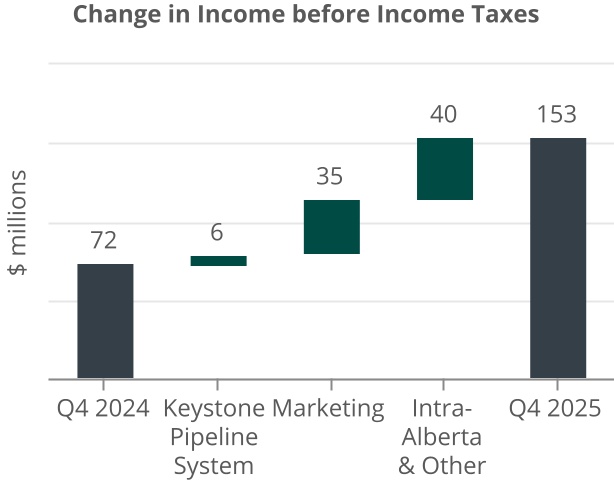
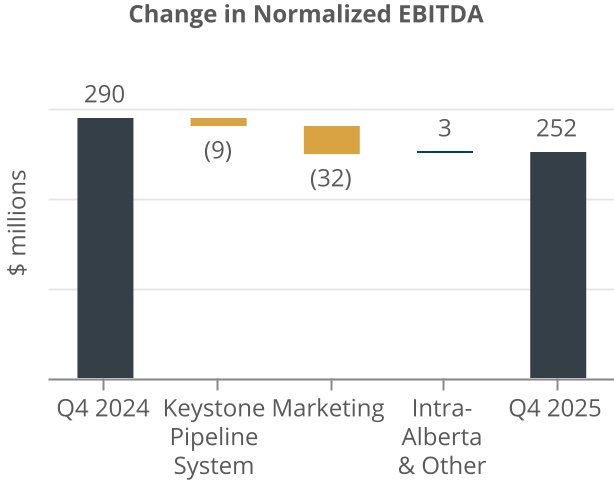
Income before income taxes for the three months ended December 31, 2025 increased to $153 million from $72 million in the same period of 2024.
Income before income taxes in the Keystone Pipeline System segment increased during the three months ended December 31, 2025 compared to 2024, primarily due to higher estimated Keystone variable toll revenues, interest income on the final tolls approved by the Canada Energy Regulator (“CER”) in the fourth quarter of 2025, and a reduction in provisions related to the long-term monitoring and close-out obligations of the historical Keystone XL project. These increases were partially offset by lower revenues generated, impacted by reduced throughput as a result of pressure restrictions from the Milepost 171 (“MP-171”) incident that occurred in April 2025, uncommitted capacity contributions impacted by tighter pricing differentials, and a $10 million non-recurring reduction to revenue under the indemnification terms with the Company’s Former Parent. Refer to the Recent Developments section of this MD&A for additional details on the CER approval of final tolls.
Higher income before income taxes in the Marketing segment in the fourth quarter of 2025 relative to 2024 was primarily driven by lower costs associated with commodity purchases and transportation fees driven by reduced throughput volumes, partially offset by lower revenues generated from physical contracts and risk management activities.
Income before income taxes in the Intra-Alberta & Other segment increased in the fourth quarter of 2025 compared to 2024, primarily attributable to higher interest income generated in 2025 and higher one-time costs relating to the Spinoff in 2024. During the fourth quarter of 2024, the Company recorded a $26 million charge in interest income and other relating to penalty for early repayment of long-term debt to the Company’s Former Parent.
South Bow's normalized EBITDA for the three months ended December 31, 2025 decreased to $252 million from $290 million in the same period of 2024, primarily driven by lower normalized EBITDA in the Keystone Pipeline System and Marketing segments.
The Keystone Pipeline System segment’s normalized EBITDA decreased by $9 million in the fourth quarter of 2025 compared to the same period in 2024, primarily attributable to tighter pricing differentials impacting contributions from uncommitted capacity on the Keystone Pipeline System. Refer to the Segment Results and Specified Financial Measures sections of this MD&A for additional details.
Normalized EBITDA for the Marketing segment decreased in the fourth quarter of 2025 relative to the fourth quarter of 2024, driven by reduced revenues as a result of lower volumes sold and tighter pricing differentials, in addition to lower realized gains recognized on financial contracts in 2025 compared to 2024. As a result of lower volumes, the segment incurred lower operating costs to fulfill its transportation contracts.
South Bow Corporation 2025 Management’s Discussion and Analysis | 3
Change in Income before Income Taxes and Normalized EBITDA
(Year Ended December 31, 2025)
(Year Ended December 31, 2025)
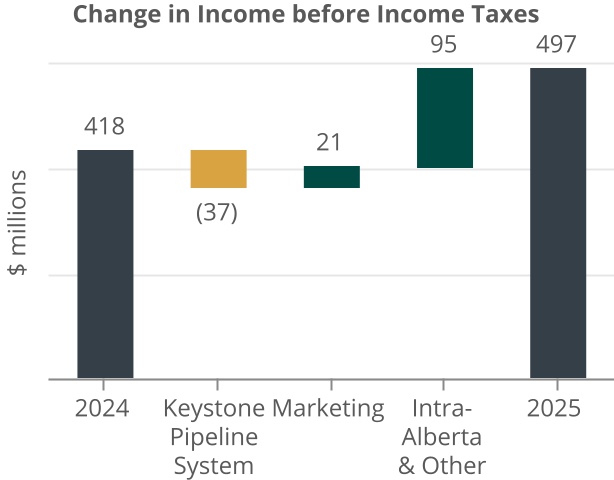
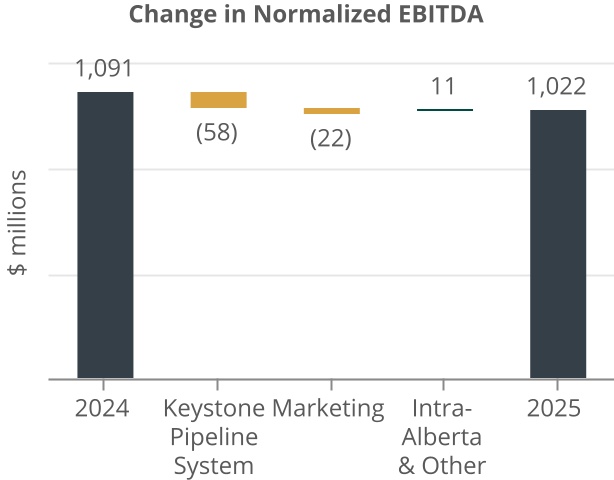
Income before income taxes for the year ended December 31, 2025 increased to $497 million from $418 million for the year ended December 31, 2024, due to increases in the Marketing and Intra-Alberta & Other segments, offset by decreases in income before income taxes for the Keystone Pipeline System.
The decrease in the Keystone Pipeline System's income before income taxes during the year ended December 31, 2025 compared to 2024 was primarily driven by lower revenues driven by reduced throughput resulting from operational restrictions following the MP-171 incident, and tighter pricing differentials impacting contributions from uncommitted capacity. Full-year 2025 income before income taxes also reflected a $43 million non-recurring charge against revenue, net of indemnification terms. These decreases to revenue were partially offset by higher estimated variable toll revenue for 2025 and $20 million of non-recurring other income related to separation terms with the Former Parent. Refer to the Recent Developments section of this MD&A for additional details on the Withdrawal of Keystone Variable Toll Disputes, tolls approved by the CER, and the MP-171 incident.
The Marketing segment's income before income taxes increased during the year ended December 31, 2025 from the year ended December 31, 2024, driven by realized and unrealized gains on risk management instruments partially offset by lower revenue and costs to purchase and market crude oil in 2025.
The Company's Intra-Alberta & Other segment income before income taxes increased during the year ended December 31, 2025 due to higher interest income and lower interest expense recognized on South Bow's long-term debt in 2025 compared to the Company's long-term debt due to affiliates of its Former Parent held in 2024. The segment also incurred lower separation-related expenses in 2025 following the Spinoff.
Normalized EBITDA of $1,022 million for the year ended December 31, 2025 decreased from normalized EBITDA of $1,091 million for the year ended December 31, 2024, attributable to decreases in the Keystone Pipeline System and Marketing segments, partially offset by higher normalized EBITDA for the Intra-Alberta & Other segment.
The decrease in the Keystone Pipeline System segment’s normalized EBITDA was a result of lower revenues primarily attributable to lower throughput and higher operating costs attributable to higher operational programs within the segment during the year ended December 31, 2025 compared to 2024. The lower revenues associated with lower throughput were partially offset by higher estimated Keystone variable toll revenue during 2025 compared to 2024.
The decrease in normalized EBITDA for the Marketing segment was driven by reduced physical volumes sold at lower prices, partially offset by a realized gain position on risk management instruments in the 2025 period compared to realized losses in the 2024 period.
South Bow Corporation 2025 Management’s Discussion and Analysis | 4
Revenue and Income from Equity Investments
| Three Months Ended December 31, | Year Ended December 31, | |||||||||||||||||||
U.S.$ millions, except where noted | 2025 | 2024 | Change | 2025 | 2024 | Change | ||||||||||||||
| Revenues | 503 | 488 | 3 | % | 1,986 | 2,120 | (6) | % | ||||||||||||
| Income from equity investments | 14 | 12 | 17 | % | 52 | 49 | 6 | % | ||||||||||||
South Bow generated revenue of $503 million during the three months ended December 31, 2025 compared to $488 million in the same period of 2024, with higher revenues generated by the Keystone Pipeline System and Marketing segments.
Higher Keystone Pipeline System revenues in the fourth quarter of 2025 compared to the fourth quarter of 2024 were primarily driven by increased revenue recognized on the Keystone estimated variable toll. These increases were partially offset by lower Marketlink revenues due to reduced throughput volumes and tighter pricing differentials in 2025, and a non-recurring charge of $10 million related to the indemnification of the final CER-approved tolls for 2020 to 2024, previously held in abeyance. Refer to the Recent Developments section of this MD&A for additional details on the final CER approved tolls.
Higher Marketing revenues during the three months ended December 31, 2025 were primarily attributable to unrealized gains on risk management instruments at December 31, 2025 compared to unrealized losses at December 31, 2024. This increase was partially offset by lower revenues resulting from reduced physical volumes transported and lower sales prices due to tighter pricing differentials, as well as lower realized gains recognized on risk management activities in the 2025 period compared to 2024.
During the year ended December 31, 2025, South Bow generated revenue of $1,986 million compared to $2,120 million in the same period of 2024, primarily driven lower revenues generated by the Keystone Pipeline System and Marketing segments.
Lower revenues generated by the Keystone Pipeline System segment during the year ended December 31, 2025 were primarily due to the impact of tight pricing differentials on uncommitted capacity contributions, in addition to pressure restrictions on the Keystone Pipeline as a result of the MP-171 incident. The Company additionally recorded non-recurring charges against revenue of $43 million during the third quarter of 2025 relating to the Withdrawal of Keystone Variable Toll Disputes and $10 million associated with the indemnification of the final CER-approved tolls in the fourth quarter of 2025. These decreases were partially offset by increased revenue recognized on the Keystone estimated variable toll for higher operating costs incurred. Refer to the Recent Developments section of this MD&A for additional details on the MP-171 incident, Withdrawal of Keystone Variable Toll Disputes, and the CER Order.
The Marketing segment generated lower revenues during the year ended December 31, 2025 compared to 2024 due to lower physical volumes sold and lower sales prices, partially offset by an unrealized gain position on risk management instruments at December 31, 2025 compared to an unrealized loss position at December 31, 2024, as well as realized gains on risk management activities in 2025 compared to realized losses in 2024.
Income from equity investments was relatively unchanged during the year ended December 31, 2025 relative to comparable periods in 2024 due to the long-term committed contracts associated with the Company's equity investments.
South Bow Corporation 2025 Management’s Discussion and Analysis | 5
Operating and Other Expenses
| Three Months Ended December 31, | Year Ended December 31, | |||||||||||||||||||
U.S.$ millions, except where noted | 2025 | 2024 | Change | 2025 | 2024 | Change | ||||||||||||||
| Plant operating costs and other | 184 | 161 | 14 | % | 719 | 738 | (3) | % | ||||||||||||
| Commodity purchases resold | 70 | 93 | (25) | % | 313 | 376 | (17) | % | ||||||||||||
| Depreciation and amortization | 58 | 62 | (6) | % | 247 | 246 | — | % | ||||||||||||
| Other | (13) | — | — | % | (8) | 15 | (153) | % | ||||||||||||
Total | 299 | 316 | (5) | % | 1,271 | 1,375 | (8) | % | ||||||||||||
Plant operating costs and other increased during the three months ended December 31, 2025 compared to the 2024 period, driven primarily by an increase in Keystone Pipeline System operational programs and remedial actions relating to the MP-171 incident. During the three months ended December 31, 2024, the Company recognized $13 million on gains on sale of assets which reduced plant operating costs in the prior period.
Plant operating costs and other decreased during the year ended December 31, 2025 compared to 2024, primarily attributable to lower corporate costs associated with the Spinoff, offset partially by higher operational program spending within the Keystone Pipeline System segment.
Commodity purchases resold decreased during the three months and year ended December 31, 2025 due to lower commodity prices and lower quantities purchased relative to the comparative periods in 2024.
Depreciation and amortization was relatively consistent year over year as the Company did not place into service or retire any major assets in 2024 or 2025.
During the three months ended December 31, 2025, the Company recognized a $13 million decrease in other expenses attributable to gains recognized on provision adjustments related to its long-term monitoring and close-out obligations for the historical Keystone XL project. During the year ended December 31, 2025, the Company additionally recorded a net $5 million charge related to the collection of its Keystone XL contractual recoveries. Refer to the Recent Developments section for additional details.
Net Income and Normalized Net Income
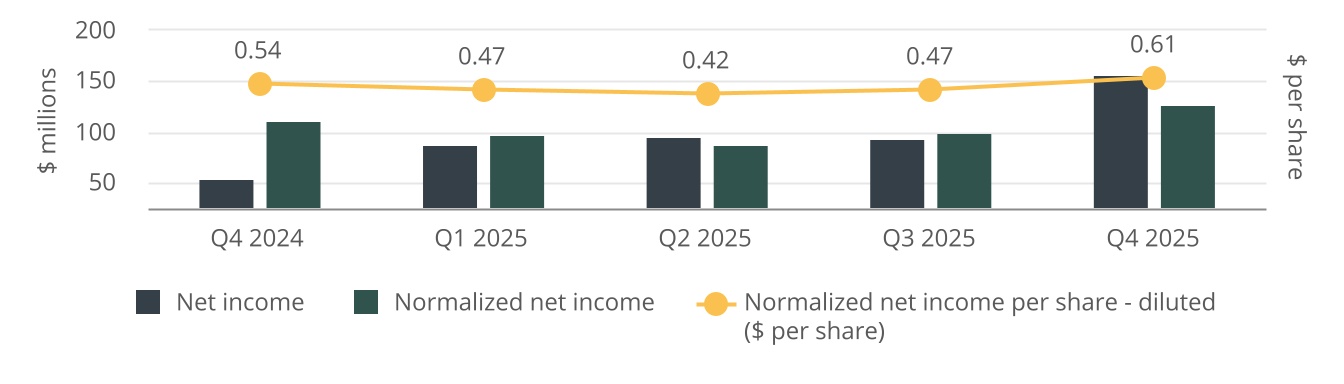
South Bow recognized net income and normalized net income of $156 million and $127 million, respectively, during the fourth quarter of 2025 compared to net income and normalized net income of $55 million and $112 million, respectively, during the fourth quarter of 2024. Normalized net income was $0.61 per share (diluted) in the fourth quarter of 2025 compared to $0.54 per share (diluted) in the fourth quarter of 2024.
The increase in net income during the three months ended December 31, 2025 compared to the same period in 2024 was primarily attributable to increases in income before income taxes discussed earlier in this MD&A in addition to an income tax recovery position in the fourth quarter of 2025 compared to income tax expense position in 2024.
South Bow Corporation 2025 Management’s Discussion and Analysis | 6
The increase in normalized net income in the fourth quarter of 2025 compared to the same period in 2024 was primarily attributable to lower income taxes in 2025 compared to 2024.
During the year ended December 31, 2025, the Company recognized net income and normalized net income of $433 million and $411 million, respectively, compared to $316 million and $383 million, respectively, during the same period in 2024. The increase in net income was a result of higher income before income taxes discussed earlier in this MD&A in addition to income tax recoveries in 2025 compared to income tax expense in 2024. The recovery of income tax expense in 2025 was driven by the deduction of certain debt settlement costs and the realization of certain state tax apportionment adjustments from the Spinoff. Normalized net income increased in 2025 relative to 2024 driven by the changes in income tax mentioned above.
Distributable Cash Flow
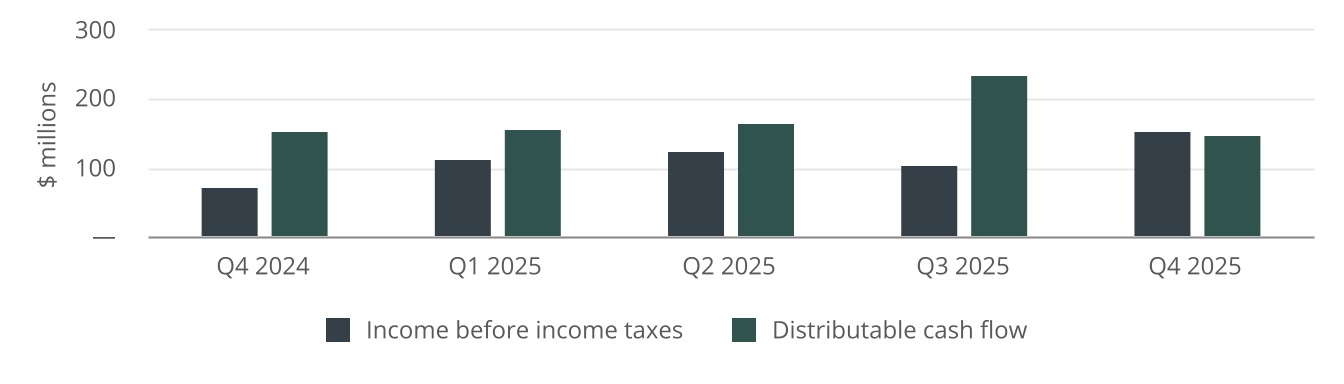
Distributable cash flow for the three months ended December 31, 2025 decreased to $149 million from $155 million for three months ended December 31, 2024 driven by higher current income tax expenses in the 2025 period attributable primarily to increased earnings.
Distributable cash flow increased to $709 million during the year ended December 31, 2025 from $621 million during the year ended December 31, 2024 primarily attributable to increases in income before income taxes discussed earlier in this MD&A and reduced current income taxes. The current income tax recovery position in 2025 compared to expense position in 2024 was due to the deduction of certain debt settlement costs mentioned above, changes in U.S. tax legislation, the realization of certain state tax apportionment adjustments, and accelerated deduction of previously incurred capital costs.
Total Long-term Debt and Net Debt
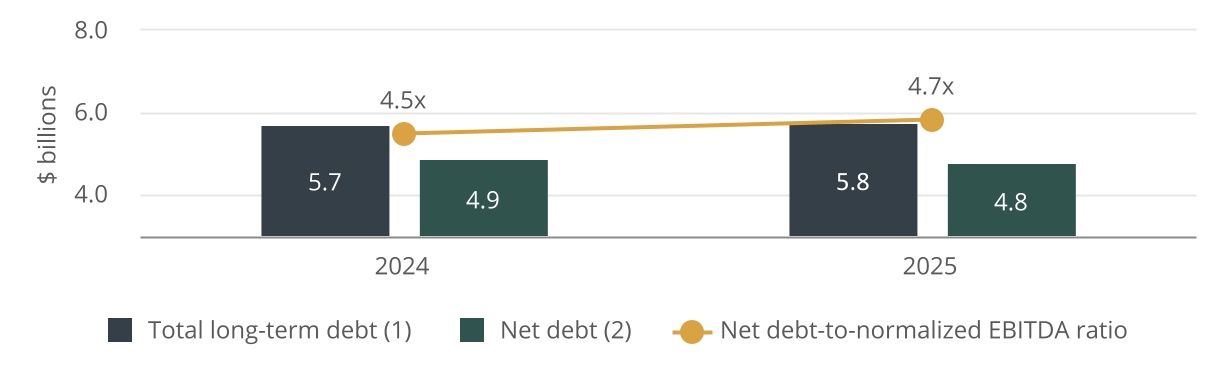
1. Total long-term debt at December 31, 2025 and December 31, 2024 includes the Company's Senior Notes and Junior Notes. Refer to the Long-term Debt, including Credit Facilities section of this MD&A for additional details.
2. Net debt at December 31, 2025 and December 31, 2024 includes 50 per cent equity treatment of the Company's Junior Notes. Refer to the Specified Financial Measures section of this MD&A for additional details on composition of net debt.
South Bow Corporation 2025 Management’s Discussion and Analysis | 7
The Company's total long-term debt of $5.8 billion was relatively unchanged at December 31, 2025 from December 31, 2024, with no issuances or repayments occurring during 2025. The Company's first debt maturity is in September 2027. Net debt at December 31, 2025 was $4.8 billion, a slight decrease from December 31, 2024 driven by higher cash balances at December 31, 2025 relative to 2024. Refer to the Liquidity, Capital Resources, and Share Capital section of this MD&A for additional details on the Company's debt, capital structure, and credit ratings.
As expected, the Company's net debt-to-normalized EBITDA ratio increased modestly to 4.7 times at December 31, 2025 compared to 4.5 times at December 31, 2024, primarily attributable to lower normalized EBITDA for the trailing four quarters at December 31, 2025 compared to December 31, 2024.
Segment Results
Keystone Pipeline System
| Year Ended December 31, | |||||||||||
| U.S.$ millions, except where noted | 2025 | 2024 | Change | ||||||||
| Revenue | 1,565 | 1,643 | (5) | % | |||||||
| Income before income taxes | 741 | 778 | (5) | % | |||||||
| Normalized EBITDA | 970 | 1,028 | (6) | % | |||||||
Total capital expenditures 1 | 36 | 35 | 3 | % | |||||||
| Keystone Pipeline throughput (Mbbl/d) | 584 | 626 | (7) | % | |||||||
| U.S. Gulf Coast segment of Keystone Pipeline System throughput (Mbbl/d) | 718 | 795 | (10) | % | |||||||
| Marketlink throughput (Mbbl/d) | 563 | 614 | (8) | % | |||||||
| Keystone SOF (%) | 94 | 95 | (1) | % | |||||||
1. Refer to capital program section of this MD&A for additional details.
Keystone Pipeline System revenues decreased during the year ended December 31, 2025 compared to the year ended December 31, 2024, primarily due to tight pricing differentials impacting contributions from uncommitted capacity, and operational restrictions from the MP-171 incident, partially offset by an increase in the 2025 estimated variable toll. During the year ended December 31, 2025, the Company recorded decreases to revenue for non-recurring charges of $43 million, net of indemnification terms, related to the Withdrawal of Keystone Variable Toll Disputes and $10 million associated with the indemnification of the Final CER Order. Refer to the Recent Developments and Specified Financial Measures sections of this MD&A for additional details.
Income before income taxes decreased during the year ended December 31, 2025 from the year ended December 31, 2024, due to lower revenues, as discussed above, partially offset by the recognition of $20 million of non-recurring other income from South Bow’s Former Parent related to the terms of the Separation Agreement.
Normalized EBITDA for the year ended December 31, 2025 decreased from 2024, driven by tight pricing differentials impacting contributions from uncommitted capacity on the Keystone Pipeline and the U.S. Gulf Coast segment of the Keystone Pipeline System.
Total capital expenditures invested for the Keystone Pipeline System segment were consistent year over year. Refer to the Outlook and Guidance section of this MD&A for details on South Bow's outlook for capital expenditures for 2026.
Throughput on the Keystone Pipeline System assets were lower for the year ended December 31, 2025, compared to the comparative periods in 2024, primarily driven by tight pricing differentials and operational restrictions from the MP-171 incident.
The Keystone Pipeline System SOF in the year ended December 31, 2025 was 94 per cent, slightly lower from the comparative period in 2024 primarily due to an increase in in-line inspection tool runs and maintenance activities as part of South Bow’s remedial actions following the MP-171 incident.
South Bow Corporation 2025 Management’s Discussion and Analysis | 8
Marketing
| Year Ended December 31, | |||||||||||
| U.S.$ millions | 2025 | 2024 | Change | ||||||||
| Revenue | 403 | 453 | (11) | % | |||||||
| Income before income taxes | 27 | 6 | 350 | % | |||||||
| Normalized EBITDA | (10) | 12 | (183) | % | |||||||
Revenue for the Marketing segment decreased during the year ended December 31, 2025 compared to the same period of 2024, primarily due to lower physical volumes sold at lower prices, owing to tighter pricing differentials. This decrease in physical revenues was partially offset by realized and unrealized gains on risk management contracts during 2025 compared to realized and unrealized losses during 2024.
The increase in the Marketing segment's income before income taxes during the year ended December 31, 2025, compared to the same period of 2024, was primarily driven by lower costs to purchase and market crude oil, partially offset by the lower revenues discussed above.
Normalized EBITDA for the Marketing segment decreased by $22 million for the year ended December 31, 2025, reflecting the Company’s risk reduction strategy. The decrease was driven by reduced physical volumes sold at lower prices, partially offset by a realized gain position on risk management instruments in the 2025 period compared to realized losses in the 2024 period.
Intra-Alberta & Other
| Year Ended December 31, | |||||||||||
| U.S.$ millions | 2025 | 2024 | Change | ||||||||
| Revenue | 18 | 24 | (25) | % | |||||||
| Income from equity investments | 42 | 39 | 8 | % | |||||||
| Interest expense | (331) | (386) | (14) | % | |||||||
| Loss before income taxes | (271) | (366) | (26) | % | |||||||
| Normalized EBITDA | 62 | 51 | 22 | % | |||||||
Total capital expenditures 1 | 152 | 106 | 43 | % | |||||||
1. Refer to capital program section of this MD&A for additional details.
Intra-Alberta & Other income from equity investments remained relatively consistent year over year.
The Company recognized a lower loss before income taxes during the year ended December 31, 2025 compared to the same periods in 2024, primarily as a result of lower interest expense incurred in the 2025 periods on the Company's long-term debt compared to the long-term debt to affiliates of its Former Parent held in the same period in 2024, as well as a $26 million charge in interest income and other relating to a penalty for early repayment of long-term debt to the Company’s Former Parent in 2024. South Bow also incurred fewer separation-related costs in 2025 than 2024.
Normalized EBITDA for the Intra-Alberta & Other segment increased during the year ended December 31, 2025 and 2024 as a result of lower corporate operating expenses and higher income from equity investments.
During the year ended December 31, 2025, South Bow invested $103 million in the development of the Blackrod Connection Project, and additional capital expenditures primarily relating to information systems and leasehold improvements relating to the establishment of South Bow as an independent company. Refer to the Outlook and Guidance section of this MD&A for information on the Company's 2026 outlook and for additional information regarding the Blackrod Connection Project.
South Bow Corporation 2025 Management’s Discussion and Analysis | 9
Recent Developments
Withdrawal of Keystone Variable Toll Disputes
Effective September 30, 2025, the Company and associated parties agreed to withdraw all complaints and protests associated with the variable toll disputes previously filed with the CER, FERC, Court of King's Bench of Alberta, and D.C. Circuit Court (collectively, the “Withdrawal of Keystone Variable Toll Disputes”). This agreement effectively resolved the Company's outstanding Keystone variable toll disputes discussed further below. Pursuant to an associated partial release of indemnification agreement and the Separation Agreement, the Former Parent was obligated to indemnify South Bow for certain amounts agreed to under the Withdrawal of Keystone Variable Toll Disputes.
Pursuant to these agreements, the Company recorded gross liabilities of $226 million, with partially offsetting receivables from its Former Parent under the indemnification terms of $189 million at September 30, 2025. The Company recorded liabilities not subject to the indemnification terms of $33 million, discounted at the Company's credit-adjusted rate, to be paid over the next six years, beginning in the fourth quarter of 2025 and due in the third quarter of subsequent years. The amounts payable under the Withdrawal of the Keystone Variable Toll Disputes are primarily recorded in accounts payable and other on the consolidated balance sheets, with amounts expected to be recovered pursuant to the indemnification terms recorded in other current assets.
As a result of the Withdrawal of Keystone Variable Toll Disputes and the Milepost 14 (“MP-14”) costs previously recorded under indemnification terms, South Bow recorded net liabilities up to its maximum indemnity liability of $22 million (C$30 million) at September 30, 2025. Any incremental costs incurred related to the items subject to indemnification are no longer the obligation of the Company. The net impact of recording the terms of the Withdrawal of Keystone Variable Toll Disputes, related indemnification asset, and the reduction of the previously accrued balances (see FERC Variable Toll Disputes below) resulted in a net reduction of revenue in the consolidated statement of income of $43 million during the year ended December 31, 2025. Under the partial release of indemnification agreement, the Company additionally recorded $20 million in other income related to separation terms with its Former Parent in September 2025.
In November 2025, the Company made gross payments of $99 million and has remaining outstanding gross liabilities of $127 million, with $91 million of partially offsetting receivables from its Former Parent relating to the Withdrawal of Keystone Variable Toll Disputes outstanding at December 31, 2025.
FERC Variable Toll Disputes
At September 30, 2025, the Company revised its provision relating to estimated payments for historical variable toll disputes with the FERC to nil in conjunction with the Withdrawal of Keystone Variable Toll Disputes (December 31, 2024 - $51 million gross liability).
CER Ruling
In March 2025, the CER issued its Reasons for Decision and Order in respect of the complaint (“CER Order”), finding the Company's proposed drag-reducing agent cost allocation methodology will result in just and reasonable tolls for 2020 and 2021. In June 2025, pursuant to the CER Order, the Company filed its application for approval of the final variable toll adjustments for 2020 and 2021, and in October 2025, the CER approved South Bow's application. In November 2025, the Company filed its application for collection of the final adjusted variable tolls for the 2022 to 2024 periods, and in December 2025, the CER approved the application. As a result of the approval of the final tolls, the Company is no longer subject to interim tolling and has commenced its collection of final adjusted variable tolls for the 2020 to 2024 periods, including associated interest, from its Keystone Canada customers.
During the year ended December 31, 2025, the Company recorded a reduction in revenue of $10 million under indemnification terms with its Former Parent and $15 million in interest income and other, net of indemnification terms, relating to the CER Order. As at December 31, 2025, the Company has a $45 million receivable, net of indemnification terms, relating to the CER approved final tolls and associated interest recorded in accounts receivable on the consolidated balance sheets (December 31, 2024 - $16 million). The Company has excluded the adjustment from its normalized measures within Keystone Variable Toll Disputes. Refer to the Specified Financial Measures section of this MD&A for additional details.
South Bow Corporation 2025 Management’s Discussion and Analysis | 10
Milepost 171 Incident
On April 8, 2025, the Company responded to an oil release of approximately 3,500 barrels at MP-171, near Fort Ransom, North Dakota. On April 11, 2025, the Pipeline and Hazardous Materials Safety Administration (“PHMSA”) issued a Corrective Action Order (“CAO”), requiring South Bow to undertake certain corrective actions in response to the MP-171 incident, including the completion of an independent third-party root cause analysis (“RCA”) along with mechanical and metallurgical testing. On April 15, 2025, South Bow safely restarted the Keystone Pipeline under certain operating pressure restrictions after receiving regulatory approval from PHMSA. In early June 2025, South Bow completed the cleanup and reclamation of the incident site.
During the year ended December 31, 2025, the Company incurred $53 million in costs related to the incident and sustaining pipeline integrity program on a prospective basis. These costs are largely expected to be recovered through the Company's insurance policies. The Company received $42 million from insurance policies during the year ended December 31, 2025.
Findings and recommendations from the independent third-party RCA were released by PHMSA on February 11, 2026 and will be incorporated into South Bow's remedial work plan. The Company continues to advance remedial actions, completing seven in-line inspection runs and 51 integrity digs to date as of March 5, 2026. The Company continues to be able to meet all contractual transportation services while operating under the CAO.
Keystone XL Contractual Recoveries
During the year ended December 31, 2025, the Company recorded a charge of $5 million, net of indemnification terms, relating to its Keystone XL contractual recoveries. As at December 31, 2025, the Company has nil Keystone XL contractual recoveries balance outstanding (December 30, 2024 - $8 million net receivable). The Company has excluded the charges from its normalized measures within Keystone XL costs and other. Refer to the Specified Financial Measures section of this MD&A for additional details.
Spinoff Transaction Transition Services Agreement Costs
Beginning on October 1, 2024, pursuant to the Transition Services Agreement ("TSA") with its Former Parent, South Bow was billed $5 million in costs associated with the TSA for the three months ended December 31, 2024 and $10 million during the year ended December 31, 2025. These costs relate to, but are not limited to, fees for services received and information system costs. Effective April 1, 2025, the Company transitioned to its own ERP system, marking a significant milestone in fully establishing South Bow as an independent company. During the fourth quarter of 2025, the Company completed the transition to its new supervisory control and data acquisition (“SCADA”) system, the final significant item in exiting the TSA.
Milepost 14 Incident
In December 2022, the MP-14 incident occurred on the Keystone Pipeline in Washington County, Kansas. As a result of the incident, the Company was subject to an Amended Corrective Action Order (“ACAO”) issued by PHMSA. By June 2023, the recovery of all released volumes was completed, and by October 2023, creek restoration was finished, returning natural flows to Mill Creek. In January 2025, the Company received PHMSA’s approval of its remedial work plan. This approval culminated the completion of 2,145 miles of in-line inspections across the Keystone Pipeline System and 68 investigative digs over a two-year period. In March 2025, South Bow received approval from PHMSA to lift the pressure restriction on the affected segment to 72 per cent of the specified minimum yield strength of the pipeline.
In the fourth quarter of 2024, South Bow recognized an additional provision for $30 million for its best estimate of incremental costs relating to the MP-14 incident. South Bow also recognized a receivable for 86 per cent of this amount ($26 million), representing its Former Parent's share of the anticipated incremental cost pursuant to the indemnity clauses in the Separation Agreement. At December 31, 2025, there have been no changes to this estimate.
During the year ended December 31, 2025, the Company incurred $2 million relating to ongoing environmental remediation activities (2024 – $68 million), adjusted the cost estimate down by $1 million (2024 - $18 million), and during 2025, nil was received (2024 – $89 million) from the insurance policies of its Former Parent related to the costs for environmental remediation.
South Bow Corporation 2025 Management’s Discussion and Analysis | 11
The remaining balance reflected in accounts payable and other and other long-term liabilities on the consolidated balance sheets was $3 million and $7 million, respectively, at December 31, 2025 (December 31, 2024 – $4 million and $10 million, respectively).
The expected recovery of the remaining estimated environmental remediation costs recorded in environmental provision recovery was $10 million at December 31, 2025 (December 31, 2024 – $31 million).
Outlook and Guidance
Market Outlook
Western Canadian Sedimentary Basin (“WCSB”) crude oil supply is expected to grow modestly throughout 2026 and remain below available pipeline egress capacity, resulting in continued tight pricing differentials which may impact contributions from uncommitted capacity on the Keystone Pipeline. Recent geopolitical events are not expected to materially impact South Bow's business or the long-term demand for Canadian crude oil. Pricing differentials impacting the rates South Bow can charge for capacity on the U.S. Gulf Coast segment of its Keystone Pipeline System are expected to remain tight throughout 2026.
Guidance
2025 Guidance and Actuals
South Bow delivered solid financial results in 2025 despite geopolitical and market uncertainty and operational restrictions from the MP-171 incident, demonstrating the Company's highly contracted cash flows and strong commercial framework. This business resiliency and cash flow stability enabled the Company to deliver normalized EBITDA of $1,022 million, slightly above guidance of $1,010 million.
South Bow generated $709 million of distributable cash flow in 2025, in line with revised guidance of $700 million, with the Company's outlook improving significantly throughout the year due to tax optimization efforts and lower expected current taxes resulting from changes in U.S. tax legislation. South Bow also recognized a one-time tax deduction, resulting in a lower effective tax rate in 2025.
Owing to its disciplined capital allocation and stronger-than-expected distributable cash flow in 2025, South Bow exited the year with a net debt-to-normalized EBITDA ratio of 4.7 times, slightly ahead of the Company's original guidance of 4.8 times.
All other 2025 financial results were generally in line with guidance.
South Bow's 2025 annual guidance compared to 2025 actuals is outlined below:
$ millions, except percentages | 2025 Guidance 1 | 2025 Actuals | % Variance from Guidance | ||||||||
Normalized EBITDA 2 3 | 1,010 +1% / -2% | 1,022 | — | % | |||||||
| Interest expense | 325 +/- 2% | 331 | — | % | |||||||
| Effective tax rate (%) | 20% - 21% | 13% | (7) | % | |||||||
Distributable cash flow 3 | 700 +/- 2% | 709 | — | % | |||||||
| Capital expenditures | — | % | |||||||||
| Growth | 110 +/- 3% | 113 | — | % | |||||||
Maintenance 4 | 55 +/- 3% | 51 | (4) | % | |||||||
1. Assumes average foreign exchange rate of C$/U.S.$1.43.
2. Previously disclosed in the Company's MD&A for the three months ended September 30, 2025.
3. Normalized EBITDA and distributable cash flow for the year ended December 31, 2024 were $1,091 million and $621 million, respectively.
4. Maintenance capital expenditures are generally recoverable through South Bow's tolling arrangements.
South Bow Corporation 2025 Management’s Discussion and Analysis | 12
2026 Guidance
South Bow's guidance aims to inform readers about Management's expectations for 2026 financial and operational results. Readers are cautioned that these estimates may not be suitable for any other purpose. Refer to the Forward-Looking Information section of this MD&A for additional information regarding the material factors or assumptions used to develop South Bow's guidance and the material factors that could cause actual events and results to be significantly different from those expected.
South Bow is reaffirming its 2026 guidance, with the Company's financial outlook underpinned by highly contracted cash flows and strong structural demand for services. Normalized EBITDA is projected to be approximately $1,030 million, within a range of two per cent, with approximately 90 per cent secured through committed arrangements, which carry minimal commodity price or volumetric risk.
Normalized EBITDA for the Keystone Pipeline System segment is expected to be approximately $15 million lower in 2026 compared to 2025, reflecting lower normalized EBITDA associated with planned maintenance capital expenditures following an active maintenance and integrity program in 2025, as well as tight pricing differentials expected to continue placing pressure on the Company's U.S. Gulf Coast segment of its Keystone Pipeline System.
Normalized EBITDA for the Marketing segment is expected to be approximately $15 million higher in 2026 compared to 2025, reflecting a recovery from the losses realized in 2025.
Normalized EBITDA for the Intra-Alberta & Other segment is expected to increase by approximately $10 million in 2026 relative to 2025, with Blackrod Connection Project cash flows increasing throughout the second half of 2026 and into 2027.
Normalized EBITDA for the first quarter of 2026 is expected to be relatively unchanged from fourth-quarter 2025 normalized EBITDA of $252 million.
South Bow has placed the Blackrod Connection Project into commercial service and will update its outlook for growth capital expenditures once it sanctions its next development project. The Company continues to expect its net debt-to-normalized EBITDA ratio to decrease modestly through 2026.
South Bow's 2026 annual guidance is outlined below:
| $ millions, except percentages | 2026 Guidance 1 | ||||
| Normalized EBITDA | 1,030 +/- 2% | ||||
Financial charges 2 | 315 +/- 2% | ||||
| Effective tax rate (%) | 22% - 23% | ||||
| Distributable cash flow | 655 +/- 2% | ||||
| Capital expenditures | |||||
Growth 3, 4 | 10 | ||||
Maintenance 3, 5 | 25 +/- 10 | ||||
1. Assumes average foreign exchange rate of C$/U.S.$1.39.
2. Comprised of interest expense and interest income and other.
3. Supplementary financial measure. See Specified Financial Measures of this MD&A for additional details.
4. South Bow will update its outlook for growth capital expenditures once it sanctions its next development project.
5. Maintenance capital expenditures are generally recoverable through South Bow's tolling arrangements.
South Bow Corporation 2025 Management’s Discussion and Analysis | 13
Liquidity, Capital Resources, and Share Capital
Liquidity
The following table summarizes the Company's sources and uses of cash for the years ended December 31, 2025 and 2024:
| Year Ended December 31, | ||||||||
| U.S.$ millions | 2025 | 2024 | ||||||
Cash from (Used in): | ||||||||
| Operating activities | 717 | 529 | ||||||
| Investing activities | (175) | (80) | ||||||
| Financing activities | (411) | (307) | ||||||
| Effect of foreign exchange rate changes on cash and cash equivalents | 21 | (7) | ||||||
Net Increase in Cash and Cash Equivalents | 152 | 135 | ||||||
At December 31, 2025, cash and cash equivalents were $549 million (December 31, 2024 - $397 million).
Operating Activities
Cash from operating activities is primarily impacted by changes in operations, fluctuations in demand for uncommitted capacity, commodity prices, changes in cost environment, and timing of cash receipts and payments made. The increase in cash from operating activities for the year ended December 31, 2025 compared to the same periods in 2024 was primarily attributable to higher net income.
Investing Activities
Cash used in investing activities is primarily related to maintenance and growth capital expenditures. Cash used in investing activities during the year ended December 31, 2025 was attributable to the Company's cash capital expenditures of $178 million, as the Company invested in its Blackrod Connection Project and other maintenance capital expenditures, compared to capital expenditures of $122 million in the comparative period of 2024. During the year ended December 31, 2024, South Bow recognized $38 million, in proceeds from sales of Keystone XL pipe which was held for sale during 2024.
Financing Activities
Cash used in financing activities primarily relates to the issuance and repayment of long-term debt balances, dividends paid, and share capital transactions. During the year ended December 31, 2025 the Company used $411 million in cash to pay $416 million in dividends. This was partially offset by $5 million in cash received from option exercises compared to $121 million in distributions paid to its Former Parent in the 2024 comparative period.
South Bow Corporation 2025 Management’s Discussion and Analysis | 14
Capital Management
| December 31, | December 31, | |||||||
| U.S.$ millions, except where noted | 2025 | 2024 | ||||||
| Cash and cash equivalents | 549 | 397 | ||||||
Senior Notes | 4,682 | 4,629 | ||||||
Junior Notes | 1,086 | 1,087 | ||||||
| Net debt | 4,806 | 4,901 | ||||||
| Income before income taxes | 497 | 418 | ||||||
| Normalized EBITDA | 1,022 | 1,091 | ||||||
Net Debt-to-normalized EBITDA Ratio 1 | 4.7 | 4.5 | ||||||
1. Normalized EBITDA is calculated using the trailing four quarters of normalized EBITDA from the applicable period end.
A significant portion of South Bow's revenues are from long-term committed contracts. The Company has no material restrictions on its cash and cash equivalents and has significant unutilized capacity under its credit facilities, with its first long-term debt maturity in 2027. South Bow believes that it is positioned to meet its operating obligations, including quarterly dividend payments, if, as, and when declared, by utilizing its cash flow from operating activities and available borrowing capacity if, and as, required.
Maintaining a strong balance sheet and financial flexibility is fundamental to South Bow's strategy. At December 31, 2025, the Company’s net debt-to-normalized EBITDA ratio was 4.7 times. The Company is committed to prudently managing leverage and expects to enhance its financial resilience, reduce debt service charges, and create additional capacity to fund future growth initiatives and potentially grow shareholder returns.
Long-term Debt, including Credit Facilities
Long-term Debt
South Bow completed its initial debt offerings on August 28, 2024, comprised of U.S. and Canadian dollar-denominated Senior Notes and U.S. dollar-denominated Junior Notes. Interest rates are fixed on the Senior Notes and Junior Notes, and interest is paid semi-annually beginning in 2025. Refer to Note 17, Long-term Debt of the accompanying financial statements for additional information.
South Bow Corporation 2025 Management’s Discussion and Analysis | 15
The table below summarizes the Senior Notes and Junior Notes issued and outstanding as at December 31, 2025:
| U.S.$ millions, except where noted | Principal Repayments 1 | ||||||||||||||||||||||
| Debt Instrument | Total | 2026 | 2027 | 2028 | 2029 | 2030 | After 2030 | ||||||||||||||||
Senior Unsecured Notes | |||||||||||||||||||||||
U.S. Dollar-denominated Debt | |||||||||||||||||||||||
| Due September 2027 ($700 million, 4.91%) | 700 | — | 700 | — | — | — | — | ||||||||||||||||
| Due October 2029 ($1,000 million, 5.03%) | 1,000 | — | — | — | 1,000 | — | — | ||||||||||||||||
| Due October 2034 ($1,250 million, 5.58%) | 1,250 | — | — | — | — | — | 1,250 | ||||||||||||||||
| Due October 2054 ($700 million, 6.18%) | 700 | — | — | — | — | — | 700 | ||||||||||||||||
3,650 | — | 700 | — | 1,000 | — | 1,950 | |||||||||||||||||
Canadian Dollar-denominated Debt | |||||||||||||||||||||||
| Due February 2030 (C$450 million, 4.32%) | 328 | — | — | — | — | 328 | — | ||||||||||||||||
| Due February 2032 (C$500 million, 4.62%) | 365 | — | — | — | — | — | 365 | ||||||||||||||||
| Due February 2035 (C$500 million, 4.93%) | 365 | — | — | — | — | — | 365 | ||||||||||||||||
1,058 | — | — | — | — | 328 | 730 | |||||||||||||||||
Less: Unamortized Debt Issue Costs | (26) | ||||||||||||||||||||||
Total Senior Unsecured Notes | 4,682 | — | 700 | — | 1,000 | 328 | 2,680 | ||||||||||||||||
Junior Subordinated Notes | |||||||||||||||||||||||
U.S. Dollar-denominated Debt | |||||||||||||||||||||||
Due March 2055 ($450 million, 7.63%) 2 | 450 | — | — | — | — | — | 450 | ||||||||||||||||
Due March 2055 ($650 million, 7.50%) 3 | 650 | — | — | — | — | — | 650 | ||||||||||||||||
Junior Subordinated Notes | 1,100 | — | — | — | — | — | 1,100 | ||||||||||||||||
Less: Unamortized Debt Issue Costs | (14) | ||||||||||||||||||||||
Total Junior Subordinated Notes | 1,086 | — | — | — | — | — | 1,100 | ||||||||||||||||
Total Long-term Debt | 5,768 | — | 700 | — | 1,000 | 328 | 3,780 | ||||||||||||||||
1. Represents principal amount to be repaid on maturity.
2. Subject to first rate reset on March 1, 2030 and every fifth year after 2030.
3. Subject to first rate reset on March 1, 2035 and every fifth year after 2035.
South Bow Corporation 2025 Management’s Discussion and Analysis | 16
Long-term Debt Repaid
Prior to the Spinoff, the Company had certain U.S. and Canadian dollar-denominated long-term debt due to affiliates of its Former Parent. On August 28, 2024, concurrent with the issuance of the Company's Senior Notes, the Company repaid a $1.25 billion term loan to an affiliate of its Former Parent. On October 1, 2024, the Company repaid the remaining outstanding long-term debt to affiliates of the Former Parent of $4.7 billion.
Credit Facilities
During the third quarter of 2024, the Company entered into a new four-year senior unsecured revolving credit facility for C$2.0 billion, maturing in October 2028 (the "Facility"). The Company, as authorized to construct and operate a pipeline under the CER Act, is required to maintain adequate financial resources for the Canadian portion of Keystone, of which $347 million (C$0.5 billion) of the Facility is reserved for this purpose.
On October 3, 2025, the Company renewed its revolving credit facility, extending maturity to October 1, 2029. The commitment remains at C$2.0 billion with no change to financial covenants. At December 31, 2025, $1.5 billion (C$2.0 billion) was available and nil was drawn on the Facility.
| As at December 31, 2025 | |||||||||||
| U.S.$ millions | Drawn | Available | Total | ||||||||
Unsecured revolving credit facility 1 | — | 1,458 | 1,458 | ||||||||
Credit facilities supporting standby letters of credit 1 | 20 | 89 | 109 | ||||||||
1. Canadian capacity available and funds drawn converted to U.S. dollars at the December 31, 2025 foreign exchange rate of 0.72913.
Interest Expense
| Year Ended December 31, | ||||||||
| U.S.$ millions | 2025 | 2024 | ||||||
| Interest on long-term debt to affiliates of Former Parent | — | 270 | ||||||
| Interest on Senior Notes | 246 | 85 | ||||||
Interest on Junior Notes | 83 | 28 | ||||||
Amortization and other financial charges 1 | 10 | 7 | ||||||
| Capitalized interest | (8) | (2) | ||||||
331 | 388 | |||||||
1. Includes amortization of debt issuance, premium, and discount costs associated with the Senior Notes and Junior Notes. Other financial charges include bank service charges and carrying charges.
During the year ended December 31, 2025, the Company recorded $331 million of interest expense compared to $388 million in 2024. The decrease in 2025 was primarily attributable to lower interest on the Company’s Senior Notes and Junior Notes compared to higher interest incurred in 2024 on the Company’s long-term debt to affiliates of its Former Parent.
Interest Income and Other
| Year Ended December 31, | ||||||||
| U.S.$ millions | 2025 | 2024 | ||||||
Interest income | 40 | 41 | ||||||
| Penalty on early repayment of long-term debt to Former Parent | — | (26) | ||||||
Foreign exchange gain (loss) | 1 | (3) | ||||||
41 | 12 | |||||||
Pursuant to the Spinoff on October 1, 2024, the Company paid a $26 million penalty for early repayment of long-term debt to affiliates of its Former Parent.
South Bow Corporation 2025 Management’s Discussion and Analysis | 17
Financial Covenants
South Bow is subject to certain financial covenants on its Facility as described in the following table. As at December 31, 2025, the Company was in compliance with the covenants on its Facilities in all material respects.
| Financial Covenant | Covenant 1 | As at December 31, 2025 | ||||||
Consolidated net debt-to-capitalization 2 | Not to exceed 65% | 52 | % | |||||
Interest coverage ratio 3 | Not less than 2.50:1:00 | 4.06 | ||||||
1. Covenant terms defined within respective debt agreements.
2. Per the covenant, consolidated net debt is consolidated total debt less unrestricted cash and cash equivalents of the restricted parties. Total debt is defined as consolidated indebtedness of the Company excluding letters of credit and junior debt securities.
3. Interest coverage ratio is consolidated EBITDA to consolidated interest expense, for the trailing four quarters. Consolidated EBITDA is consolidated net income plus interest expense, income taxes, depreciation and amortization, and other non-cash items. Consolidated interest expense includes all interest paid excluding interest related to Junior Notes and upfront fees associated with the Facilities.
Share Capital
The Company is authorized to issue an unlimited number of common shares and first and second preferred shares, up to 20 per cent of the issued common shares outstanding. As at the date of this MD&A, no first or second preferred shares have been issued.
The following table summarizes South Bow's share capital at December 31, 2025:
| U.S.$ millions, except where noted | Common Shares | Common Shares ($) | ||||||
| Balance at December 31, 2023 | — | — | ||||||
| Issued on October 1, 2024 | 207,570,409 | 2,187 | ||||||
| Issued on exercise of stock options | 470,700 | 9 | ||||||
Balance at December 31, 2024 | 208,041,109 | 2,196 | ||||||
| Issued on exercise of stock options | 209,403 | 5 | ||||||
Balance at December 31, 2025 | 208,250,512 | 2,201 | ||||||
As of the date of this MD&A, the Company has 208,559,099 common shares outstanding and 263,260 stock options outstanding. All outstanding stock options are fully vested and exercisable for one common share.
Dividends
Dividends become payable, if, as, and when declared by the Board. Dividends are declared at the discretion of the Board and subject to various factors, including but not limited to, the Company's distributable cash flow and overall financial performance.
On November 13, 2025, the Board approved a quarterly dividend of $0.50 per share, paid on January 15, 2026, to shareholders of record on December 31, 2025.
On March 5, 2026, the Board approved a quarterly dividend of $0.50 per share, payable on April 15, 2026 to shareholders of record at the close of business on March 31, 2026. The dividends will be designated as eligible dividends for Canadian income tax purposes.
South Bow Corporation 2025 Management’s Discussion and Analysis | 18
Capital Program
| Year Ended December 31, | ||||||||
| U.S.$ millions | 2025 | 2024 | ||||||
Growth capital expenditures 1 | 113 | 73 | ||||||
Maintenance capital expenditures 1, 2 | 51 | 61 | ||||||
Separation capital expenditures 1 | 24 | 7 | ||||||
Total Capital Expenditures 1 | 188 | 141 | ||||||
1. Supplementary financial measure to assist the reader in understanding the Company’s capital investments and capital allocation decisions. Refer to the Supplementary Financial Measures section of this MD&A for additional details.
2. Maintenance capital expenditures are generally recoverable through South Bow's tolling arrangements.
Total capital expenditures were $188 million for the year ended December 31, 2025 compared to $141 million in the respective 2024 period.
The Company’s 2025 growth capital expenditures included $103 million invested in the development of the Blackrod Connection Project. Maintenance capital expenditures included investments made to support the Company’s operations as well as spending for key infrastructure used by the Company. Higher maintenance capital spend in the comparative 2024 period was primarily attributable to investments made in preparation for the Spinoff partially offset by higher maintenance capital investments on the Keystone Pipeline System in 2025 compared to 2024.
Separation capital expenditures during the year ended December 31, 2025 related to one-time capital investments to support the Spinoff transition, including information system infrastructure.
Blackrod Connection Project
Supported by long-term committed contracts, South Bow’s first major growth initiative, the Blackrod Connection Project, consists of a 25-km (16-mi) crude oil pipeline and a 25-km (16-mi) natural gas lateral, as well as associated facilities, providing crude oil transportation from International Petroleum Corporation's Blackrod Project to the Grand Rapids Pipeline in Intra-Alberta.
In the third quarter of 2025, the Company placed the natural gas pipeline of the project into service, and achieved mechanical completion for the project early in the fourth quarter of 2025. The project was designated in-service on March 1, 2026. The project was completed on time and on budget, with zero safety incidents. Associated cash flows from the project are expected to increase throughout the second half of 2026 and into 2027.
Contractual Obligations and Off-balance Sheet Arrangements
Contractual Obligations
South Bow's contractual obligations include operating leases, purchase obligations, and other liabilities incurred within the business.
| U.S.$ millions | Total | 2026 | 2027 | 2028 | 2029 | 2030 | Thereafter | ||||||||||||||||
Operating commitments 1 | 130 | 29 | 8 | 24 | 14 | 15 | 40 | ||||||||||||||||
Transportation by other parties 2 | 3 | 3 | — | — | — | — | — | ||||||||||||||||
Capital expenditures 3 | 16 | 16 | — | — | — | — | — | ||||||||||||||||
| Total | 149 | 48 | 8 | 24 | 14 | 15 | 40 | ||||||||||||||||
1. Includes commitments for in-line inspection runs and power.
2. Contractual obligations are based on volumes contracted through capacity arrangements and exclude any variable charges that may be incurred when volumes flow.
3. Capital expenditures relate to the remaining Blackrod Connection Project expenditures, in addition to other capital commitments by the Company. Amounts are estimates and subject to variability based on timing of construction and project requirements. Expenditures include obligations for growth projects and are presented based on projects proceeding as currently planned. Any changes to projects, including timing or possible cancellation, could change these estimates.
South Bow Corporation 2025 Management’s Discussion and Analysis | 19
Guarantees
The Company has guaranteed the Senior Notes and Junior Notes issued by certain subsidiaries. Refer to the Parental Guarantees of Debt section of this MD&A for additional details.
South Bow and its partners in certain jointly-owned entities have guaranteed the financial performance of these entities to a maximum term to 2043. At December 31, 2025, the Company's share of maximum potential exposure under the guarantees is C$56 million (December 31, 2024 - C$56 million). Under these guarantees, if the Company makes a payment that exceeds its share of ownership interest, the additional amount must be reimbursed by the partners of such jointly-owned entities.
Off-balance Sheet Arrangements
Except for the guarantees discussed above, as at December 31, 2025, South Bow does not have any off-balance sheet arrangements that have, or are reasonably likely to have, a current or future effect on the Company's financial performance or financial condition.
Specified Financial Measures
Non-GAAP Financial Measures
Throughout this MD&A, South Bow references certain non-GAAP financial measures and non-GAAP ratios which do not have any standardized meaning as prescribed by GAAP and therefore may not be comparable to similar measures presented by other entities. These non-GAAP financial measures and non-GAAP ratios include adjustments to the composition of the most directly comparable GAAP measures. Management considers these non-GAAP financial measures and non-GAAP ratios to be important in evaluating and understanding the operating performance and liquidity of South Bow. These non-GAAP financial measures should not be considered in isolation or as a substitute for financial information or measures of performance presented in accordance with GAAP.
South Bow's non-GAAP financial measures used in this MD&A include normalized EBITDA, segment normalized EBITDA, normalized net income, distributable cash flow, and net debt. Non-GAAP ratios include normalized net income per share and net debt-to-normalized EBITDA. These non-GAAP financial measures and non-GAAP ratios are further described with a reconciliation to their most directly comparable GAAP measure below.
Normalizing Items
Normalized measures are (or include) non-GAAP financial measures and include normalized EBITDA, segment normalized EBITDA, normalized net income, normalized net income per share, distributable cash flow, and net debt-to-normalized EBITDA. Management uses these normalized measures as a way to assess the financial performance of South Bow's operations and compare period over period. During certain reporting periods, the Company may incur costs which are not indicative of core operations or results. These normalized measures represent income (loss) adjusted for specific normalizing items that are believed to be significant; however, not reflective of South Bow's underlying operations in the period.
These specific normalizing items include gains or losses on sales of assets or assets held for sale, unrealized fair value adjustments related to risk management activities, tariff charges, separation, acquisition, integration, and restructuring costs, and other charges, including but not limited to, impairment, contractual costs, and settlements.
South Bow excludes the unrealized fair value adjustments related to risk management activities as these represent the changes in the fair value of derivatives, but do not accurately reflect the gains and losses that will be realized at settlement and impact income. Therefore, the Company does not consider these items reflective of its underlying operations, despite providing effective economic hedges. Realized gains and losses on grade financial contracts are adjusted to improve comparability as they settle in a subsequent period to the underlying transaction they are hedged against.
South Bow excludes tariff charges as they are not reflective of ongoing business conducted by the Company and are subject to uncertainty.
South Bow Corporation 2025 Management’s Discussion and Analysis | 20
Separation costs relate to internal costs and external fees incurred specific to the Spinoff. These items have been excluded from normalized measures as Management does not consider them reflective of ongoing operations and they are non-recurring in nature.
Normalized EBITDA and Segment Normalized EBITDA
Normalized EBITDA is a measure indicative of core operations. Management uses this measure to monitor and evaluate the financial performance of the Company's operations and to identify and evaluate trends. This measure is useful for investors as Management believes it allows for more comparable performance of the Company across periods for ongoing operations. Normalized EBITDA represents income before income taxes adjusted for the normalizing items, in addition to excluding charges for depreciation and amortization, interest expense, interest income and other, and other income.
Normalized EBITDA guidance is a forward-looking non-GAAP financial measure. South Bow does not provide a reconciliation of such forward-looking measure to the most directly comparable financial measure calculated and presented in accordance with GAAP due to unknown variables and the uncertainty related to future results. These unknown variables may be inherently difficult to determine without unreasonable efforts. Guidance for normalized EBITDA is calculated in the same manner as described above for historical normalized EBITDA, as applicable.
The following table reconciles income (loss) before income taxes to normalized EBITDA for the three months and year ended December 31, 2025 and 2024:
| Three Months Ended December 31, | Year Ended December 31, | |||||||||||||
| U.S.$ millions | 2025 | 2024 | 2025 | 2024 | ||||||||||
Income before income taxes 1 | 153 | 72 | 497 | 418 | ||||||||||
| Adjusted for specific items: | ||||||||||||||
Depreciation and amortization 1 | 58 | 62 | 247 | 246 | ||||||||||
Interest expense 1 | 83 | 84 | 331 | 388 | ||||||||||
Interest income and other 1 | (18) | 28 | (41) | (12) | ||||||||||
Other income 1 | — | — | (20) | — | ||||||||||
Risk management instruments 2 | (11) | 57 | (36) | 8 | ||||||||||
Keystone variable toll disputes 3 | 5 | (3) | 48 | 8 | ||||||||||
MP-14 costs | — | 4 | — | 4 | ||||||||||
Separation costs 4 | 1 | (1) | 9 | 29 | ||||||||||
Tariff charges 5 | — | — | 1 | — | ||||||||||
Keystone XL costs and other 6 | (19) | (13) | (14) | 2 | ||||||||||
Normalized EBITDA | 252 | 290 | 1,022 | 1,091 | ||||||||||
1. Per the consolidated statements of income.
2. Unrealized (gains) losses on risk management instruments incurred by the Marketing segment.
3. Adjustments recorded to revenue in the consolidated statements of income in relation to disputes on historical variable tolls. Refer to the Recent Developments section of this MD&A for additional details.
4. Expenses recorded within plant operating costs and other in the consolidated statements of income in relation to non-recurring separation-related activities incurred to establish South Bow as an independent company.
5. Tariff charges incurred on the Company’s Marketing activities recorded within plant operating costs and other in the consolidated statements of income.
6. Adjustments and charges recorded in other expenses in the consolidated statements of income relating to Keystone XL termination activities.
South Bow Corporation 2025 Management’s Discussion and Analysis | 21
The following tables reconcile income (loss) before income tax to normalized EBITDA by operating segment for the three months and year ended December 31, 2025 and 2024:
| Three Months Ended December 31, 2025 | ||||||||||||||
| U.S.$ millions | Keystone Pipeline System | Marketing | Intra-Alberta & Other | Total | ||||||||||
| Income (loss) before income taxes | 211 | 3 | (61) | 153 | ||||||||||
| Adjusted for specific items: | ||||||||||||||
| Depreciation and amortization | 58 | — | — | 58 | ||||||||||
| Interest expense | (1) | — | 84 | 83 | ||||||||||
| Interest income and other | (13) | — | (5) | (18) | ||||||||||
| Other income | — | — | — | — | ||||||||||
| Risk management instruments | — | (11) | — | (11) | ||||||||||
| Keystone variable toll disputes | 5 | — | — | 5 | ||||||||||
| Separation costs | — | — | 1 | 1 | ||||||||||
| Keystone XL costs and other | (19) | — | — | (19) | ||||||||||
Segment Normalized EBITDA | 241 | (8) | 19 | 252 | ||||||||||
| Three Months Ended December 31, 2024 | ||||||||||||||
| U.S.$ millions | Keystone Pipeline System | Marketing | Intra-Alberta & Other | Total | ||||||||||
| Income (loss) before income taxes | 205 | (32) | (101) | 72 | ||||||||||
| Adjusted for specific items: | ||||||||||||||
| Depreciation and amortization | 59 | — | 3 | 62 | ||||||||||
| Interest expense | (1) | — | 85 | 84 | ||||||||||
| Interest income and other | (1) | (1) | 30 | 28 | ||||||||||
| Other income | — | — | — | — | ||||||||||
| Risk management instruments | — | 57 | — | 57 | ||||||||||
| Keystone variable toll disputes | (3) | — | — | (3) | ||||||||||
| MP-14 Costs | 4 | — | — | 4 | ||||||||||
| Separation costs | — | — | (1) | (1) | ||||||||||
| Keystone XL costs and other | (13) | — | — | (13) | ||||||||||
Segment Normalized EBITDA | 250 | 24 | 16 | 290 | ||||||||||
South Bow Corporation 2025 Management’s Discussion and Analysis | 22
| Year Ended December 31, 2025 | ||||||||||||||
| U.S.$ millions | Keystone Pipeline System | Marketing | Intra-Alberta & Other | Total | ||||||||||
| Income (loss) before income taxes | 741 | 27 | (271) | 497 | ||||||||||
| Adjusted for specific items: | ||||||||||||||
| Depreciation and amortization | 236 | — | 11 | 247 | ||||||||||
| Interest expense | — | — | 331 | 331 | ||||||||||
| Interest income and other | (21) | (2) | (18) | (41) | ||||||||||
| Other income | (20) | — | — | (20) | ||||||||||
| Risk management instruments | — | (36) | — | (36) | ||||||||||
| Keystone variable toll disputes | 48 | — | — | 48 | ||||||||||
| Separation costs | — | — | 9 | 9 | ||||||||||
Tariff charges | — | 1 | — | 1 | ||||||||||
| Keystone XL costs and other | (14) | — | — | (14) | ||||||||||
Segment Normalized EBITDA | 970 | (10) | 62 | 1,022 | ||||||||||
| Year Ended December 31, 2024 | ||||||||||||||
| U.S.$ millions | Keystone Pipeline System | Marketing | Intra-Alberta & Other | Total | ||||||||||
| Income (loss) before income taxes | 778 | 6 | (366) | 418 | ||||||||||
| Adjusted for specific items: | ||||||||||||||
| Depreciation and amortization | 238 | — | 8 | 246 | ||||||||||
| Interest expense | 1 | 1 | 386 | 388 | ||||||||||
| Interest income and other | (3) | (3) | (6) | (12) | ||||||||||
| Risk management instruments | — | 8 | — | 8 | ||||||||||
| Keystone variable toll disputes | 8 | — | — | 8 | ||||||||||
MP-14 costs | 4 | — | — | 4 | ||||||||||
| Separation costs | — | — | 29 | 29 | ||||||||||
| Keystone XL costs and other | 2 | — | — | 2 | ||||||||||
Segment Normalized EBITDA | 1,028 | 12 | 51 | 1,091 | ||||||||||
Normalized Net Income and Normalized Net Income per Share
Normalized net income represents net income adjusted for the normalizing items described above and is used by Management to assess the earnings that it believes are representative of South Bow's operations. By adjusting for non-recurring items and other factors that do not reflect the Company's ongoing performance, the Company believes that normalized net income provides a clearer picture of its continuing operations. This measure is particularly useful for investors as it allows for a more accurate comparison of financial performance and trends across different periods. On a per share basis, normalized net income is derived by dividing the normalized net income by the weighted average common shares outstanding at the end of the period. This per share measure is valuable for investors as it provides insight into the Company's profitability on a per share basis, making it easier to evaluate the Company's performance.
South Bow Corporation 2025 Management’s Discussion and Analysis | 23
The following table reconciles net income to normalized net income for the three months and year ended December 31, 2025 and 2024:
| Three Months Ended December 31, | Year Ended December 31, | |||||||||||||
| U.S.$ millions, except share and per share amounts | 2025 | 2024 | 2025 | 2024 | ||||||||||
Net income | 156 | 55 | 433 | 316 | ||||||||||
| Adjusted for specific items: | ||||||||||||||
Other income 1 | — | — | (20) | — | ||||||||||
Risk management instruments 2 | (11) | 57 | (36) | 8 | ||||||||||
Keystone variable toll disputes 3 | (9) | (3) | 31 | 8 | ||||||||||
MP-14 costs | — | 4 | — | 4 | ||||||||||
Separation costs 4 | 1 | 27 | 9 | 67 | ||||||||||
Tariff charges 5 | — | — | 1 | — | ||||||||||
Keystone XL costs and other 6 | (19) | (13) | (14) | 2 | ||||||||||
Tax effect of above adjustments 7 | 9 | (15) | 7 | (22) | ||||||||||
Normalized Net Income | 127 | 112 | 411 | 383 | ||||||||||
| Weighted average common shares outstanding - diluted (millions) | 208.8 | 208.4 | 208.8 | 208.2 | ||||||||||
Normalized Net Income per Share - Diluted | 0.61 | 0.54 | 1.97 | 1.84 | ||||||||||
1. Relates to non-recurring other income from the Company’s Former Parent under separation terms.
2. Unrealized (gains) losses on risk management instruments incurred by the Marketing segment. Recorded within revenue in the consolidated statements of income.
3. Adjustments recorded to revenue and interest income and other in the consolidated statements of income related to historical variable toll disputes and the Withdrawal of Keystone Variable Toll Disputes. Refer to the Recent Developments section of this MD&A for additional details.
4. Expenses recorded within plant operating costs and other as adjusted in normalized EBITDA, in addition to interest expense and interest income and other, and other income in the consolidated statements of income. Amounts relate to non-recurring separation-related costs incurred to establish South Bow as an independent company.
5. Tariff charges incurred on the Company’s Marketing business activities recorded within plant operating costs and other in the consolidated statements of income.
6. Adjustments and charges recorded in other expenses in the consolidated statements of income relating to Keystone XL termination activities and other non-recurring charges.
7. Tax effect of the adjustments added to, and deducted from, net income.
Distributable Cash Flow
Distributable cash flow is used to assess the cash generated through business operations that can be used for South Bow's capital allocation decisions, helping investors understand the Company's cash-generating capabilities and its potential for returning value to shareholders. Distributable cash flow is based on income (loss) before income taxes, adjusted for depreciation and amortization, the normalizing items discussed above, and further adjusted for specific items, including income and distributions from the Company's equity investments, maintenance capital expenditures, which are capitalized and generally recoverable through South Bow's tolling arrangements, and current income taxes.
Distributable cash flow guidance is a forward-looking non-GAAP financial measure. South Bow does not provide a reconciliation of such forward-looking measure to the most directly comparable financial measure calculated and presented in accordance with GAAP due to unknown variables and the uncertainty related to future results. These unknown variables may be inherently difficult to determine without unreasonable efforts.
In the second quarter of 2025, South Bow modified the definition of distributable cash flow to no longer adjust income (loss) before income taxes for interest income and other. Management believes that this modified definition of distributable cash flow more accurately reflects the amount of cash generated through business operations that can be used for South Bow's capital allocation decisions. Comparative measures have been restated to reflect these changes.
South Bow Corporation 2025 Management’s Discussion and Analysis | 24
The following table reconciles income before income taxes to distributable cash flow for the three months and year ended December 31, 2025 and 2024:
| Three Months Ended December 31, | Year Ended December 31, | |||||||||||||
U.S.$ millions, except where noted | 2025 | 2024 | 2025 | 2024 | ||||||||||
Income before income taxes 1 | 153 | 72 | 497 | 418 | ||||||||||
| Adjusted for specific items: | ||||||||||||||
Depreciation and amortization 1 | 58 | 62 | 247 | 246 | ||||||||||
Income from equity investments 2 | (14) | (12) | (52) | (49) | ||||||||||
Distributions from equity investments 2 | 23 | 20 | 74 | 70 | ||||||||||
Maintenance capital expenditures 3 | (19) | (15) | (51) | (61) | ||||||||||
Current income tax recovery (expense) 1 | (23) | (6) | 16 | (43) | ||||||||||
Normalizing items, net of tax 4 | (29) | 34 | (22) | 40 | ||||||||||
Distributable Cash Flow | 149 | 155 | 709 | 621 | ||||||||||
1. Per the consolidated statements of income.
2. Per the consolidated statements of cash flows.
3. Maintenance capital expenditures are generally recoverable from customers through South Bow's tolling arrangements and are capitalized for GAAP purposes. Refer to the Capital Program section of this MD&A for additional details on maintenance capital expenditures.
4. Refers to the adjustments made to normalized net income, net of tax, and include other income, risk management instruments, Keystone variable toll disputes, separation costs, tariff charges, and Keystone XL costs and other.
Net Debt and Net Debt-to-normalized EBITDA Ratio
Net debt is used as a key leverage measure to assess and monitor South Bow's financing structure. It provides an overview of the Company's long-term debt obligations, net of cash and cash equivalents. This measure is useful for investors as South Bow believes it offers insights into the Company's financial health and its ability to manage and service its debt obligations. Net debt is defined as the sum of total long-term debt and 50 per cent equity treatment of Junior Notes, operating lease liabilities, and dividends payable, less cash and cash equivalents per the Company's consolidated balance sheets.
Net debt-to-normalized EBITDA ratio is used to monitor the Company's leverage position relative to its normalized EBITDA for the trailing four quarters. This ratio provides investors with insight into the Company's ability to service its long-term debt obligations relative to its operational performance. A lower ratio indicates stronger financial health and greater capacity to meet its debt obligations.
South Bow Corporation 2025 Management’s Discussion and Analysis | 25
The following table reconciles total long-term debt to net debt at December 31, 2025 and December 31, 2024:
| December 31, | December 31, | |||||||
| U.S.$ millions, except where noted | 2025 | 2024 | ||||||
Senior Notes 1 | 4,682 | 4,629 | ||||||
Junior Notes 1 | 1,086 | 1,087 | ||||||
| Total long-term debt | 5,768 | 5,716 | ||||||
| Adjusted for: | ||||||||
Hybrid treatment for Junior Notes 2 | (543) | (544) | ||||||
Operating lease liabilities 3 | 26 | 22 | ||||||
Dividends payable 1 | 104 | 104 | ||||||
Cash and cash equivalents 1 | (549) | (397) | ||||||
Net Debt | 4,806 | 4,901 | ||||||
Normalized EBITDA for trailing four quarters 4 | 1,022 | 1,091 | ||||||
Net Debt-to-normalized EBITDA Ratio | 4.7 | 4.5 | ||||||
1. Per the consolidated balance sheets.
2. The Company's Junior Notes receive 50 per cent equity treatment from credit rating agencies. This treatment is captured in the Company's net debt calculation above.
3. Represents the current and long-term operating lease liabilities recorded on the consolidated balance sheets. Current operating lease liabilities are recorded within accounts payable and other and long-term lease liabilities are recorded in other long-term lease liabilities.
4. Calculated as the normalized EBITDA for the trailing four quarters from the current period end.
Supplementary Financial Measures
South Bow uses certain supplementary financial measures that are not defined under U.S. GAAP but are commonly used in the energy infrastructure industry to evaluate capital allocation and operational performance. These measures include growth capital expenditures, maintenance capital expenditures, separation capital expenditures and total capital expenditures.
Growth capital expenditures represent capital investments attributable to new projects or expansions that are intended to enhance the Company's capacity or service offerings. Maintenance capital expenditures refer to routine capital investments required to sustain the Company's existing operations and asset base and are generally recoverable through South Bow's tolling arrangements. Separation capital expenditures represent non-recurring capital investments incurred in connection with the Spinoff and are not expected to be recovered through the Company's tolling arrangements. Total capital expenditures represents the sum of the Company’s growth capital expenditures, maintenance capital expenditures and separation capital expenditures.
Accounting Matters
Disclosure Controls and Procedures
Management is responsible for establishing and maintaining adequate disclosure controls and procedures which are designed to provide reasonable assurance that the material information relating to the Company is made known to the Chief Executive Officer (“CEO”) and Chief Financial Officer (“CFO”) by others, particularly during the period in which annual and interim filings are prepared, and that information required to be disclosed by the Company in its annual, interim filings or other reports filed or submitted by the Company under Canadian and U.S. securities laws is recorded, processed, summarized and reported within the time periods specified under those laws and the related rules.
South Bow Corporation 2025 Management’s Discussion and Analysis | 26
South Bow’s Management, including the CEO and CFO, concluded, as a result of the general information technology (“IT”) control deficiencies described below, that the Company’s disclosure controls and procedures (as defined in Rules 13a-15(e) and 15d-15(e) under the United States Securities Exchange Act of 1934, as amended (the "Exchange Act")), were not effective as at December 31, 2025 to ensure that information required to be disclosed by the Company in reports that are filed or submitted to Canadian and U.S. securities authorities is recorded, processed, summarized, and reported within the time periods specified in applicable Canadian and U.S. securities laws.
Management’s Report on Internal Control over Financial Reporting
The Company’s Management is also responsible for establishing and maintaining adequate internal control over financial reporting as defined in Rules 13a-15(f) and 15d-15(f) of the Exchange Act. South Bow’s financial reporting process and associated internal controls, including operational controls and procedures for non-financial disclosures were all designed to provide reasonable assurance regarding the reliability of financial reporting and the preparation of the Company’s accompanying financial statements for external reporting in accordance with GAAP. This design included certain compensating controls and procedures. Management, with the participation of the Company’s CEO and CFO, assessed the effectiveness of the Company’s internal control over financial reporting as of December 31, 2025. Management based its assessment on criteria established in Internal Control–Integrated Framework issued by the Committee of Sponsoring Organizations of the Treadway Commission ("2013 Framework"). Based on this assessment, Management has concluded, based on the existence of the material weakness described below, that the Company did not maintain effective internal control over financial reporting.
In April 2025, the Company implemented a new ERP system and ancillary applications across the entire organization in conjunction with the termination of the use of its Former Parent's ERP system under the TSA. As a result, the Company modified a number of internal controls to accommodate related changes to its information systems and business processes. These changes introduced increased complexity and transition risks within the control environment, resulting in control deficiencies related to general IT controls. Management identified a material weakness related to the design and operating effectiveness of certain general IT controls that are relevant to the preparation of the Company’s consolidated financial statements. The Company did not (i) maintain certain change management controls to ensure configuration changes affecting certain IT applications were appropriate; (ii) design and maintain certain program development controls to ensure the data migration, program testing and approval of a new software development is aligned with business and IT requirements; and (iii) maintain user access controls in all instances to ensure segregation of duties in the Company’s financial applications. As a result of these control deficiencies, process level automated controls that are dependent on configuration in the affected IT environment and manual controls that rely on system-generated data or reports from the affected IT environments were ineffective because certain data derived from IT applications could have been adversely impacted.
A material weakness is a deficiency, or a combination of deficiencies, in internal control over financial reporting, such that there is a reasonable possibility that a material misstatement of the annual or interim consolidated financial statements will not be prevented or detected on a timely basis.
Although Management has performed procedures to gain comfort that the consolidated financial statements are fairly stated in all material respects, the aggregation of these control deficiencies give rise to the possibility that a material misstatement could occur that may not be prevented or detected in a timely manner. Accordingly, these control deficiencies aggregate within the risk assessment, the control activities and the information and communication components of the 2013 Framework and constitute a material weakness. The material weakness did not result in any identified material misstatements to the accompanying financial statements, and no adjustments were made to previously issued consolidated financial statements. Management believes the accompanying financial statements for the year ended December 31, 2025 fairly present, in all material respects, the Company’s financial position, results of operations, and cash flows.
South Bow Corporation 2025 Management’s Discussion and Analysis | 27
Changes in Internal Control over Financial Reporting
Other than with respect to the material weakness and remediation efforts described herein, there were no other changes in the internal control over financial reporting (as defined in Exchange Act Rules 13a-15(f) and 15d-15(f)) that occurred during the year ended December 31, 2025, that have materially affected, or are reasonably likely to materially affect, the Company's internal control over financial reporting. Management will continue to periodically evaluate the Company's disclosure controls and procedures and internal control over financial reporting and will make any modifications from time to time as deemed necessary.
The Company continues to monitor and maintain appropriate internal controls during the transition of the new ERP system implementation, including performance and modification of controls, verifications, and testing to ensure data integrity and completeness.
Based on their inherent limitations, disclosure controls and procedures and internal control over financial reporting may not prevent or detect misstatements, and even those controls determined to be effective can provide only reasonable assurance with respect to financial statement preparation and presentation.
Remedial Measures
The Company’s Management, under the oversight of the Audit Committee, is in the process of designing controls to ensure that control deficiencies contributing to the material weakness are remediated, such that these controls are designed, implemented, and operating effectively. Management has made meaningful progress in addressing these matters, with several deficiencies remediated prior to year‑end, and the remaining items subject to a defined remediation plan expected to be continued and completed during 2026.
The Company has engaged third party advisors to assist with this process. The remediation actions are ongoing and include or are expected to include:
•Enhancing risk assessment and control identification procedures for application changes;
•Expanding controls and/or applying other appropriate procedures to address the design and operation of IT general controls on system implementations and application changes; and
•Enhancing our existing training program addressing IT general controls and policies, including educating control owners concerning the principles and requirements of each control, including evidence for the performance of the control. The focus will be on those areas related to user access, change management, and segregation of duties over IT systems impacting financial reporting.
The material weakness will not be considered remediated until the new and redesigned controls operate for a sufficient period of time and management has concluded, through testing, that these controls are operating effectively. As the Company continues to evaluate and work to remediate the control deficiencies that gave rise to the material weakness, additional measures or time may be required to address the control deficiencies or otherwise modify the remediation measures described above. Management will continue to assess the effectiveness of our remediation efforts in connection with our evaluation of our internal control over financial reporting.
Auditor’s Report on Internal Control over Financial Reporting
The effectiveness of internal control over financial reporting as of December 31, 2025 has been audited by KPMG LLP, (“KPMG”), the Company’s independent registered public accounting firm. KPMG has expressed an adverse opinion on the Company’s internal control over financial reporting as of December 31, 2025.
South Bow Corporation 2025 Management’s Discussion and Analysis | 28
Critical Accounting Estimates
In preparing the consolidated financial statements in accordance with U.S. GAAP, Management is required to make estimates and assumptions that impact the reported amounts of assets, liabilities, revenues, and expenses, as well as the disclosure of contingent assets and liabilities. These estimates and assumptions are based on the most current information available and, depending on facts and circumstances, can involve a significant degree of judgment. Changes in estimates are carefully monitored and any changes in estimates are recorded in the current period. Critical accounting estimates may significantly impact South Bow's financial position, changes in financial position, and financial performance. These estimates affect various financial statement line items and are essential in providing a clear and accurate representation of the Company's financial health. At December 31, 2025, the estimates recorded in the financial statements do not rise to the level of critical accounting estimates.
Changes in Accounting Policies
In December 2023, the Financial Accounting Standards Board (“FASB”) issued Accounting Standards Update (“ASU”) 2023-09 Improvements to Income Tax Disclosures to enhance the transparency and decision-usefulness of income tax disclosures through improvements to the rate reconciliation and income taxes paid information. The guidance also includes certain other amendments to improve the effectiveness of income tax disclosures. This new guidance is effective for the annual period beginning January 1, 2025 and the Company has applied changes to the disclosures for the periods presented in the consolidated financial statements. Refer to Note 15, Income Taxes of the accompanying financial statements for additional information.
New and Amended Standards Issued but Not Yet Adopted
Disaggregation of Income Statement Expenses
In November 2024, the FASB issued ASU 2024-03 Disaggregation of Income Statement Expenses, which requires additional disclosures about certain costs and expenses in the notes to the consolidated financial statements. This new guidance is effective for annual periods beginning after December 15, 2026, and interim periods within annual periods beginning after December 15, 2027, with early adoption permitted. The guidance is to be applied prospectively, with retrospective application permitted. The Company is currently evaluating the impact on its consolidated financial statements and related disclosures.
South Bow Corporation 2025 Management’s Discussion and Analysis | 29
Related Party Transactions
Prior to the Spinoff, South Bow did not operate as a standalone entity and its Former Parent was responsible for providing the Company's administrative and operating services (referred to as "corporate expenses") necessary to operate the business. These allocated corporate expenses are capitalized or expensed based on the nature of underlying expenditure. In addition, the Company also incurs operating costs provided by subsidiaries of its Former Parent that are not allocated but are direct costs. These direct costs are capitalized or expensed based on the nature of underlying expenditure. These transactions were considered related party transactions up to September 30, 2024, the day prior to the Spinoff.
The allocated corporate expenses, direct operating costs, interest expense on long-term debt due to affiliates of South Bow's Former Parent, and interest income with affiliates of its Former Parent were as follows:
| Year Ended December 31, | ||||||||
| U.S.$ millions | 2025 | 2024 | ||||||
Allocated Corporate Expenses | ||||||||
| Plant operating costs and other | — | 89 | ||||||
Plant, property and equipment, net | — | 3 | ||||||
Equity investments 1 | — | 2 | ||||||
— | 94 | |||||||
Direct Operating Costs | ||||||||
| Plant operating costs and other | — | 81 | ||||||
Plant, property and equipment, net | — | 4 | ||||||
Equity investments 2 | — | 1 | ||||||
— | 86 | |||||||
Interest Expense on Long-term Debt to Affiliates of Former Parent | — | 270 | ||||||
Return-of-capital payment 3 | — | 24 | ||||||
1. For the year ended December 31, 2025, nil impacted income from equity investments (2024 - $2 million).
2. For the year ended December 31, 2025, nil impacted income from equity investments (2024 - $1 million).
3. On September 30, 2024, the Company declared a return-of-capital distribution and paid it on October 1, 2024.
Risk Factors
Financial Risks
South Bow is exposed to various financial risks and has strategies, policies, and limits in place to manage the impact of these risks on the Company’s earnings and cash flows and, ultimately, shareholder value.
Risk management strategies, policies, and limits are designed to ensure the Company's risks and related exposures are in line with South Bow's business objectives and risk tolerance. The Company's risks are managed within limits that are established by the Board, implemented by senior Management and monitored by the risk management, internal audit, and business segment groups. South Bow's Audit Committee of the Board oversees how Management monitors compliance with risk management policies and procedures and oversees Management's review of the adequacy of the risk management framework.
Market Risk
The Company constructs and invests in crude oil pipeline systems, purchases and sells commodities, including amounts in foreign currencies, and invests in foreign operations. Certain of these activities expose the Company to market risk from changes in commodity prices, foreign exchange, and liquidity risk, all of which may impact the Company's earnings, cash flows, and the value of its financial assets and liabilities. The Company assesses contracts used to manage market risk to determine whether all, or a portion, meets the definition of a derivative.
South Bow Corporation 2025 Management’s Discussion and Analysis | 30
Derivative contracts that the Company uses to assist in managing exposure to market risk may include the following:
•forwards and futures contracts – agreements to purchase or sell a specific financial instrument or liquids commodity at a specified price and date in the future; and
•options – agreements that convey the right, but not the obligation, of the purchaser to buy or sell a specific amount of a financial instrument or commodity at a fixed price, either at a fixed date or at any time within a specified period.
Commodity Price Risk
The Company's Marketing business enters into pipeline and storage terminal capacity contracts as well as crude oil purchase and sale agreements, fixing a portion of the exposure on these contracts by entering into financial instruments to manage price fluctuations that arise from physical commodity transactions.
Sustained lower crude oil prices could lead to reduced investment in upstream development, expansion, and production, which could negatively impact opportunities for the Company to expand its asset base and re‑contract with customers as contractual agreements expire.
Liquidity Risk
Liquidity risk is the risk that South Bow will not be able to meet its financial obligations as they come due. The Company’s ability to fund future capital projects and carry out its business plan is dependent on South Bow’s ability to generate cash flows, raise capital in a timely manner and under favourable terms and conditions, and will be impacted by credit ratings and general capital markets condition. Changes in credit ratings may impact South Bow’s ability to enter and maintain certain contracts. Management of liquidity risk requires the Company to maintain sufficient cash and cash equivalents, maintain adequate cash flows from operating activities, availability of credit facilities, and access to capital markets to meet obligations as they become due.
Foreign Exchange Risk
A portion of the Company's entities generate all or most of their earnings in Canadian dollars and, since the Company reports its financial results in U.S. dollars, changes in the value of the Canadian dollar against the U.S. dollar can impact its net income. If the Company's Canadian dollar-denominated operations continue to grow, this exposure increases.
The Company is exposed to foreign exchange risk in its Canadian-dollar functional currency entity which holds U.S dollar-denominated debt. This foreign exchange risk is offset by the designation of $1.1 billion of U.S. dollar-denominated Junior Notes as a net investment hedge in foreign operations at December 31, 2025 (2024 - $1.1 billion). The net investment hedge is perfectly effective and foreign exchange gain or loss, as determined by the respective period end rate, is reported as cumulative translation adjustment within accumulated other comprehensive income (“AOCI”).
| As at December 31, | ||||||||
| U.S.$ millions | 2025 | 2024 | ||||||
Notional amount of U.S. dollar-denominated Junior Notes | 1,100 | 1,100 | ||||||
Fair value of U.S. dollar-denominated Junior Notes | 1,165 | 1,135 | ||||||
| Cumulative translation adjustment recognized in AOCI | (12) | (67) | ||||||
Counterparty Credit Risk
South Bow's exposure to counterparty credit risk includes its cash and cash equivalents, accounts receivable, environmental provision and certain contractual recoveries, available-for-sale assets, and the fair value of derivative assets.
South Bow Corporation 2025 Management’s Discussion and Analysis | 31
At times, the Company's counterparties may endure financial challenges resulting from commodity price and market volatility, economic instability, and political or regulatory changes. In addition to actively monitoring these situations, there are a number of factors that reduce the Company's counterparty credit risk exposure in the event of default, including:
•contractual rights and remedies, together with the utilization of contractually-based financial assurances;
•the competitive position of the Company's assets and the demand for the Company's services; and
•potential recovery of unpaid amounts through bankruptcy and similar proceedings.
South Bow reviews financial assets carried at amortized cost for impairment using the lifetime expected loss of the financial asset at initial recognition and throughout the life of the financial asset. The Company uses historical credit loss and recovery data, adjusted for Management's judgment regarding current economic and credit conditions, along with reasonable and supportable forecasts to determine any impairment, which is recognized in plant operating costs and other in the consolidated statements of income.
Entering into derivative instruments may result in exposure to credit risk from the possibility that a counterparty will default on its contractual obligations. In order to mitigate this risk, the Company enters into derivative transactions primarily with institutions that possess strong investment-grade credit ratings. Credit risk relating to derivative counterparties is mitigated through the maintenance and monitoring of credit exposure limits, contractual requirements, and netting arrangements. South Bow also reviews counterparty credit exposure using external credit rating services and other analytical tools to manage credit risk.
The Company had no significant credit losses and no significant amounts impaired at December 31, 2025 and 2024 within normal trade accounts receivable. At December 31, 2025 and 2024, there were no significant credit risk concentrations.
At December 31, 2025, the Company has nil Keystone XL contractual recoveries, and $172 million of Keystone contractual recoveries from certain customers related to variable toll disputes with the CER, which were approved during the three months ended December 31, 2025 (at December 31, 2024 - $56 million and $114 million, respectively). These recoveries are part of the indemnity adjustments with the Company's Former Parent. Refer to the Recent Developments section of this MD&A for additional information.
The Company has significant credit and performance exposure to financial institutions that hold cash. The Company’s portfolio of financial sector exposure consists primarily of highly-rated investment grade, systemically important financial institutions.
Legal Proceedings
The Company is subject to various legal proceedings, arbitration, and actions arising in the normal course of business. South Bow assesses all legal matters on an ongoing basis, including those relating to the Company’s equity investments. With the potential exception of matters discussed in Note 23, Commitments, Contingencies, and Guarantees of the accompanying financial statements, it is the opinion of Management that the ultimate resolution of such proceedings and actions will not have a material impact on the Company’s financial position or results of operations.
Financial Instruments
Non-derivative Financial Instruments
Fair Value of Non-derivative Financial Instruments
Available-for-sale assets are recorded at fair value, which is calculated using quoted market prices where available. Certain non-derivative financial instruments included in cash and cash equivalents, accounts receivable, environmental provision recovery, contractual recoveries, other current assets, other long-term assets, accounts payable and other, and other long-term liabilities, have carrying amounts that approximate their fair value due to the nature of the item or the short time to maturity. Each of these instruments are classified in Level II of the fair value hierarchy.
South Bow Corporation 2025 Management’s Discussion and Analysis | 32
Credit risk has been taken into consideration when calculating the fair value of non-derivative financial instruments.
Balance Sheet Presentation of Non-derivative Financial Instruments
The following table details the fair value of non-derivative financial instruments, excluding those where carrying amounts approximate fair value, and would be classified in Level II of the fair value hierarchy:
| As at December 31, | 2025 | 2024 | ||||||||||||
| U.S.$ millions | Carrying Amount | Fair Value | Carrying Amount | Fair Value | ||||||||||
Senior Notes 1 | (4,682) | (4,745) | (4,629) | (4,598) | ||||||||||
Junior Notes 1 | (1,086) | (1,165) | (1,087) | (1,135) | ||||||||||
1. The carrying amount of the Senior Notes and Junior Notes include unamortized debt issuance costs of $26 million and $14 million, respectively (2024 - $28 million and $13 million, respectively).
Available-for-sale Assets Summary
The following tables summarize additional information about the Company's Land Matters Consultation Initiative ("LMCI") restricted investments that were classified as available‑for‑sale assets:
| As at December 31, | ||||||||
| U.S.$ millions | 2025 | 2024 | ||||||
Fair Value of Fixed Income Securities 1, 2 | ||||||||
| Maturing after 10 years | 88 | 80 | ||||||
88 | 80 | |||||||
1. Available-for-sale assets are recorded at fair value and included in other long-term assets on the Company's consolidated balance sheets.
2. Classified in Level II of the fair value hierarchy.
| Year Ended December 31, | ||||||||
| U.S.$ millions | 2025 | 2024 | ||||||
Net unrealized gains (losses) 1 | (4) | (1) | ||||||
Net realized losses 1, 2 | (3) | (2) | ||||||
1. Unrealized and realized losses arising from changes in the fair value of LMCI restricted investments impact the subsequent amounts to be collected through tolls to cover future pipeline abandonment costs. As a result, the Company records these losses within other long-term assets and liabilities on the consolidated balance sheets.
2. Realized losses on the sale of LMCI restricted investments are determined using the average cost basis.
Derivative Instruments
Fair Value of Derivative Instruments
The fair value of commodity derivatives has been calculated using quoted market prices where available. In the absence of quoted market prices, third-party broker quotes or other valuation techniques have been used. The fair value of options has been calculated using the binomial pricing model. Credit risk has been taken into consideration when calculating the fair value of derivative instruments. Unrealized gains and losses on derivative instruments are not necessarily representative of the amounts that will be realized on settlement.
Even though the derivatives are considered to be effective economic hedges, they do not meet the specific criteria for hedge accounting treatment or are not designated as a hedge, and are accounted for at fair value with changes in fair value recorded in net income in the period of change. This may expose the Company to increased variability in reported earnings because the fair value of the derivative instruments can fluctuate significantly from period to period.
South Bow Corporation 2025 Management’s Discussion and Analysis | 33
Balance Sheet Presentation of Derivative Instruments
The balance sheet classification of the fair value of held-for-trading, commodity derivative instruments was as follows:
| As at December 31, | ||||||||
| U.S.$ millions | 2025 | 2024 | ||||||
Total Derivative Assets (other current assets) | 34 | 188 | ||||||
Total Derivative Liabilities (accounts payable and other) | (29) | (219) | ||||||
Total Derivatives 1, 2 | 5 | (31) | ||||||
1. Fair value equals carrying value.
2. Includes purchases and sales of crude oil.
The majority of derivative instruments held for trading have been entered into for risk management purposes and all are subject to South Bow's risk management strategies, policies, and limits. These include derivatives that have not been designated as hedges or do not qualify for hedge accounting treatment but have been entered into as economic hedges to manage the Company's exposures to market risk.
Notional and Maturity Summary
The maturity and notional amount or quantity outstanding related to the Company's liquids commodity derivative instruments was as follows:
| Year Ended December 31, | ||||||||
| 2025 | 2024 | |||||||
| Gross sales volumes (millions of barrels) | (33) | (130) | ||||||
| Gross purchases volumes (millions of barrels) | 22 | 116 | ||||||
Net Purchases Volumes (millions of barrels) | (11) | (14) | ||||||
| Maturity dates (year) | 2026 | 2025 | ||||||
Unrealized and Realized Gains (Losses) on Commodity Derivative Instruments
| Year Ended December 31, | ||||||||
| U.S.$ millions | 2025 | 2024 | ||||||
Derivative Instruments Held for Trading 1 | ||||||||
| Unrealized gains (losses) | 36 | (6) | ||||||
| Realized gains | 367 | 459 | ||||||
| Gains on Derivatives | 403 | 453 | ||||||
1. Realized and unrealized gains (losses) on derivative instruments held for trading used to purchase and sell crude oil are included on a net basis in revenues on the consolidated statements of income.
South Bow Corporation 2025 Management’s Discussion and Analysis | 34
Offsetting of Derivative Instruments
South Bow enters into commodity derivative contracts with the right to offset in the normal course of business as well as in the event of default. The Company has no master netting agreements; however, similar contracts are entered into containing rights to offset.
The Company has elected to present the fair value of derivative instruments with the right to offset on a gross basis on the consolidated balance sheets.
The following tables show the impact on the presentation of the fair value of derivative instrument assets and liabilities had the Company elected to present these contracts on a net basis:
| As at December 31, 2025 | Gross Derivative Instruments | Amounts Available for Offset 1 | Net Amounts | ||||||||
| U.S.$ millions | |||||||||||
| Derivative instrument assets | 34 | (28) | 6 | ||||||||
| Derivative instrument liabilities | (29) | 28 | (1) | ||||||||
1. Amounts available for offset do not include cash collateral pledged or received.
| As at December 31, 2024 | Gross Derivative Instruments | Amounts Available for Offset 1 | Net Amounts | ||||||||
| U.S.$ millions | |||||||||||
| Derivative instrument assets | 188 | (187) | 1 | ||||||||
| Derivative instrument liabilities | (219) | 187 | (32) | ||||||||
1. Amounts available for offset do not include cash collateral pledged or received.
With respect to the derivative instruments presented above, the Company provided cash collateral of $26 million and letters of credit of $11 million at December 31, 2025 (at December 31, 2024 – $66 million and $16 million, respectively) to its counterparties. At December 31, 2025, the Company held nil cash collateral and $70 million in letters of credit (at December 31, 2024 – nil and $70 million, respectively) from counterparties on asset exposures.
Credit Risk-related Contingent Features of Derivative Instruments
Derivative contracts entered into to manage market risk often contain financial assurance provisions that allow parties to the contracts to manage credit risk. These provisions may require collateral to be provided if a credit risk-related contingent event occurs, such as a downgrade in South Bow's credit rating to non-investment grade. The Company may also need to provide collateral if the fair value of its derivative financial instruments exceeds pre-defined exposure limits. The Company has provided collateral for the derivative instruments with credit risk-related contingent features, recorded within other current assets on the consolidated balance sheets. At December 31, 2025 and December 31, 2024, there were no other derivative instruments that had credit risk-related features for which collateral was not provided.
Risk Management
South Bow is subject to various risks which could have a potential material impact on the Company's financial results and operations. These risks include, but are not limited to, financial risks, market risk, commodity price risk, liquidity risk, foreign exchange risk, and counterparty credit risk.
For details on the risk factors impacting South Bow, refer to the Company's AIF for the year ended December 31, 2025, which is available on South Bow's website at www.southbow.com, under South Bow's SEDAR+ profile at www.sedarplus.ca, and in South Bow's filings with the SEC at www.sec.gov.
Net Investment Hedge
A portion of the Company's entities generate all or most of their earnings in Canadian dollars and, since the Company reports its financial results in U.S. dollars, changes in the value of the Canadian dollar against the U.S. dollar can impact its comprehensive income. If the Company's Canadian dollar-denominated operations continue to grow, this exposure increases.
South Bow Corporation 2025 Management’s Discussion and Analysis | 35
The Company is exposed to foreign exchange risk in its Canadian dollar functional currency entity which holds U.S dollar-denominated debt. This foreign exchange risk is offset by the designation of its U.S. dollar-denominated Junior Notes as a net investment hedge in foreign operations. The net investment hedge is perfectly effective and any foreign exchange gain or loss, as determined by the respective period-end rate, is reported as cumulative translation adjustment within AOCI.
| As at December 31, | ||||||||
| U.S.$ millions | 2025 | 2024 | ||||||
Notional amount of U.S. dollar-denominated Junior Notes | 1,100 | 1,100 | ||||||
Fair value of U.S. dollar-denominated Junior Notes | 1,165 | 1,135 | ||||||
| Cumulative translation adjustment recognized in AOCI | (12) | (67) | ||||||
Fair Value Hierarchy
The Company's financial assets and liabilities recorded at fair value have been categorized into three categories based on a fair value hierarchy.
| Levels | How Fair Value Has Been Determined | ||||
| Level I | Quoted prices in active markets for identical assets and liabilities that the Company has the ability to access at the measurement date. An active market is a market in which frequency and volume of transactions provides pricing information on an ongoing basis. | ||||
| Level II | This category includes commodity derivatives where fair value is determined using the market approach. Inputs include yield curves and broker quotes from external data service providers. | ||||
| Level III | This category includes long-dated transactions in certain markets where liquidity is low and the Company uses the most observable inputs available or, alternatively, long-term broker quotes or negotiated commodity prices that have been contracted for under similar terms in determining an appropriate estimate of these transactions. There is uncertainty caused by using unobservable market data which may not accurately reflect possible future changes in fair value. | ||||
The fair value of the Company's derivative assets and liabilities measured on a recurring basis, including both current and non‑current portions, were categorized as follows:
| Quoted Prices in Active Markets (Level I) | Significant Other Observable Inputs (Level II) 1 | Significant Unobservable Inputs (Level III) 1 | Total | |||||||||||
| U.S.$ millions | ||||||||||||||
| Derivative instrument assets | 30 | 4 | — | 34 | ||||||||||
| Derivative instrument liabilities | (28) | (1) | — | (29) | ||||||||||
As at December 31, 2025 | 2 | 3 | — | 5 | ||||||||||
| Derivative instrument assets | 184 | 4 | — | 188 | ||||||||||
| Derivative instrument liabilities | (203) | (16) | — | (219) | ||||||||||
| As at December 31, 2024 | (19) | (12) | — | (31) | ||||||||||
1. There were no transfers from Level II to Level III for the periods presented.
South Bow Corporation 2025 Management’s Discussion and Analysis | 36
Select Quarterly Financial & Operational Information
The following table presents select quarterly financial and operational information over the last eight quarters:
U.S.$ millions, except per share, ratios, and operational data, and where noted | 2025 | 2024 1 | ||||||||||||||||||||||||
| Q4 | Q3 | Q2 | Q1 | Q4 | Q3 | Q2 | Q1 | |||||||||||||||||||
| Revenue | 503 | 461 | 524 | 498 | 488 | 534 | 554 | 544 | ||||||||||||||||||
| Income from equity investments | 14 | 12 | 13 | 13 | 12 | 12 | 13 | 12 | ||||||||||||||||||
| Income before income taxes | 153 | 104 | 126 | 114 | 72 | 90 | 110 | 146 | ||||||||||||||||||
Normalized EBITDA 2 | 252 | 254 | 250 | 266 | 290 | 262 | 241 | 298 | ||||||||||||||||||
Distributable cash flow 2, 3 | 149 | 236 | 167 | 157 | 155 | 190 | 90 | 186 | ||||||||||||||||||
Capital expenditures 4 | 60 | 52 | 34 | 32 | 28 | 62 | 20 | 12 | ||||||||||||||||||
| Net income | 156 | 93 | 96 | 88 | 55 | 61 | 88 | 112 | ||||||||||||||||||
Weighted average common shares outstanding - diluted (millions) 5 | 208.8 | 208.8 | 208.8 | 208.7 | 208.4 | 207.6 | 207.6 | 207.6 | ||||||||||||||||||
Net income per share - diluted 5 | 0.75 | 0.45 | 0.46 | 0.42 | 0.26 | 0.29 | 0.42 | 0.54 | ||||||||||||||||||
Normalized net income 2 | 127 | 99 | 87 | 98 | 112 | 86 | 71 | 114 | ||||||||||||||||||
Normalized net income per share - diluted 2, 5 | 0.61 | 0.47 | 0.42 | 0.47 | 0.54 | 0.41 | 0.34 | 0.55 | ||||||||||||||||||
| Dividends declared | 104 | 104 | 104 | 104 | 104 | |||||||||||||||||||||
Dividends declared per share 5 | 0.50 | 0.50 | 0.50 | 0.50 | 0.50 | |||||||||||||||||||||
Total long-term debt 6 | 5,768 | 5,751 | 5,774 | 5,719 | 5,716 | 10,452 | 5,905 | 5,924 | ||||||||||||||||||
Net debt 2 | 4,806 | 4,836 | 4,903 | 4,910 | 4,901 | 4,827 | 5,578 | 5,421 | ||||||||||||||||||
Net debt-to-normalized EBITDA ratio 2 | 4.7 | 4.6 | 4.6 | 4.6 | 4.5 | 4.5 | 5.0 | 4.8 | ||||||||||||||||||
Operational Information | ||||||||||||||||||||||||||
Keystone Pipeline SOF (%) 7 | 94 | 92 | 93 | 98 | 96 | 95 | 94 | 96 | ||||||||||||||||||
| Keystone Pipeline throughput (Mbbl/d) | 594 | 584 | 544 | 613 | 621 | 616 | 623 | 643 | ||||||||||||||||||
U.S. Gulf Coast segment of Keystone Pipeline System throughput (Mbbl/d) 8 | 680 | 703 | 760 | 726 | 784 | 815 | 802 | 779 | ||||||||||||||||||
| Marketlink throughput (Mbbl/d) | 531 | 547 | 625 | 549 | 615 | 636 | 622 | 582 | ||||||||||||||||||
1. Figures presented prior to October 1, 2024 are based on the Company's carve-out financial statements prepared prior to the Spinoff and have been presented based on information from the carve-out financial statements. Figures not presented were not included within the carve-out financial statements. Figures prior to the Spinoff were previously disclosed in Canadian dollars.
2. Non-GAAP financial measure or ratio that does not have a standard meaning under GAAP. Refer to the Specified Financial Measures section of this MD&A for additional details.
3. Distributable cash flow and net debt are non-GAAP financial measures used by the Company beginning on October 1, 2024 and therefore no figures have been presented for periods prior to October 1, 2024 in the above table.
4. Capital expenditures within investing activities in the consolidated statements of cash flows of the accompanying financial statements.
5. Effective October 1, 2024, the Company completed the Spinoff into an independent, publicly traded entity. Per-share figures for comparative periods have been calculated using the outstanding shares at October 1, 2024.
6. Total long-term debt subsequent to October 1, 2024 includes the Company's Senior Notes and Junior Notes per the consolidated balance sheets of the accompanying financial statements. For periods prior to October 1, 2024, the Company had long-term debt to affiliates of its Former Parent.
7. SOF measures South Bow’s ability to deliver crude oil at the planned maximum rate of the Keystone Pipeline System.
8. Comprises throughput originating in Hardisty, Alberta transported on the Keystone Pipeline System, and throughput originating in Cushing, Oklahoma transported on Marketlink for destination in the U.S. Gulf Coast.
South Bow Corporation 2025 Management’s Discussion and Analysis | 37
Fluctuations in quarterly revenues and earnings are and can be impacted by regulatory decisions, timing of newly constructed assets being placed into service, acquisitions and divestitures, demand for uncommitted transportation services, marketing activities and commodity prices, developments outside of the normal course of operations, certain fair value adjustments, and foreign exchange rates. Over the last eight quarters, the Company's results have been impacted primarily by the following:
•Charges as a result of the Withdrawal of the Keystone Variable Toll Disputes with the CER and FERC that were recorded in the third quarter of 2025. Refer to the Recent Developments section of this MD&A for additional details.
•Charges as a result of the FERC Initial Decision and FERC Order on Initial Decision. Refer to the Recent Developments of this MD&A for additional details.
•Separation expenses related to the planning, execution, and completion of the Spinoff. The associated costs were primarily recorded beginning in 2024.
•Changes in market demand and opportunity for shipping uncommitted volumes, which can impact revenue recorded between quarters. During the first quarter of 2024, the Company shipped high uncommitted volumes at high rates due to high market demand.
•Impacts on throughput volumes and revenues associated with the MP-171 incident, which occurred early in the second quarter of 2025. Refer to the Recent Developments section of this MD&A for additional details.
Fourth-quarter 2025 Review
The fourth quarter of 2025 was highlighted by the following events:
•Generated revenue of $503 million and income from equity investments of $14 million compared to revenues of $461 million and income from equity investments of $12 million during the third quarter of 2025. Lower revenue in the third quarter of 2025 was primarily attributable to a net $43 million charge recorded against revenue relating to the Withdrawal of Keystone Variable Toll Disputes.
•Delivered normalized EBITDA of $252 million, a decrease of $2 million from the third quarter of 2025, primarily driven by lower costs and realized gains in the Marketing segment, and lower corporate costs in the Intra-Alberta & Other segment.
•South Bow declared its quarterly dividend of $0.50 per share on November 13, 2025, paid on January 15, 2026 to shareholders of record on December 31, 2025.
•Total Keystone Pipeline System throughput was approximately 594,000 bbl/d, an increase of approximately 10,000 bbl/d from the third quarter of 2025.
•Exited the period with net debt of $4,806 million and a net debt-to-normalized EBITDA ratio of 4.7 times compared to net debt of $4,901 million and a net debt-to-normalized EBITDA ratio of 4.5 times at December 31, 2024.
Select Annual Financial Information
The following table presents selected annual information for the last three years:
U.S.$ millions, except where noted | 2025 | 2024 | 2023 | ||||||||
| Revenue | 1,986 | 2,120 | 2,092 | ||||||||
| Net income | 433 | 316 | 624 | ||||||||
Net income per share - basic | 2.08 | 1.52 | 3.01 | ||||||||
Net income per share - diluted | 2.07 | 1.52 | 3.00 | ||||||||
| Total assets | 11,193 | 11,329 | 11,515 | ||||||||
| Total non-current liabilities | 7,143 | 6,958 | 1,949 | ||||||||
| Dividends declared per share | 2.00 | 0.50 | — | ||||||||
| Dividends payable | 104 | 104 | — | ||||||||
The Company’s results are impacted by various factors including those noted in the Select Quarterly Information section.
South Bow Corporation 2025 Management’s Discussion and Analysis | 38
Over the last three fiscal years, the Company’s financial results have been impacted by various factors including, but not limited to, changes in market prices, fluctuations in foreign exchange, regulatory changes, new pipelines being placed into service, and weather and other environmental events. Revenues have fluctuated due to changes in contracted volumes, uncommitted volumes, the MP-14 pipeline incident which occurred in late 2022 and impacted volumes shipped, the MP-171 pipeline incident which occurred early in the second quarter of 2025 and impacted volumes shipped, and changes in commodity prices and pricing differentials. Net income has been impacted by changes in revenue as well as fluctuations in operating expenses, environmental cleanup efforts, litigation, asset impairments, gains and losses on asset sales, changes in long-term debt obligations, capital expenditures and capital projects, and costs incurred in anticipation and execution of the Spinoff.
Changes in non-current liabilities have primarily been impacted by fluctuations in foreign exchange rates on long-term debt balances and changes in deferred income tax liabilities.
Parental Guarantees of Debt
On August 28, 2024, the Company completed its initial debt offering which included U.S. and Canadian dollar-denominated Senior Notes and U.S. dollar-denominated Junior Notes issued by certain subsidiaries of South Bow Corporation. The guarantees are full and unconditional. The issuers and guarantors of the U.S. dollar-denominated Senior Notes and Junior Notes are summarized below:
Issuer and Guarantors ("Obligor Group") | |||||
Senior Notes | |||||
| Due September 2027 ($700 million, 4.91%) | Issued by South Bow USA Infrastructure Holdings LLC and guaranteed by South Bow Infrastructure Holdings Ltd., South Bow Canadian Infrastructure Holdings Ltd., and South Bow Corporation. | ||||
| Due October 2029 ($1,000 million, 5.03%) | |||||
| Due October 2034 ($1,250 million, 5.58%) | |||||
| Due October 2054 ($700 million, 6.18%) | |||||
| Due February 2030 (C$450 million, 4.32%) | Issued by South Bow Canadian Infrastructure Holdings Ltd. and guaranteed by South Bow Infrastructure Holdings Ltd., South Bow USA Infrastructure Holdings LLC, and South Bow Corporation. | ||||
| Due February 2032 (C$500 million, 4.62%) | |||||
| Due February 2035 (C$500 million, 4.93%) | |||||
Junior Notes | |||||
| Due March 2055 ($450 million, 7.63%) | Issued by South Bow Canadian Infrastructure Holdings Ltd. and guaranteed by South Bow Infrastructure Holdings Ltd., South Bow USA Infrastructure Holdings LLC, and South Bow Corporation. | ||||
| Due March 2055 ($650 million, 7.50%) | |||||
The Senior Notes guarantees rank above all subordinated debts, including the Junior Notes, and are equal in payment priority with other non-subordinated debts. They are subordinated to secured debts to the extent of the value of the securing assets. Additionally, they are structurally subordinated to the debts and liabilities of subsidiaries that do not guarantee the Senior Notes. The indentures governing the Senior Notes limit South Bow's ability to: create liens without equally and ratably securing the notes; and engage in certain sale and leaseback transactions. Such indentures also limit South Bow's ability to consolidate, merge, or transfer all or substantially all its assets.
The Junior Notes guarantees are unsecured and rank below all senior debts, including the Senior Notes. They are equal in payment priority with other specified unsecured subordinated debts and are structurally subordinated to the debts of subsidiaries that do not guarantee the Junior Notes. In the event of bankruptcy or insolvency, they rank above common and preferred shares in asset distribution.
The guarantees on the Senior Notes and Junior Notes do not limit the amount of senior indebtedness that South Bow may incur or the amount of other indebtedness or liabilities that South Bow or its subsidiaries may incur, and do not contain any financial or other similar restrictive covenants.
South Bow Corporation 2025 Management’s Discussion and Analysis | 39
Summarized Financial Information of the Obligor Group
In accordance with Rule 3-10 of the SEC's Regulation S-X, South Bow has provided the following summarized information and disclosures in lieu of filing separate financial statements for each of the guarantors of the securities. The summarized financial information of the Obligor Group is presented on a combined basis and has eliminated intercompany balances and transactions between the entities in the Obligor Group. The summarized financial information excludes information of any subsidiaries who are not issuers or guarantors as well as income from equity method investments. South Bow's credit ratings are based on the accompanying financial statements and therefore the accompanying financial statements provide a more appropriate view of the Company's financial position. The summarized financial information of the Obligor Group is below:
| As at December 31, | ||||||||
| U.S.$ millions | 2025 | 2024 | ||||||
Select Asset Information: | ||||||||
| Current assets | 586 | 426 | ||||||
| Receivables from non-obligor subsidiaries | — | 6 | ||||||
| Non-current assets | 262 | 207 | ||||||
| Non-current receivables from non-obligor subsidiaries | 2,137 | 2,137 | ||||||
Select Liability Information: | ||||||||
| Current liabilities | 206 | 226 | ||||||
| Payables to non-obligor subsidiaries | 2,493 | 1,023 | ||||||
| Non-current liabilities, including guaranteed debt | 5,818 | 5,768 | ||||||
| Non-current liabilities to non-obligor subsidiaries | 4,137 | 4,137 | ||||||
U.S.$ millions | Year Ended December 31, 2025 | ||||
| Revenues - external | — | ||||
| Revenues from non-obligor subsidiaries | — | ||||
| Operating loss of Obligor Group | (539) | ||||
Net loss of Obligor Group | (509) | ||||
Forward-looking Information
To help the reader understand Management's assessment of South Bow's future plans and financial outlook and future prospects overall, this MD&A includes certain statements and information which constitute forward-looking statements or forward-looking information (collectively, "forward-looking statements"). Forward-looking statements are typically identified by words such as "anticipate", "continue", "estimate", "expect", "may", "will", "project", "should", "could", "would", "believe", "plan", "intend", "design", "target", "undertake", "view", "indicate", "maintain", "explore", "entail", "schedule", "objective", "strategy", "likely", "potential", "outlook", "aim", "purpose", "goal", and similar expressions suggesting future events or future performance.
In particular, forward-looking statements in this MD&A include information and certain financial outlooks, about the following, among other things:
•the Company's financial and operational performance;
•expectations about strategies and goals for optimization, growth, and expansion and the methods South Bow expects to employ to implement such strategies;
•South Bow's capital allocation priorities;
•the expectation that liabilities associated with the Withdrawal of the Keystone Variable Toll Disputes will be paid over the next six years, beginning in the fourth quarter of 2025 and due in the third quarter of the subsequent years;
•expected costs related to the MP-14 and MP-171 incidents;
South Bow Corporation 2025 Management’s Discussion and Analysis | 40
•the expectation that costs associated with the MP-171 incident will be recovered through the Company's insurance policies by early 2026;
•expected impacts of the findings of the RCA regarding the MP-171 incident to South Bow's remedial work plan;
•the expectation that the Company will continue to be able to meet all contractual transportation services while operating under the CAO;
•the estimated amount of the Former Parent's share of the anticipated incremental costs associated with the MP-14 incident pursuant to the Separation Agreement;
•the expected recovery of the remaining estimated environmental remediation costs associated with the MP-14 incident;
•expectations that WCSB crude oil supply will grow modestly throughout 2026 and remain below available pipeline egress capacity and the results and impacts thereof;
•South Bow's expectation that recent geopolitical events will not materially impact South Bow's business or the long-term demand for Canadian crude oil;
•expectations that pricing differentials on the Company's U.S. Gulf Coast operations will remain tight throughout 2026 and the impacts thereof;
•that South Bow's financial outlook is underpinned by highly contracted cash flows and strong structural demand for services;
•South Bow's financial outlook and annual guidance for 2026, including normalized EBITDA, financial charges, expected effective tax rate, distributable cash flow, and capital expenditures;
•South Bow's forecast of normalized EBITDA for each of its segments;
•expected normalized EBITDA in the first quarter of 2026;
•expectations that South Bow's net debt-to-normalized EBITDA ratio will decrease modestly through 2026;
•South Bow's plans with respect to growth capital expenditures in 2026 and its intention to update its outlook for growth capital expenditures once it sanctions its next development project;
•the expected timing of principal repayments and certain other terms of South Bow's Senior Notes and Junior Notes;
•that the Company has significant capacity on its Facility and the timing of its first long-term debt maturity;
•South Bow's belief that it is positioned to meet its operating obligations, including quarterly dividend payments, if, as, and when declared, and fund its ongoing development projects;
•the Company's continued commitment to prudently managing leverage and the expectation that it will enhance its financial resilience, reduce debt service charges and create additional capacity to fund future growth initiatives and potentially grow shareholder returns;
•expected costs in establishing the Company's capabilities;
•expected dividends and the designation thereof;
•expectations regarding cash flows associated with the Blackrod Connection Project in 2026 and 2027;
•South Bow's contractual obligations from 2025 through 2030 and thereafter and the categories thereof;
•the maximum term of South Bow's guarantees for certain jointly-owned entities and the potential exposure thereunder;
•that separation capital expenditures are not expected to be recovered through the Company's tolling arrangements;
•estimated contractual recoveries related to Keystone XL and Keystone;
•expected capital expenditures, contractual obligations, commitments, and contingent liabilities;
•expected regulatory processes and outcomes;
•expected outcomes with respect to legal proceedings, including arbitration and insurance claims;
•the expected impact of future legal and accounting changes;
•the remediation plan and the effectiveness of the actions taken pursuant to the remediation plan to remediate the identified material weakness in the Company's internal controls;
•the possibility that South Bow may need to provide collateral if a credit risk-related contingent event occurs or if the fair value of its derivative financial instruments exceeds pre-defined exposure limits; and
•expected industry, market, and economic conditions, including their impact on South Bow and on its customers and suppliers.
South Bow Corporation 2025 Management’s Discussion and Analysis | 41
Forward-looking statements do not guarantee future performance. Actual events and results could be significantly different from those implied by forward-looking statements, including because of assumptions, risks, or uncertainties related to South Bow's business or events that happen after the date of this MD&A.
Forward-looking statements are based on a number of different assumptions, predictions, or projections and subject to a number of different risks, including but not limited to the following key assumptions and subject to the following risks and uncertainties:
Assumptions
•realization of expected benefits from acquisitions, divestitures, and the Spinoff;
•regulatory decisions and outcomes;
•planned and unplanned outages and the use of the Company's pipelines;
•integrity and reliability of the Company's assets;
•anticipated construction costs, schedules, and completion dates;
•access to capital markets, including portfolio management;
•expected industry, market and economic conditions, including the impact of these on the Company and on its customers and suppliers;
•future operating costs being consistent with Management's current expectations;
•the Company's ability to maintain current credit ratings;
•the timely and effective implementation of the remediation plan to remediate the material weakness in the Company's internal controls;
•prevailing inflation rates, commodity, and labour prices;
•prevailing interest, tax, and foreign exchange rates;
•changes in U.S. tax legislation and its impacts on lowering current taxes; and
•nature and scope of hedging.
Risks and Uncertainties
•failure to realize the expected benefits from acquisitions, divestitures, and the Spinoff;
•the Company's ability to successfully implement its strategic priorities and whether they will yield the expected benefits;
•the Company's ability to implement a capital allocation strategy aligned with maximizing shareholder value;
•operating performance of the Company's pipelines and storage assets;
•amount of capacity sold and rates achieved in the Company's business;
•changing global trade policies, including tariffs and the impact on the Company's business, financial results, and operations;
•production levels within supply basins;
•construction and completion of capital projects;
•the implementation and effectiveness of the Company's new ERP and supervisory control and data acquisition systems;
•the remediation of the material weakness in the Company's internal controls and the timing thereof;
•identification of additional material weaknesses or deficiencies in the Company's internal controls;
•cost and availability of, and inflationary pressures on, labour, equipment, and materials;
•availability and market prices of commodities;
•access to capital and insurance markets on competitive terms;
•interest, tax, and foreign exchange rates;
•performance and credit risk of the Company's counterparties;
•regulatory decisions and outcomes of legal proceedings, including arbitration and insurance claims;
•the Company's ability to effectively anticipate and assess changes to government policies and regulations, including those related to the environment;
•the Company's ability to realize the value of tangible assets and contractual recoveries;
•competition in the business in which the Company operates;
•unexpected or unusual weather;
•acts of civil disobedience;
•cyber security and technological developments;
•sustainability-related risks;
•impact of energy transition on the Company's business;
South Bow Corporation 2025 Management’s Discussion and Analysis | 42
•economic conditions in North America as well as globally;
•global health crises, such as pandemics and epidemics, and the impacts related thereto;
•recovery of costs resulting from unexpected pollution or environmental events related to the Company's operations; and
•the other factors discussed under Risk Management herein and in the Company's annual information form for the year ended December 31, 2025, which is available at www.sedarplus.ca.
The foregoing lists should not be construed as exhaustive. As actual results could vary significantly from the results implied by forward-looking statements, readers should not put undue reliance on forward-looking statements and should not use future-oriented information or financial outlooks for anything other than their intended purpose. South Bow does not update its forward-looking statements due to new information or future events unless required to by law.
Management approved the financial outlooks contained in this MD&A, including 2026 normalized EBITDA, 2026 financial charges, 2026 distributable cash flow, 2026 effective tax rate, and 2026 capital expenditures (including growth and maintenance capital expenditures), which are based on, among other things, the various assumptions disclosed in this MD&A, including those under Forward-looking Information as of the date of this MD&A. The internal projections, expectations, or beliefs are based on the 2026 budget, as applicable, which are subject to change in light of ongoing results, prevailing economic conditions, commodity prices, and industry conditions and regulations. The purpose of these financial outlooks is to inform readers about Management's expectations for the Company's financial and operational results in 2026, and such information may not be appropriate for other purposes. Readers are cautioned that the assumptions used in the preparation of such information, although considered reasonable at the time of preparation, may prove to be imprecise and may be material and adverse and, as such, undue reliance should not be placed on such financial outlooks.
South Bow's future shareholder distributions, including but not limited to the payment of dividends, if any, and the level thereof is uncertain. Any decision to pay dividends on South Bow's shares (including the actual amount, the declaration date, the record date and the payment date in connection therewith and any special dividends) will be subject to the discretion of the Board and may depend on a variety of factors, including, without limitation, South Bow's business performance, financial condition, financial requirements, growth plans, expected capital requirements and other conditions existing at such future time including, without limitation, contractual restrictions and satisfaction of the solvency tests imposed on South Bow under applicable corporate law. Further, the actual amount, the declaration date, the record date and the payment date of any dividend are subject to the discretion of the Board. There can be no assurance that South Bow will pay dividends in the future.
South Bow Corporation 2025 Management’s Discussion and Analysis | 43
Glossary
Below are common abbreviations used within this MD&A:
| bbl | barrel | ||||
| bbl/d | barrels per day | ||||
| C$ or CAD | Canadian dollar | ||||
| CER | Canada Energy Regulator | ||||
| EBITDA | earnings before interest, taxes, depreciation and amortization | ||||
ERP | enterprise resource planning | ||||
| FERC | Federal Energy Regulatory Commission | ||||
LMCI | Land Matters Consultation Initiative | ||||
| Mbbl | thousand barrels | ||||
| Mbbl/d | thousand barrels per day | ||||
MP-14 | Refers to the Milepost 14 pipeline incident in December 2022 involving the release of oil from the Keystone Pipeline System into a creek in Washington County, Kansas. Discussed in the Recent Developments section. | ||||
MP-171 | Refers to the Milepost 171 pipeline incident in April 2025 involving the release of oil from the Keystone Pipeline System near Fort Ransom, North Dakota. Discussed in the Recent Developments section. | ||||
NYSE | New York Stock Exchange | ||||
PHMSA | Pipeline and Hazardous Materials Safety Administration | ||||
RCA | root cause analysis | ||||
| TSX | Toronto Stock Exchange | ||||
U.S.$ or USD | United States dollar | ||||
| U.S. GAAP | United States Generally Accepted Accounting Principles | ||||
WCSB | Western Canadian Sedimentary Basin | ||||
South Bow Corporation 2025 Management’s Discussion and Analysis | 44
Exhibit 99.4
Consent of Independent Registered Public Accounting Firm
The Board of Directors of South Bow Corporation
We consent to the use of:
•our report dated March 13, 2026 on the consolidated financial statements of South Bow Corporation (the “Entity”) which comprise the consolidated balance sheets as at December 31, 2025 and December 31, 2024, the related consolidated statements of income, comprehensive income, cash flows and changes in shareholders’ equity for each of the years in the two-year period ended December 31, 2025, and the related notes (collectively the “consolidated financial statements”), and
•our report dated March 13, 2026 on the effectiveness of the Entity’s internal control over financial reporting as of December 31, 2025
each of which is included in the Annual Report on Form 40-F of the Entity for the fiscal year ended December 31, 2025.
We also consent to the incorporation by reference of such reports in the Registration Statements No. 333-288161 and 333-288163 on Form S-4, No. 333-282631 on Form S-8, and No. 333-288159, 333-288160 and 333-288162 on Form F-10 of the Entity.
/s/ KPMG LLP
Chartered Professional Accountants
March 13, 2026
Calgary, Canada
Exhibit 99.5
CERTIFICATION OF PRINCIPAL EXECUTIVE OFFICER
PURSUANT TO RULE 13A-14(A) AND 15D-14(A) UNDER THE SECURITIES EXCHANGE ACT OF
1934, AS AMENDED,
AS ADOPTED PURSUANT TO SECTION 302 OF THE SARBANES-OXLEY ACT OF 2002
I, Bevin Wirzba, certify that:
1.I have reviewed this annual report on Form 40-F of South Bow Corporation;
2.Based on my knowledge, this report does not contain any untrue statement of a material fact or omit to state a material fact necessary to make the statements made, in light of the circumstances under which such statements were made, not misleading with respect to the period covered by this report;
3.Based on my knowledge, the financial statements, and other financial information included in this report, fairly present in all material respects the financial condition, results of operations and cash flows of the registrant as of, and for, the periods presented in this report;
4.The registrant’s other certifying officer and I are responsible for establishing and maintaining disclosure controls and procedures (as defined in Exchange Act Rules 13a-15(e) and 15d-15(e)) and internal control over financial reporting (as defined Exchange Act Rules 13a-15(f) and 15d-15(f)) for the registrant and have:
(a)Designed such disclosure controls and procedures, or caused such disclosure controls and procedures to be designed under our supervision, to ensure that material information relating to the registrant, including its consolidated subsidiaries, is made known to us by others within those entities, particularly during the period in which this report is being prepared;
(b)Designed such internal control over financial reporting, or caused such internal control over financial reporting to be designed under our supervision, to provide reasonable assurance regarding the reliability of financial reporting and the preparation of financial statements for external purposes in accordance with generally accepted accounting principles;
(c)Evaluated the effectiveness of the registrant’s disclosure controls and procedures and presented in this report our conclusions about the effectiveness of the disclosure controls and procedures, as of the end of the period covered by this report based on such evaluation; and
(d)Disclosed in this report any change in the registrant’s internal control over financial reporting that occurred during the period covered by the annual report that has materially affected, or is reasonably likely to materially affect, the registrant’s internal control over financial reporting; and
5.The registrant’s other certifying officer and I have disclosed, based on our most recent evaluation of internal control over financial reporting, to the registrant’s auditors and the audit committee of the registrant’s board of directors (or persons performing the equivalent functions):
(a)All significant deficiencies and material weaknesses in the design or operation of internal control over financial reporting which are reasonably likely to adversely affect the registrant’s ability to record, process, summarize and report financial information; and
(b)Any fraud, whether or not material, that involves management or other employees who have a significant role in the registrant’s internal control over financial reporting.
Date: March 13, 2026
/s/ Bevin Wirzba | |||||
Bevin Wirzba President and Chief Executive Officer (Principal Executive Officer) | |||||
Exhibit 99.6
CERTIFICATION OF PRINCIPAL FINANCIAL OFFICER
PURSUANT TO RULE 13A-14(A) AND 15D-14(A) UNDER THE SECURITIES EXCHANGE ACT OF
1934, AS AMENDED,
AS ADOPTED PURSUANT TO SECTION 302 OF THE SARBANES-OXLEY ACT OF 2002
I, Van Dafoe, certify that:
1.I have reviewed this annual report on Form 40-F of South Bow Corporation;
2.Based on my knowledge, this report does not contain any untrue statement of a material fact or omit to state a material fact necessary to make the statements made, in light of the circumstances under which such statements were made, not misleading with respect to the period covered by this report;
3.Based on my knowledge, the financial statements, and other financial information included in this report, fairly present in all material respects the financial condition, results of operations and cash flows of the registrant as of, and for, the periods presented in this report;
4.The registrant’s other certifying officer and I are responsible for establishing and maintaining disclosure controls and procedures (as defined in Exchange Act Rules 13a-15(e) and 15d-15(e)) and internal control over financial reporting (as defined Exchange Act Rules 13a-15(f) and 15d-15(f)) for the registrant and have:
(a)Designed such disclosure controls and procedures, or caused such disclosure controls and procedures to be designed under our supervision, to ensure that material information relating to the registrant, including its consolidated subsidiaries, is made known to us by others within those entities, particularly during the period in which this report is being prepared;
(b)Designed such internal control over financial reporting, or caused such internal control over financial reporting to be designed under our supervision, to provide reasonable assurance regarding the reliability of financial reporting and the preparation of financial statements for external purposes in accordance with generally accepted accounting principles;
(c)Evaluated the effectiveness of the registrant’s disclosure controls and procedures and presented in this report our conclusions about the effectiveness of the disclosure controls and procedures, as of the end of the period covered by this report based on such evaluation; and
(d)Disclosed in this report any change in the registrant’s internal control over financial reporting that occurred during the period covered by the annual report that has materially affected, or is reasonably likely to materially affect, the registrant’s internal control over financial reporting; and
5.The registrant’s other certifying officer and I have disclosed, based on our most recent evaluation of internal control over financial reporting, to the registrant’s auditors and the audit committee of the registrant’s board of directors (or persons performing the equivalent functions):
(a)All significant deficiencies and material weaknesses in the design or operation of internal control over financial reporting which are reasonably likely to adversely affect the registrant’s ability to record, process, summarize and report financial information; and
(b)Any fraud, whether or not material, that involves management or other employees who have a significant role in the registrant’s internal control over financial reporting.
Date: March 13, 2026
/s/ Van Dafoe | |||||
Van Dafoe Senior Vice-President and Chief Financial Officer (Principal Financial Officer) | |||||
Exhibit 99.7
CERTIFICATION OF PRINCIPAL EXECUTIVE OFFICER PURSUANT TO
18 U.S.C. 1350
(SECTION 906 OF THE SARBANES-OXLEY ACT OF 2002)
I, Bevin Wirzba, the President and Chief Executive Officer of South Bow Corporation (the “Company”), in compliance with 18 U.S.C. Section 1350, as adopted pursuant to Section 906 of the Sarbanes-Oxley Act of 2002, hereby certify, in connection with the Company’s annual report on Form 40-F for the fiscal year ended December 31, 2025 with the Securities and Exchange Commission (the “Report”), that:
1.the Report fully complies with the requirements of Section 13(a) or 15(d) of the Securities Exchange Act of 1934; and
2.the information contained in the Report fairly presents, in all material respects, the financial condition and results of operations of the Company.
Date: March 13, 2026
/s/ Bevin Wirzba | ||
Bevin Wirzba | ||
President and Chief Executive Officer | ||
(Principal Executive Officer) | ||
Exhibit 99.8
CERTIFICATION OF PRINCIPAL FINANCIAL OFFICER PURSUANT TO
18 U.S.C. 1350
(SECTION 906 OF THE SARBANES-OXLEY ACT OF 2002)
I, Van Dafoe, the Senior Vice-President and Chief Financial Officer of South Bow Corporation (the “Company”), in compliance with 18 U.S.C. Section 1350, as adopted pursuant to Section 906 of the Sarbanes-Oxley Act of 2002, hereby certify, in connection with the Company’s annual report on Form 40-F for the fiscal year ended December 31, 2025 with the Securities and Exchange Commission (the “Report”), that:
1.the Report fully complies with the requirements of Section 13(a) or 15(d) of the Securities Exchange Act of 1934; and
2.the information contained in the Report fairly presents, in all material respects, the financial condition and results of operations of the Company.
Date: March 13, 2026
/s/ Van Dafoe | ||
Van Dafoe | ||
Senior Vice-President and Chief Financial Officer | ||
(Principal Financial Officer) | ||
South Bow’s Code of Business Ethics (COBE) Policy Exhibit 99.9
South Bow’s Code of Business Ethics (COBE) Policy 2 Message from CEO Bevin Wirzba South Bow is dedicated to doing the right thing as it safely and reliability delivers critical energy supplies for our customers, that North Americans rely on. For us, doing the right thing covers how we conduct ourselves and our business. Key to that is acting with humility, integrity and respect every single day. What’s more, we believe listening to our employees, our customers and communities is paramount as we seek to always improve the way we operate and innovate. South Bow’s vision and values underpin our goals of protecting the environment and being good stewards of the communities where we operate. We believe earning the trust and respect of our stakeholders, rightsholders and the public is only possible by putting our values in action every day. Our corporate values form the foundation of how we do business to deliver energy, and forge progress, together. Our Code of Business Ethics (COBE) demonstrates what ethical conduct looks like. • We are safe. • We do the right thing. • We take pride in what we do. • We win as a team. We expect all South Bow team members to read, understand and comply with the principles and requirements set out in COBE and to complete annual COBE training and certification. We encourage our teams to refer to COBE to facilitate all decision-making when faced with ethical situations experienced at work. The policy includes clear guidelines, examples of expected behaviour a framework for asking questions, and resources to report concerns. Our reputation as a company that safely and efficiently delivers needed energy will be measured by how well we live our values. Doing so positions us to be successful as a business and community member. Bevin Wirzba President & CEO
South Bow’s Code of Business Ethics (COBE) Policy 3 Our expectations and your responsibilities The Code of Business Ethics (COBE) Policy reinforces South Bow Corporation’s (the Company’s or South Bow’s) requirements and expectations for conducting business and behaviours, and provides guidance to ensure our daily activities and decisions appropriately reflect, and are consistent with, our corporate values: We are safe. We do the right thing. We take pride in what we do. We win as team. Doing business ethically, fairly and responsibly is not just a concept at South Bow, it is a commitment we make every day. The COBE Policy functions in conjunction with South Bow’s other policies and applies to all Team Members, directors, and officers) of South Bow and its wholly-owned subsidiaries and/or operated entities in all countries in which South Bow conducts business. In addition, South Bow has a Contractor Code of Business Ethics (Contractor COBE) Policy that communicates the same requirements in the COBE Policy, as applicable. You must understand these requirements and know how to meet South Bow’s standards. We expect compliance with all applicable laws, regulations, policies and rules. Have a question? We’re here to help. If you are unsure of what standard you need to comply with, ask. Contact information is located in the Resources section of this document. Failure to comply with the requirements set out in this document, or any South Bow policy, may lead to serious consequences and corrective action up to and including termination of employment or contract. Look for this symbol throughout the COBE Policy to guide you to relevant policies.
South Bow’s Code of Business Ethics (COBE) Policy 4 Table of Contents Message from CEO Bevin Wirzba .......................................................................... 2 Our expectations and your responsibilities ........................................................... 3 Ethics Help Line..................................................................................................... 4 Living our values ................................................................................................... 5 Our Commitment .................................................................................................. 6 Our values ............................................................................................................ 7 Doing the right thing ............................................................................................. 8 Reporting safety, legal and ethical violations ........................................................ 9 Leader responsibilities ........................................................................................ 10 Operating safely.................................................................................................. 11 Being fit for work ................................................................................................ 12 Human rights ...................................................................................................... 13 Discrimination, harassment, and violence-free workplace .................................. 14 Protecting everyone from weapons in the workplace ......................................... 15 Ethical business conduct ..................................................................................... 16 Avoiding conflicts of interest .............................................................................. 17 Personal Relationships ........................................................................................ 18 Outside business activities and outside directorships ......................................... 19 Other potential conflicts of interest .................................................................... 20 Gifts, invitations and entertainment ................................................................... 21 Engaging Government Officials ........................................................................... 23 Political contributions and lobbying .................................................................... 24 International trade ............................................................................................. 25 Insider trading .................................................................................................... 26 Complying with regulatory requirements............................................................ 27 Inter-affiliate interactions ................................................................................... 28 Competing fairly ................................................................................................. 29 Accounting, financial reporting and fraud prevention ......................................... 30 Preventing money laundering and terrorist financing ......................................... 31 Communication .................................................................................................. 32 Being socially responsible ................................................................................... 33 Being a good ambassador of South Bow ............................................................. 34 Social media and communications with the public ............................................. 35 Public disclosure of information ......................................................................... 36 Dealing fairly with customers, Contractors and other stakeholders .................... 37 Dealing fairly with competitors ........................................................................... 38 Assets and information ....................................................................................... 39 Protecting confidential information .................................................................... 40 Protecting personal information ......................................................................... 41 Managing and maintaining the security of information ...................................... 42 Protecting and respecting intellectual property rights ........................................ 43 Use and protection of South Bow’s assets .......................................................... 44 Have a question? We’re here to help. ................................................................. 45 Your responsibility .............................................................................................. 45 Interpretation and administration ...................................................................... 45 Non-retaliation ................................................................................................... 45 Asking questions and reporting concerns ........................................................... 46 Glossary .............................................................................................................. 47 Ethics Help Line 1-888-770-0018
South Bow’s Code of Business Ethics (COBE) Policy 5 Living our values We are safe. We will… • Integrate safety into every decision and action. • Equip our people to achieve excellence in occupational and process safety. • Earn the trust of our stakeholders by operating safely. We do the right thing. We will… • Embrace humility and act with integrity. • Listen to our Employees, our customers, and our communities and treat them with sincerity and respect. • Protect the environment and be stewards of the communities where we operate. We take pride in what we do. We will… • Exhibit passion for our business and its essential role in our lives. • Operate with excellence, deliver extraordinary quality and exceed customer expectations. • Ensure our priorities are guided by the enduring nature of our business. We win as a team. We will… • Have an owner’s mindset to grow our franchise corridor and responsibly deliver shareholder value. • Empower our Employees to make quality decisions and own the outcomes. • Operate our business on a foundation of trust, discipline, and sense of community.
South Bow’s Code of Business Ethics (COBE) Policy 6 Our Commitment Strong governance, responsible management and committed leadership We are committed to our strong safety culture and conducting business with a disciplined approach through the South Bow Management System to achieve our goals for the prevention of personal and process safety events, and to ensure we are ready to respond to incidents and emergency situations. This management system establishes how we build, operate, and maintain our pipeline systems safely and in an environmentally responsible manner and applies to all work conducted on pipeline assets throughout the full asset lifecycle. The South Bow Management System: • Sets expectations for how we conduct our business, including expectations for leadership and management commitment, stakeholder engagement, emergency preparedness, qualification and training, and asset information management. • Outlines a consistent and proactive approach to risk management and establishes threat management programs designed to protect people, property and the environment from harm. • Creates a safe environment where individuals are encouraged to speak up if they become aware of or suspect a legal or ethical violation, and help prevent against retaliation for reporting • Meets or exceeds all applicable laws and regulations and is aligned to industry standards • Establishes processes for quality assurance, investigation, audit and performance monitoring, and continual improvement. All Employees and Contractors are accountable for delivering on our commitments and must: • Communicate and report risks, hazards, potential hazards, quality issues, incidents and near hits • Communicate and uphold expectations concerning quality for our business processes, decisions and products • Stop work when there are unsafe conditions • Endeavor to do business only with companies and Contractors that share our values, and regularly assess and audit their performance. South Bow expects and requires our Employees and Contractors to report all quality concerns, suspected violations of corporate governance documents, applicable laws and authorizations, as well as risks, hazards, potential hazards, incidents involving health and safety or the environment, and near hits. South Bow takes reports seriously and, where appropriate, investigates to identify facts, conduct a root-cause analysis and prevent reoccurrence. All Employees and Contractors making reports in good faith will be protected from retaliation.
South Bow’s Code of Business Ethics (COBE) Policy 7 Our values • Doing the right thing • Reporting safety, legal and ethical violations • Leader responsibilities • Operating safely • Being fit for work • Human rights • Discrimination, harassment, and violence-free workplace • Protecting everyone from weapons in the workplace
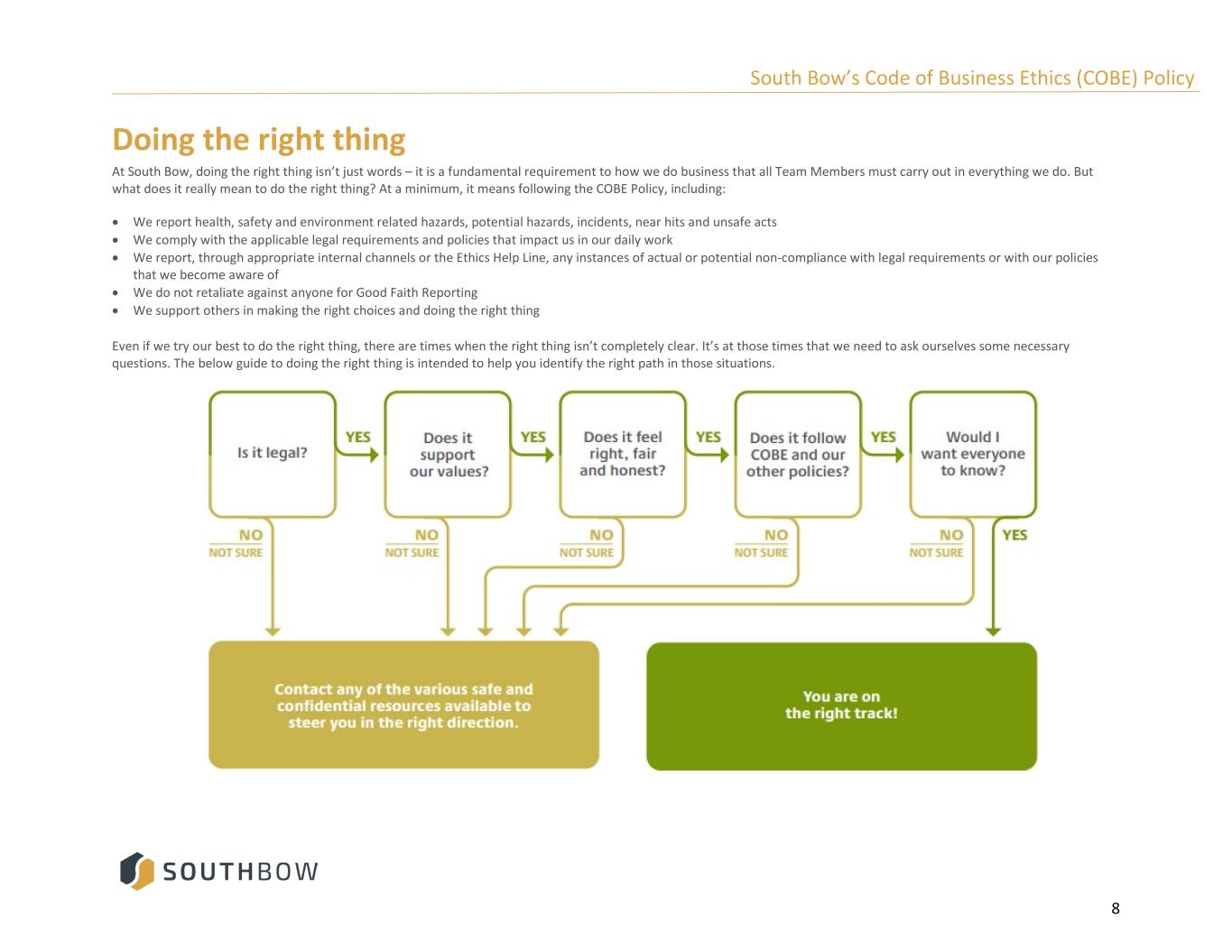
South Bow’s Code of Business Ethics (COBE) Policy 8 Doing the right thing At South Bow, doing the right thing isn’t just words – it is a fundamental requirement to how we do business that all Team Members must carry out in everything we do. But what does it really mean to do the right thing? At a minimum, it means following the COBE Policy, including: • We report health, safety and environment related hazards, potential hazards, incidents, near hits and unsafe acts • We comply with the applicable legal requirements and policies that impact us in our daily work • We report, through appropriate internal channels or the Ethics Help Line, any instances of actual or potential non-compliance with legal requirements or with our policies that we become aware of • We do not retaliate against anyone for Good Faith Reporting • We support others in making the right choices and doing the right thing Even if we try our best to do the right thing, there are times when the right thing isn’t completely clear. It’s at those times that we need to ask ourselves some necessary questions. The below guide to doing the right thing is intended to help you identify the right path in those situations.
South Bow’s Code of Business Ethics (COBE) Policy 9 Reporting safety, legal and ethical violations We report actual or potential non-compliances with our policies or our legal requirements, so they can be addressed appropriately. Retaliation for Good Faith Reporting is prohibited at South Bow and your confidentiality and identity will be protected to the greatest extent possible. How do I report an issue or seek guidance? You are required to report any actual or suspected violation of the law or COBE and all health, safety and environment related hazards, potential hazards, incidents, near hits and unsafe acts of which you may become aware. We take every report seriously and provide immunity from disciplinary action for Good Faith Reporting of incidents and issues. Resources To report an issue, or if you would like guidance on how to make the right choices and do the right thing in a particular situation, the following resources are available to you: • Your leader • Human Resources • Your Compliance Coordinator • Corporate Compliance • Legal department • Safety Team Members • South Bow’s Incident Management System If you are uncomfortable speaking to any of these resources or if you would like to remain anonymous, you can contact the Ethics Help Line. Ethics Help Line 1-888-770-0018
South Bow’s Code of Business Ethics (COBE) Policy 10 Leader responsibilities South Bow’s leaders are here to help us make the right choices and do the right thing together. If you are a leader, in addition to acting in accordance with the principles set out in COBE, you are required to: • Inspire Team Members to act ethically by setting an ethical tone within your team. • Reinforce the importance of doing the right thing when carrying out corporate objectives (for example, profits and cost management) and support those who are unsure how to do the right thing in a particular situation. • Set an example by modeling exemplary ethical business conduct. • Create a safe environment where individuals are encouraged to speak up if they become aware of or suspect a legal or ethical violation, and help prevent against retaliation for reporting. • Ensure that your team members understand and act in accordance with all legal and ethical requirements that impact them in their jobs, that they know how to report actual or potential non-compliance with the law or COBE or to ask questions regarding ethical or legal matters, and that they complete all required ethics and compliance-related training. • Understand your obligation to act on any actual or suspected violations of COBE, any of our other policies, or the law that may be reported to you and the requirement for you to report these issues, as appropriate, to Corporate Compliance, Human Resources, or the Ethics Help Line. • Engage with Human Resources, or Corporate Compliance to ensure violations of legal requirements or COBE by your direct reports are addressed appropriately (including appropriate corrective action). The Board of Directors’ Governance and Risk Committee is responsible for assisting the board with maintaining strong governance policies and practices at South Bow and recommends and reports to the board on corporate governance issues, principles and guidelines for review, discussion, approval, or other action by the board.
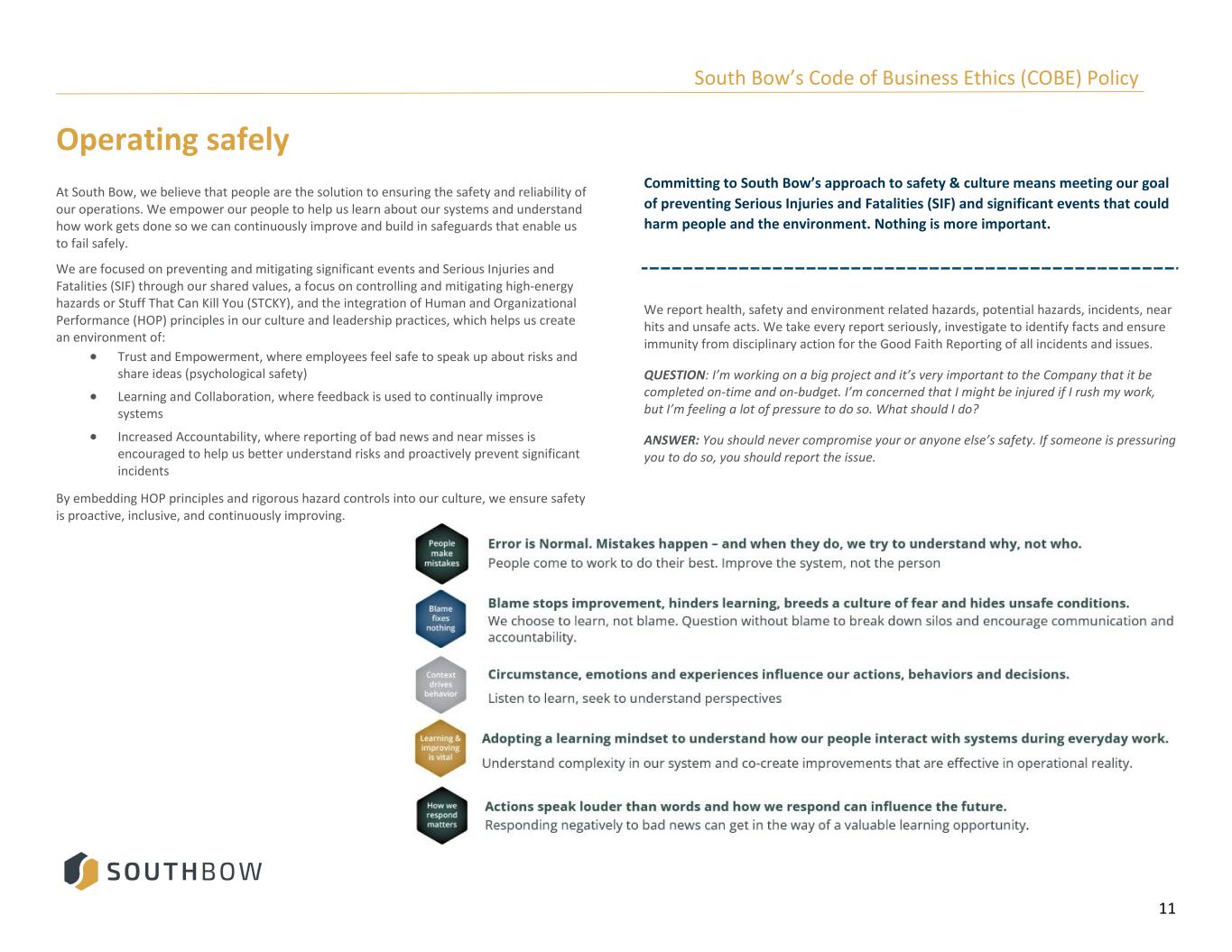
South Bow’s Code of Business Ethics (COBE) Policy 11 Operating safely At South Bow, we believe that people are the solution to ensuring the safety and reliability of our operations. We empower our people to help us learn about our systems and understand how work gets done so we can continuously improve and build in safeguards that enable us to fail safely. We are focused on preventing and mitigating significant events and Serious Injuries and Fatalities (SIF) through our shared values, a focus on controlling and mitigating high-energy hazards or Stuff That Can Kill You (STCKY), and the integration of Human and Organizational Performance (HOP) principles in our culture and leadership practices, which helps us create an environment of: • Trust and Empowerment, where employees feel safe to speak up about risks and share ideas (psychological safety) • Learning and Collaboration, where feedback is used to continually improve systems • Increased Accountability, where reporting of bad news and near misses is encouraged to help us better understand risks and proactively prevent significant incidents By embedding HOP principles and rigorous hazard controls into our culture, we ensure safety is proactive, inclusive, and continuously improving. Committing to South Bow’s approach to safety & culture means meeting our goal of preventing Serious Injuries and Fatalities (SIF) and significant events that could harm people and the environment. Nothing is more important. We report health, safety and environment related hazards, potential hazards, incidents, near hits and unsafe acts. We take every report seriously, investigate to identify facts and ensure immunity from disciplinary action for the Good Faith Reporting of all incidents and issues. QUESTION: I’m working on a big project and it’s very important to the Company that it be completed on-time and on-budget. I’m concerned that I might be injured if I rush my work, but I’m feeling a lot of pressure to do so. What should I do? ANSWER: You should never compromise your or anyone else’s safety. If someone is pressuring you to do so, you should report the issue.
South Bow’s Code of Business Ethics (COBE) Policy 12 Being fit for work Given the nature of South Bow’s business, it is essential that all Team Members be fit to perform their jobs. We do not compromise our ability to do our jobs or the safety of others through the use of intoxicants, including alcohol, drugs or medications, whether they are legal or not. The use of alcohol or drugs can impair your judgment and productivity and can lead to serious accidents and health and safety concerns – not only for yourself, but also for your coworkers and the public. South Bow takes a zero-tolerance approach toward the use of alcohol, drugs and intoxication while working. Not being fit for work due to the use of alcohol, drugs or other intoxicants will result in serious consequences including being removed from our site(s) and subject to appropriate corrective action, up to and including termination of employment or contract. Alcohol and Drug Policy What does being fit for work mean? Fit for work means being able to safely and acceptably perform your assigned duties without any limitations due to the use or after-effects of any intoxicants. This can include limitations due to legally-obtained medications (prescription and over the counter) which have the potential to change or adversely affect the way a person thinks, feels, or acts. Being fit for work also means being free from other forms of impairment such as fatigue, which is a state of physical or mental exhaustion that can compromise safe functioning, similar to alcohol or drug use.
South Bow’s Code of Business Ethics (COBE) Policy 13 Human rights South Bow does not tolerate human rights abuses. In our business activities, including engaging with Indigenous groups and stakeholders across Canada and the United States, we are committed to respecting human rights. We will not be complicit with, nor engage in, any business activity that supports or facilitates abuse of human rights. South Bow considers the International Bill of Human Rights, which consists of the Universal Declaration of Human Rights, and the core International Labour Organization (ILO) Conventions when adopting human rights best practices. This enables the Company to comply with all applicable international standards, federal, provincial, state, and local laws, rules, regulations, orders, and ordinances, including, without limitation, environmental protection, energy, health and safety, and labor laws and regulations, as well as applicable industry codes and standards. We stand firmly against the use of forced labour, including child labour, prison labour, bonded labour, military labour, modern forms of slavery, human trafficking and any form of physical or mental abuse within our business and operations, including the Contractors we do business with. South Bow monitors and assesses its Contractors for compliance with human rights requirements, and may terminate business relationships in the event violations are confirmed. In addition to South Bow complying with applicable legislated compensation standards, such as minimum wage, wage payment, maximum work hours, mandatory holidays, progressive remuneration in case of overtime and benefits laws, we are committed to providing a fair living wage for all Employees. Employment of individuals below the minimum age permitted by local law is strictly prohibited. Respect for human rights is covered in South Bow’s annual online Code of Business Ethics training and certification, as well as other related training, as required. Additional mandatory online training includes, but is not limited to, the following courses: • Health and Safety Core training • Respectful Workplace training
South Bow’s Code of Business Ethics (COBE) Policy 14 Discrimination, harassment, and violence-free workplace South Bow is committed to fostering a workplace where differences are valued and a culture of inclusion and respect is encouraged. We prohibit any form of discrimination and require reasonable accommodation of differences. We expect Team Members to create and reinforce an inclusive, creative and productive work environment in which everyone is accepted and respected. Everyone deserves to do their job in a safe, respectful, and inclusive workplace, without fear of harassment or violence. You must always be respectful to our Employees and Contractors and be sensitive to the way in which others may react to your behaviours, comments, gestures or contacts. Always try to resolve differences in a calm and respectful manner, without resorting to insults, threats or violence. South Bow prohibits any behaviour, including displaying any statements, messages, or images (e.g., on clothing, stickers on hard hats, decals on vehicles, etc.), that is: • Intimidating • Hostile • Offensive • Threatening • Violent • Demeaning or humiliating • Of a sexual nature • Creating an inappropriate work environment South Bow will take allegations of harassment and violence seriously and address them promptly in a respectful, fair and thorough manner by trained investigators. If required, South Bow will take appropriate corrective action, up to and including termination of employment or contract. South Bow requires you to be tolerant, inclusive and to demonstrate respect for others. South Bow requires that we treat one another with dignity and respect, and we are committed to maintaining an inclusive and respectful work environment that is free of discrimination, harassment, and violence. Equal Employment Opportunity and Non-Discrimination Policy Harassment-Free Workplace Policy Canada – U.S. Reasonable Workplace Accommodation Policy In particular, you must never take actions or make unwanted comments or gestures or discriminate against anyone on the basis of: • Gender • Race • National or ethnic origin • Colour • Disability • Religion • Age • Sexual orientation • Gender identity • Marital status • Family status • Veteran status • National Guard or reserve unit obligations • A criminal conviction which has been pardoned or for which a pardon has been granted • Or any other legally protected grounds
South Bow’s Code of Business Ethics (COBE) Policy 15 Protecting everyone from weapons in the workplace Unless otherwise prohibited by law, we prohibit the possession, use, carrying and transportation of any dangerous or potentially dangerous weapons, as defined by South Bow’s Weapons in the Workplace Policy, when conducting Company business: • On or off all Company owned or controlled premises • In all Company vehicles (whether owned, leased or rented) • In all personal vehicles being used while conducting Company business For individuals in jurisdictions that permit firearms to be kept in personal vehicles, the vehicle must be locked, firearms must be hidden from plain view and be kept within a locked case or container within the vehicle. Any and all jurisdictional requirements must be met. Corporate Security Policy Individuals who are licensed to carry firearms (openly or in a concealed manner) are not exempt from our Policy.
South Bow’s Code of Business Ethics (COBE) Policy 16 Ethical business conduct • Avoiding conflicts of interest • Personal Relationships • Outside business activities and outside directorships • Other potential conflicts of interest • Gifts, invitations and entertainment • Engaging Government Officials • Political contributions and lobbying • International trade • Insider trading • Complying with regulatory requirements • Inter-affiliate interactions • Competing fairly • Accounting, financial reporting and fraud prevention • Preventing money laundering and terrorist financing
South Bow’s Code of Business Ethics (COBE) Policy 17 Avoiding conflicts of interest We must act in the best interests of South Bow, avoiding any situation that could place us in a conflict of interest, or create the perception of a conflict of interest. If, and when, a conflict of interest arises, you are required to report the conflict in a timely manner so it can be appropriately investigated and addressed. You should never make or influence business decisions on behalf of South Bow based on personal relationships, bias or the potential for personal gain. Some examples of where conflicts of interest can arise include, but are not limited to: • Gifts, invitations and entertainment • Outside business activities • Corporate opportunities • Community investment • Directorships or other board positions outside of South Bow • Director independence • Personal Relationships • Intimate Relationships We do the right thing – always. At South Bow, this is part of who we are and how we do business, every day. What is a conflict of interest? Conflict of interest means a situation in which Team Members have private interests that could conflict with their ability to act in good faith and the best interests of the Company, or where they may improperly benefit from knowledge acquired at the Company which is not available to the general public.
South Bow’s Code of Business Ethics (COBE) Policy 18 Personal Relationships Team Members who have a Personal Relationship within the Company must not be in a direct or indirect reporting relationship with each other. In particular, the Company prohibits all Intimate Relationships between individuals in a direct or indirect reporting relationship. If Team Members are not certain whether a Personal Relationship within the Company is permissible, they should immediately discuss their situation with their South Bow leader or Human Resources.
South Bow’s Code of Business Ethics (COBE) Policy 19 Outside business activities and outside directorships Team Members must not engage in outside business activities (e.g., as a consultant, employee, or director) or Advisory Relationships that could conflict with, or be perceived to conflict with, or are detrimental to the interests of South Bow, and which may include: • Owning, controlling or directing a material financial interest (greater than one per cent) in a competitor, or in a vendor, supplier, customer or other business which does or seeks to do business with South Bow • Advising or being involved in a business that competes with South Bow or that does or seeks to do business with South Bow • Outside business activities that interfere with Team Members’ day-to-day responsibilities at South Bow • An outside business activity that requires Team Members to violate their confidentiality or other obligations to South Bow South Bow Team Members who have a Family Relationship with a supplier or potential supplier to the Company must ensure that they are not involved in the selection process or in directing or influencing the work of the supplier to whom they are related. In cases where the spouse, common law partner, or other family member of Team Members owns, controls, or directs a material financial interest in any of the outside business activities, that Team Members must contact the Corporate Compliance department for guidance. Team Members must declare all outside business activities and Advisory Relationships that could conflict with or be perceived to conflict with the interests of South Bow to the Corporate Compliance department for guidance. Any outside business activities must be conducted outside of South Bow work hours since your time and attention during South Bow work hours is expected to be directly related to your employment with South Bow. Team Members must declare all Outside Directorship positions on a board (e.g., board chair, treasurer, secretary, member, etc.) to the Corporate Compliance group for review and approval, prior to accepting the position or upon joining the Company.
South Bow’s Code of Business Ethics (COBE) Policy 20 Other potential conflicts of interest Corporate opportunities Team Members must not take personal advantage of a business opportunity that you discover through the use of Company assets, property, information or your position with South Bow, or use Company assets, property, information or your position with South Bow for personal gain or to compete with South Bow. Political office, appointments to boards or tribunals Team Members may not serve in a political office or on an administrative board or tribunal, if that office, board or tribunal has or may have decision-making authority in respect of any aspect of South Bow’s business (such as the approval of projects or the issuing of permits). Executive leadership team - other business activities In addition to the conditions set out in the outside business activities and outside directorships section above, prior to serving in any capacity in an unaffiliated organization, the Chief Executive Officer and any member of the Executive Leadership Team must obtain the consent of the Chair of the Governance and Risk Committee. Directors’ independence To maintain their independence and to ensure that no relationships exist that may violate applicable corporate, securities and competition laws, all members of the Board of Directors of South Bow must have their independence assessed: • Annually • In the event of a material change in their respective primary employment status • When they wish to join another board of directors, whether private or public All candidates to South Bow’s Board of Directors must declare to the Corporate Secretarial group any material interest that they may have in a contract or transaction. All members of the South Bow Board of Directors who have any material interest in a contract or transaction must recuse themselves from related deliberations and approval.
South Bow’s Code of Business Ethics (COBE) Policy 21 Gifts, invitations and entertainment While local customs regarding gifts and other benefits may vary by regions where we do business, they must never compromise or appear to compromise our commitment to acting legally, ethically, and objectively. Giving gifts can help to build and maintain strong business relationships, however they can also be seen to improperly influence decisions depending on the nature and context of the gift. Only offer gifts or entertainment that are: • Transparent and would not be perceived to have an intention, or suggestion, of trying to influence others or attain a business advantage • Not of significant value (e.g. Company swag) • Not cash or cash equivalents like gift cards (except for specific, pre-approved promotional purposes) • Infrequent and not in excess of four gifts or invitations per year to the same person or organization • In compliance with all applicable laws and the spirit and intent of our policies We must always be prudent in offering gifts, entertainment or anything of value to anyone or any organization that is a competitor, or that South Bow does or seeks to do business with, or that South Bow requires consent or approval from (e.g., a government authority). Corruption in business and government prevents fair and open competition based on merit and it can have a negative impact for both the Company and the individual. To mitigate these negative impacts, we must all comply with South Bow’s Avoiding Bribery and Corruption Policy and COBE.
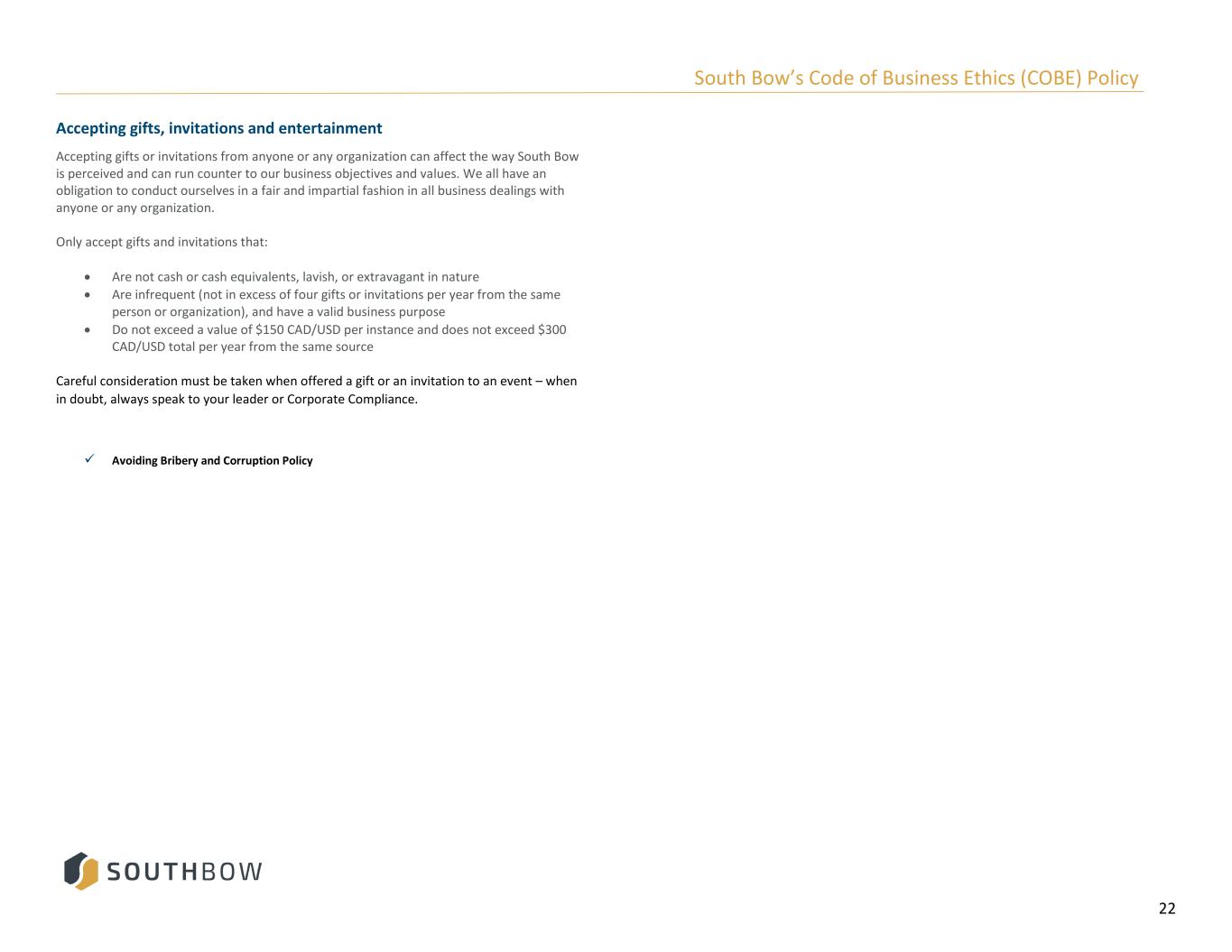
South Bow’s Code of Business Ethics (COBE) Policy 22 Accepting gifts, invitations and entertainment Accepting gifts or invitations from anyone or any organization can affect the way South Bow is perceived and can run counter to our business objectives and values. We all have an obligation to conduct ourselves in a fair and impartial fashion in all business dealings with anyone or any organization. Only accept gifts and invitations that: • Are not cash or cash equivalents, lavish, or extravagant in nature • Are infrequent (not in excess of four gifts or invitations per year from the same person or organization), and have a valid business purpose • Do not exceed a value of $150 CAD/USD per instance and does not exceed $300 CAD/USD total per year from the same source Careful consideration must be taken when offered a gift or an invitation to an event – when in doubt, always speak to your leader or Corporate Compliance. Avoiding Bribery and Corruption Policy
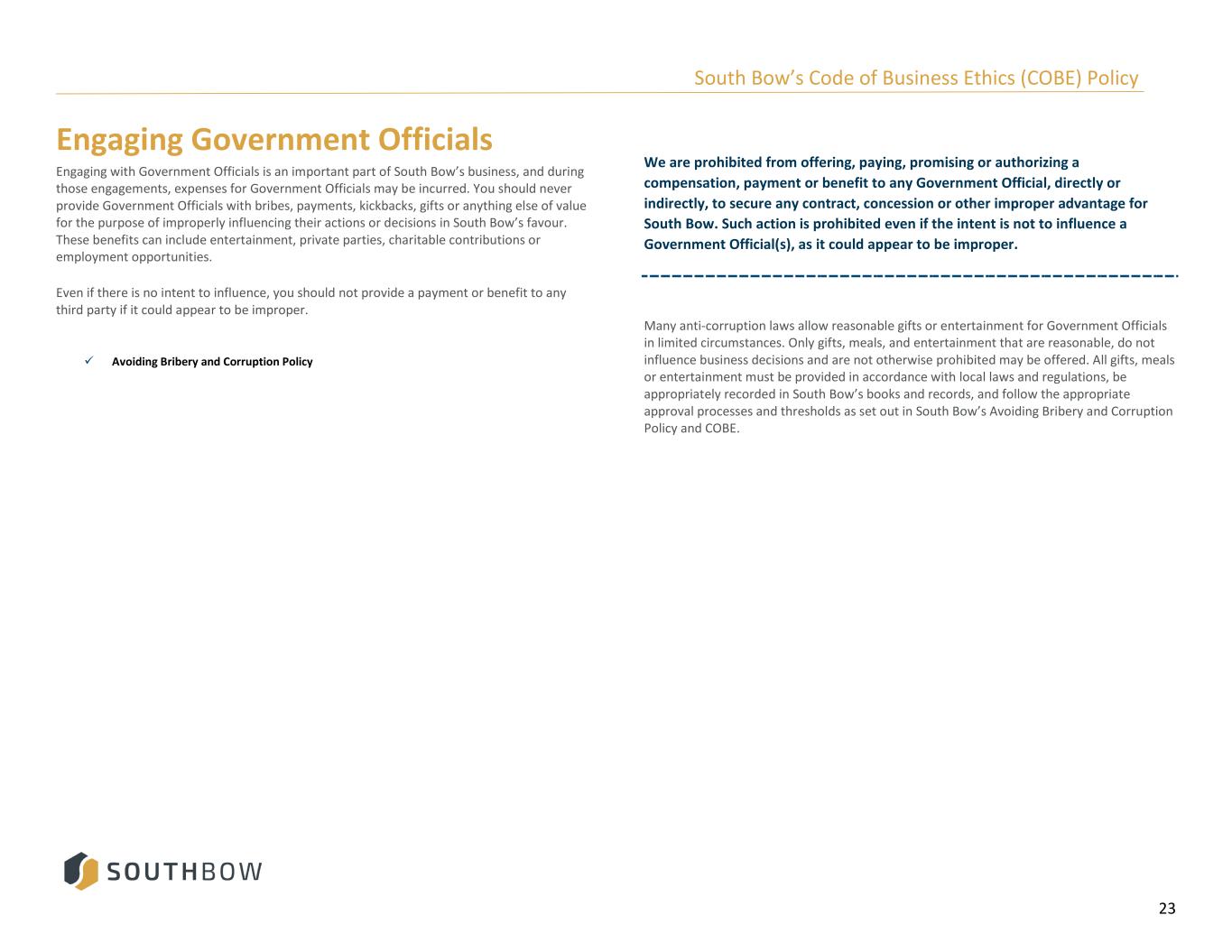
South Bow’s Code of Business Ethics (COBE) Policy 23 Engaging Government Officials Engaging with Government Officials is an important part of South Bow’s business, and during those engagements, expenses for Government Officials may be incurred. You should never provide Government Officials with bribes, payments, kickbacks, gifts or anything else of value for the purpose of improperly influencing their actions or decisions in South Bow’s favour. These benefits can include entertainment, private parties, charitable contributions or employment opportunities. Even if there is no intent to influence, you should not provide a payment or benefit to any third party if it could appear to be improper. Avoiding Bribery and Corruption Policy We are prohibited from offering, paying, promising or authorizing a compensation, payment or benefit to any Government Official, directly or indirectly, to secure any contract, concession or other improper advantage for South Bow. Such action is prohibited even if the intent is not to influence a Government Official(s), as it could appear to be improper. Many anti-corruption laws allow reasonable gifts or entertainment for Government Officials in limited circumstances. Only gifts, meals, and entertainment that are reasonable, do not influence business decisions and are not otherwise prohibited may be offered. All gifts, meals or entertainment must be provided in accordance with local laws and regulations, be appropriately recorded in South Bow’s books and records, and follow the appropriate approval processes and thresholds as set out in South Bow’s Avoiding Bribery and Corruption Policy and COBE.
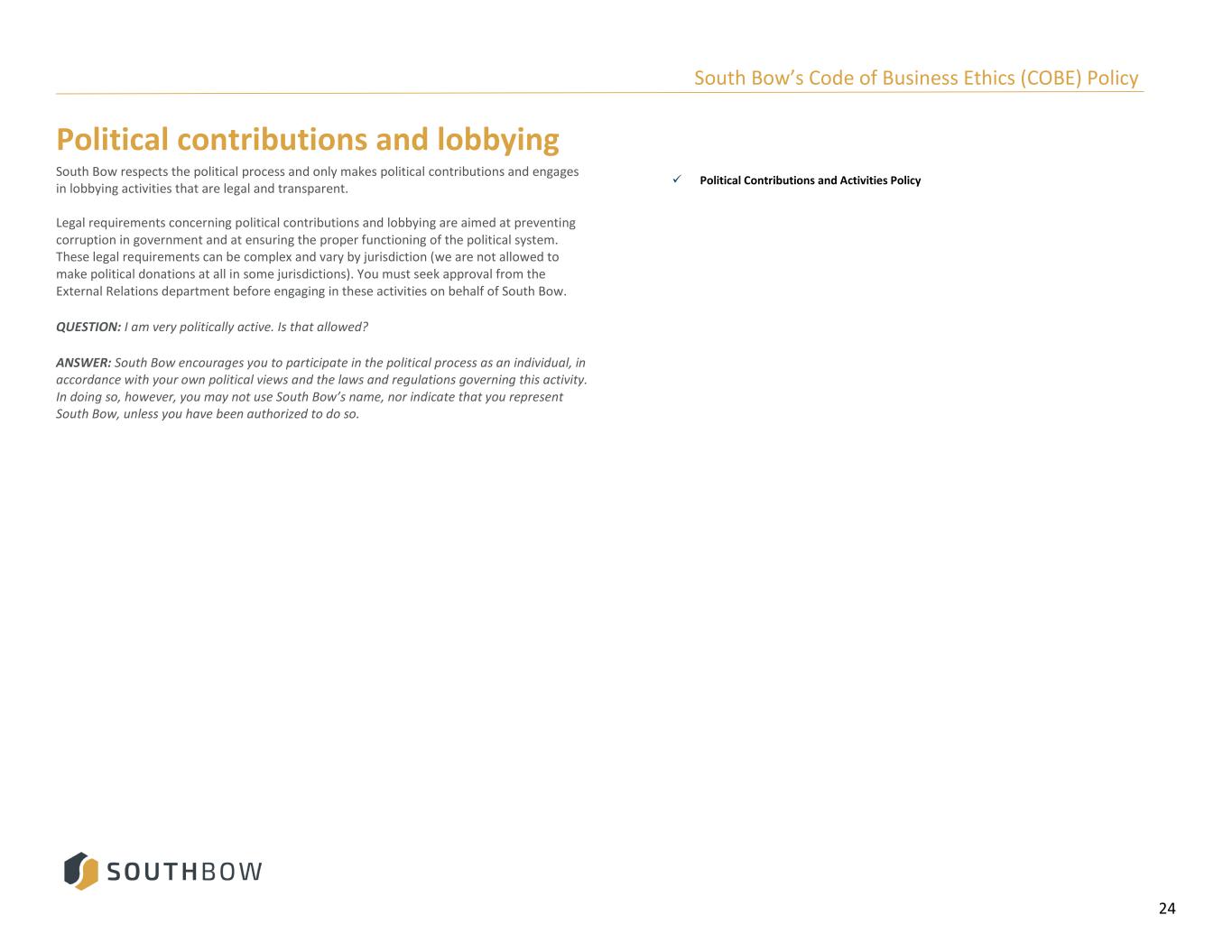
South Bow’s Code of Business Ethics (COBE) Policy 24 Political contributions and lobbying South Bow respects the political process and only makes political contributions and engages in lobbying activities that are legal and transparent. Legal requirements concerning political contributions and lobbying are aimed at preventing corruption in government and at ensuring the proper functioning of the political system. These legal requirements can be complex and vary by jurisdiction (we are not allowed to make political donations at all in some jurisdictions). You must seek approval from the External Relations department before engaging in these activities on behalf of South Bow. QUESTION: I am very politically active. Is that allowed? ANSWER: South Bow encourages you to participate in the political process as an individual, in accordance with your own political views and the laws and regulations governing this activity. In doing so, however, you may not use South Bow’s name, nor indicate that you represent South Bow, unless you have been authorized to do so. Political Contributions and Activities Policy
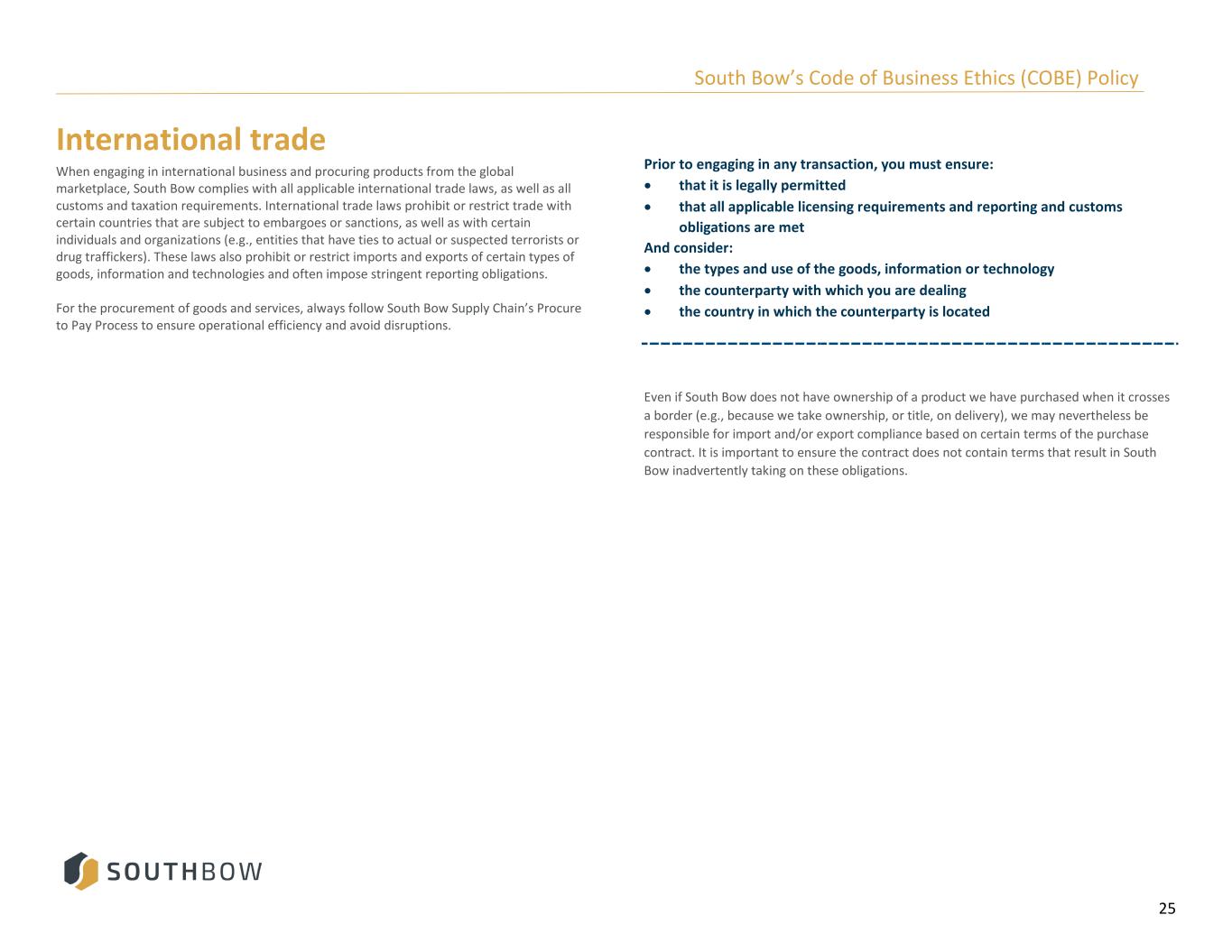
South Bow’s Code of Business Ethics (COBE) Policy 25 International trade When engaging in international business and procuring products from the global marketplace, South Bow complies with all applicable international trade laws, as well as all customs and taxation requirements. International trade laws prohibit or restrict trade with certain countries that are subject to embargoes or sanctions, as well as with certain individuals and organizations (e.g., entities that have ties to actual or suspected terrorists or drug traffickers). These laws also prohibit or restrict imports and exports of certain types of goods, information and technologies and often impose stringent reporting obligations. For the procurement of goods and services, always follow South Bow Supply Chain’s Procure to Pay Process to ensure operational efficiency and avoid disruptions. Prior to engaging in any transaction, you must ensure: • that it is legally permitted • that all applicable licensing requirements and reporting and customs obligations are met And consider: • the types and use of the goods, information or technology • the counterparty with which you are dealing • the country in which the counterparty is located Even if South Bow does not have ownership of a product we have purchased when it crosses a border (e.g., because we take ownership, or title, on delivery), we may nevertheless be responsible for import and/or export compliance based on certain terms of the purchase contract. It is important to ensure the contract does not contain terms that result in South Bow inadvertently taking on these obligations.
South Bow’s Code of Business Ethics (COBE) Policy 26 Insider trading We engage only in transactions that have a legitimate business purpose, and we do not interfere with the normal functioning of the financial markets in which we operate and transact. We also report transactions in accordance with all legal requirements. Through the course of your work with South Bow, you may have access to non-public information regarding South Bow, our customers, Contractors and other business partners. You must always maintain the confidentiality of any non-public information encountered through the course of business with South Bow. To the extent non-public information that you are aware of could be material to a decision to buy or sell shares in South Bow or another company: • You and your immediate family members must not trade South Bow shares or other securities based on that information. • You must not share material non-public information with another person, except as necessary in the course of business, as outlined in the Public Disclosure & Insider Trading Policy. Public Disclosure & Insider Trading Policy We conduct business in a way that promotes the fair, efficient and openly competitive operation of the financial markets in which we participate, while complying with market manipulation laws. QUESTION: I own units of a mutual fund that invests in shares of one of our suppliers. Is that a problem? ANSWER: Your ownership of mutual fund units is likely not a problem. If your investment in the supplier is through a mutual fund, you would need to ensure that you do not own more than one per cent of the stock of the supplier; however, because of the indirect nature of the investment, it is also less of a concern than if you owned the shares directly. Insider trading is a serious offence and can have significant reputational and legal impacts. For Securities and Insider trading inquiries contact the Corporate Secretarial group.
South Bow’s Code of Business Ethics (COBE) Policy 27 Complying with regulatory requirements South Bow is committed to meeting our obligations under all regulations and tariffs. As a regulated company, South Bow is subject to many regulatory requirements, including those of the Canada Energy Regulator (CER), and the Federal Energy Regulatory Commission (FERC), among others. In addition, South Bow’s transmission providers are subject to tariffs that we must comply with. Although it is impossible to list all of these requirements here, you must ensure you are familiar with the specific requirements applicable to you in your job. These can include reporting requirements and compliance with technical or other standards. To the extent the requirements of more than one jurisdiction apply, you must comply with the highest of the various standards.
South Bow’s Code of Business Ethics (COBE) Policy 28 Inter-affiliate interactions As a transmission provider, South Bow is subject to the Interstate Commerce Act (ICA) and the rules and regulations of the Federal Energy Regulatory Commission in the U.S.; along with the Canadian Energy Regulator Act in Canada (collectively, the “Inter-Affiliate Rules”). These Inter- Affiliate Rules are intended to ensure that our non-regulated affiliates do not receive an unfair advantage over other customers, whether as a result of discriminatory treatment or the improper sharing of information, Team Members or resources. The Inter-Affiliate Rules also prohibit cross-subsidization at the expense of our transmission customers. In order to ensure compliance with the Inter-Affiliate Rules, you must observe the following rules in your day-to-day activities: All customers must be treated equally Regulated transmission providers cannot give undue preference to any customer, whether affiliated with a South Bow entity or not. Independent functioning Regulated Team Members must function independently of non-regulated Team Members (e.g., they cannot perform the same jobs). No conduit of information Regulated and shared Team Members must not share, or act as a conduit for the sharing of regulated information* with non-regulated Team Members. Pay fair share Non-regulated entities must pay their fair share of any costs incurred by our regulated transmission providers, so as not to burden our transmission customers with costs our non- regulated entities benefit from. Reporting violations Any violations of the Inter-Affiliate Rules must be reported to the Corporate Compliance department, since South Bow may be legally required to either publicly post such information on its web site or report it to our regulators. *Regulated information (which may not be shared with non-regulated Team Members or affiliates) includes commercial, financial, strategic, planning, operational and customer information of our transmission providers. South Bow Inter-Affiliate Rules
South Bow’s Code of Business Ethics (COBE) Policy 29 Competing fairly A competitive marketplace in the energy and transmission services that South Bow provides helps ensure fair prices and customer choice and, in turn, results in the industry as a whole providing more effective and better service. We believe in vigorous, fair competition and comply with all laws designed to protect the ability of companies to compete freely. You should never enter into agreements to: • Fix prices • Decrease capacity or volume available to customers • Allocate customers or markets among competitors • Boycott certain customers or Contractors You need to be very careful whenever you have contact with competitors (whether in trade association meetings, at conferences, through participation in benchmarking groups or in negotiating or otherwise dealing with actual or potential joint venture partners who are also South Bow competitors) to avoid sharing competitively sensitive information. You must never enter into an agreement to reduce competition, or that is likely to have that effect. QUESTION: While at a trade association meeting recently, a few competitors I was sitting with at dinner started talking about their pricing. I knew it wasn’t appropriate, so I didn’t say anything. Did I do the right thing? ANSWER: While you were right not to participate in the discussion, when in such a situation, it’s a good idea to take the further step of making clear to everyone that the discussion is inappropriate and that you will not participate. If the inappropriate discussion continues, you should excuse yourself from the situation. You should also document what happened and report the matter. This will help to protect you and South Bow in case anyone ever points to the fact that you were part of a group in which an inappropriate discussion took place.
South Bow’s Code of Business Ethics (COBE) Policy 30 Accounting, financial reporting and fraud prevention South Bow ensures that our accounting, financial records and reporting are fair, accurate, understandable and complete, and we do not falsify financial documents or records, or misstate or misrepresent the nature of costs or expenditures. You must ensure all transactions that you engage in, or that you approve, whether under a South Bow contract or as an individual business expense, are true and reported accurately, completely and in compliance with all applicable accounting and legal requirements. You must also follow South Bow’s corporate policies and other requirements respecting the transaction (for example, obtaining of approvals). You must never engage in “off-the-record” or other transactions or accounts that do not fully and accurately state the nature and amount of specific transactions. You must also never falsify any invoice, expenditure, time sheet or other document related to Company cost or revenue. Doing so constitutes fraud and may result in appropriate corrective action, up to and including termination of employment or contract. Avoiding Bribery and Corruption Policy Business Expense and Travel Policy South Bow’s Business Expense Policy The Business Expense Policy outlines proper management of low cost and low risk expenses incurred while conducting business on South Bow’s behalf and sets expectations regarding Employee use of the corporate credit card for such expenses. These expectations include a prohibition on splitting transactions to circumvent credit card limits or incurring costs for other Employees. If there is more than one Employee from the same business unit included in the expense, the most senior Employee present must always incur the expense.
South Bow’s Code of Business Ethics (COBE) Policy 31 Preventing money laundering and terrorist financing We expect all our Team Members to be vigilant in ensuring the payments we make and the methods of payment we use are legitimate and legal. Legal requirements concerning money laundering and terrorist financing are in place to deter criminal and terrorist activities of those with whom we might do business. To ensure compliance with these legal requirements you must: • Exercise care before agreeing to do business with a third-party, including ensuring that they were reviewed as part of Supply Chain’s qualification process • Ensure the third-party is legitimate and reputable • Recognize and report any suspicious payments or transactions Ignoring the signs that a transaction or payment initiated by a third party is not legitimate can result in South Bow being found complicit in any illegal activity that may be associated with the transaction, even if the Company did not expressly authorize it or even know about it. Examples of suspicious payments or transactions include: • Any request by a third-party to have a payment deposited into a personal account rather than a business account • Transactions with entities other than those involved in the underlying contract or business deal • Payments or other transactions involving a country other than that in which the parties to the contract or business deal are located Payments of cash, unusual financing arrangements, fictitious invoices or other efforts by a third party to conceal the true purpose of a payment or transaction also raise concerns.
South Bow’s Code of Business Ethics (COBE) Policy 32 Communication • Being socially responsible • Being a good ambassador of South Bow • Social media and communication with the public • Public disclosure of information • Dealing fairly with customers, Contractors and other stakeholders • Dealing fairly with competitors
South Bow’s Code of Business Ethics (COBE) Policy 33 Being socially responsible South Bow is committed to being a good neighbour and supporting and enhancing the communities in which we live and work. Important communities our business impacts are Indigenous communities. We are committed to working with these communities, to develop positive, long-term relationships based on mutual trust and respect, and recognizing their diversity and the importance they place on the land, their culture and their traditional way of life. In addition to working with Indigenous communities, we also work hard to build and maintain relationships with landowners. We recognize the importance of farming to their communities and actively support farming-related organizations. South Bow understands the importance that community, charitable and similar non-governmental organizations play in making the communities in which we live and work better places. We actively support these organizations and encourage our Team Members to become involved by volunteering and contributing to charitable and other community-based organizations, including during work hours if approved by your leader. Indigenous Relations Policy
South Bow’s Code of Business Ethics (COBE) Policy 34 Being a good ambassador of South Bow We are all ambassadors of South Bow and as ambassadors we must act as owners. We conduct ourselves in a manner that is respectful and appropriate, and that will enhance South Bow’s reputation. You must always keep in mind that you are a representative of South Bow. The things you say and do should reflect the Company’s core values. You should not speak publicly on behalf of South Bow unless authorized to do so. Any posting or statement on an external website, including personal sites or in other media, should be considered a public statement. Even on your personal time, you must not participate in any illegal or inappropriate statements or activities that could be detrimental to the Company or its reputation. Team members must also contact the External Relations department before engaging in activities relating to our branding and communications publicly, including, but not limited to: • Media inquiries • Public announcements • Corporate memberships to industry-related associations • Creation of official South Bow pages on social media or external websites • Reproduction or sharing of company content or branding for external use
South Bow’s Code of Business Ethics (COBE) Policy 35 Social media and communications with the public In the age of social media, it is easy to broadly and publicly communicate information. You need to be particularly aware of your obligations and our expectations when it comes to the disclosure of Company information and ensuring it is in accordance with legal and internal requirements. When sharing information on social media, keep the following requirements in mind: • Do not speak on behalf of, or giving the impression that you are speaking on behalf of, South Bow unless you have been authorized to do so • Never falsely represent yourself • Do not post anything that reflects negatively on South Bow and ensure posts are not discriminatory, offensive, or in poor taste • Share only approved South Bow content, add value to the conversation, and be accurate • Do not post pictures of South Bow’s facilities or operations unless you are authorized to do so
South Bow’s Code of Business Ethics (COBE) Policy 36 Public disclosure of information South Bow ensures that public statements regarding the Company are provided in a timely manner, are fair, accurate and complete, comply with legal requirements and corporate policies, and preserve and protect our reputation and brand. South Bow has prescribed Team Members who are authorized to speak on our behalf. If you receive an inquiry for information or comment, you should direct it to the appropriate Company representative for response. If you are not sure who the appropriate company representative is to respond, please direct the inquiry to our media line. Public Disclosure & Insider Trading Policy Use of company name for personal gain You must never use the Company’s name or purchasing power or your employment status to obtain personal discounts or rebates from Contractors unless those discounts or rebates are available to all Employees.
South Bow’s Code of Business Ethics (COBE) Policy 37 Dealing fairly with customers, Contractors and other stakeholders We consider the impact of our actions on stakeholders, rightsholders, the environment and the communities in which we operate. We follow the requirements of our policies, procedures and commitments to make sure we act responsibly to protect us, our co-workers, our workplace and assets and the communities we work in. We act as responsible stewards of the environment and manage risk, share knowledge and best practices to ensure continual improvement. You should never make business decisions on behalf of South Bow based on personal relationships, unfair bias or the potential for personal gain. We are fair and honest in our dealings with customers, Contractors and other stakeholders and we honour our obligations and commitments to them. Treating customers, Contractors and other stakeholders fairly requires that you: • Enter into business relationships based on merit • Use objective criteria to evaluate them, such as: - Price - Quality - Service It also requires that you are honest and forthright when dealing with others (never omitting important facts, manipulating another person or situation, or misrepresenting yourself or South Bow), and that you honour South Bow’s contractual, regulatory and other commitments.
South Bow’s Code of Business Ethics (COBE) Policy 38 Dealing fairly with competitors You must ensure that you use only legitimate means (such as searches of public information) to obtain competitive intelligence. You must never use deceit or misrepresent yourself to obtain such information, and you should never take advantage of information you receive in error, for example: • Emails or faxes received in error • Physical documents left in a meeting room or in a public place or which have been sent to you in error • Information you overheard
South Bow’s Code of Business Ethics (COBE) Policy 39 Assets and information • Protecting confidential information • Protecting personal information • Managing and maintaining the security of information • Protecting and respecting intellectual property rights • Use and protection of South Bow assets
South Bow’s Code of Business Ethics (COBE) Policy 40 Protecting confidential information We protect South Bow’s confidential information, and that of our customers, Contractors and other stakeholders, from improper disclosure and use. We all have access to confidential information. South Bow confidential information includes all South Bow non-public information that may be of use to competitors or harmful to South Bow or its customers, Contractors or other stakeholders, if disclosed. Confidential information can include: • Marketing information and field notes • Sketches and photographs • Electronic information assets (including emails, voicemails, and text messages) • Computer records or software, specifications, models • Other information which is or may be either applicable to or related in any way to the assets, business or affairs of South Bow Confidential information about South Bow’s projects and operations, such as project delays, costs or outage timing and the resulting system capacity impacts can influence the decisions of our customers, other participants in energy markets, and investors. Such information must be disclosed through our typical communication protocols.Because such information is commercially sensitive and can be used by competitors or others to South Bow’s detriment, it must be protected. You must not disclose such information to anyone who does not need to know the information for legitimate business purposes (including within South Bow). All confidential information should be protected from unauthorized access. When disposing of confidential information, you should do so in a secure manner, which may include shredding of physical copies. See additional information in the Use and Protection of South Bow’s Assets and the Managing and Maintaining the Security of Information sections. Information Management Policy Cybersecurity and Acceptable Use Policy Artificial Intelligence Policy Records Retention Schedule • Information regarding South Bow’s business, operations, finances, strategies, business plans, or projects • Proposed mergers, acquisitions and divestitures • Engineering designs and reports • Legal proceedings, contracts • Environmental reports • Land and lease information • Technical and economic data
South Bow’s Code of Business Ethics (COBE) Policy 41 Protecting personal information South Bow takes seriously the fact that its Employees, Contractors, customers and other stakeholders have entrusted the Company with their personal information. Some examples of personal information include an individual’s name, home address, telephone number, identification numbers (such as an Employee number or social insurance/social security number), financial information, and medical information. You should never collect, store, access, use, or disclose personal information for an inappropriate purpose or by inappropriate or illegal means. Use of personal information must be limited to the business purposes for which the information was provided. To the extent that you have personal information of any individual as a result of your work with South Bow, whether the individual is an Employee, Contractor, landowner or a shareholder (to name just a few examples), you may not disclose that personal information to others, nor may you use it for a purpose other than that for which it was collected, either within or outside South Bow, without the express approval of South Bow’s Privacy Officer or the individual’s written consent. If you are ever unsure if information can be disclosed or used for a new purpose, check with South Bow’s Privacy Office (Corporate Compliance) before taking any action. For more information, please see the Protection of Personal Information Policy. South Bow is committed to protecting personal information in compliance with all legal requirements and requires that our Contractors share this commitment to information security. Protection of Personal Information Policy You should also protect and safeguard personal information from inappropriate access by keeping it in a locked cabinet, or in a password protected or otherwise restricted folder, memory stick or other similar storage device, if the information is electronic.
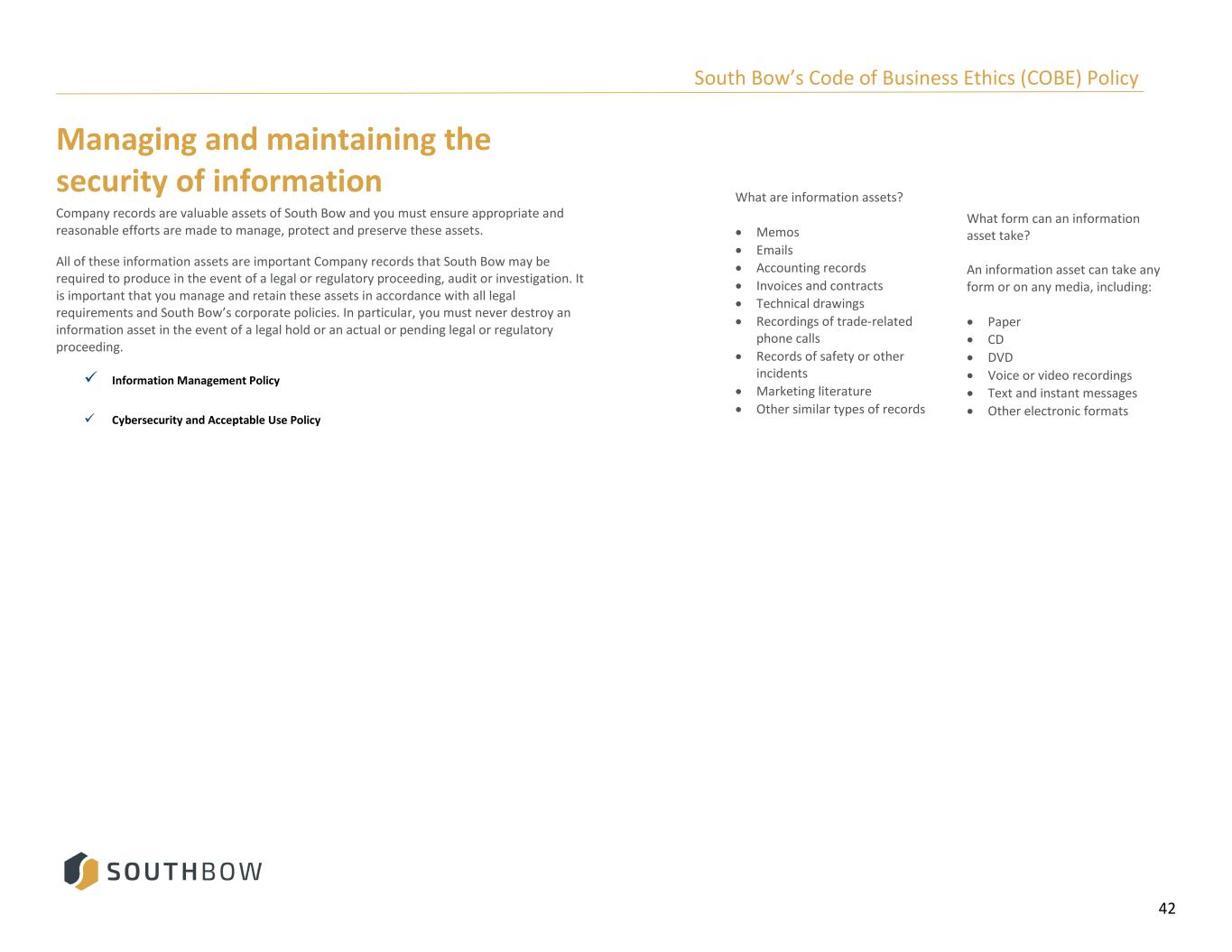
South Bow’s Code of Business Ethics (COBE) Policy 42 Managing and maintaining the security of information Company records are valuable assets of South Bow and you must ensure appropriate and reasonable efforts are made to manage, protect and preserve these assets. All of these information assets are important Company records that South Bow may be required to produce in the event of a legal or regulatory proceeding, audit or investigation. It is important that you manage and retain these assets in accordance with all legal requirements and South Bow’s corporate policies. In particular, you must never destroy an information asset in the event of a legal hold or an actual or pending legal or regulatory proceeding. Information Management Policy Cybersecurity and Acceptable Use Policy What are information assets? • Memos • Emails • Accounting records • Invoices and contracts • Technical drawings • Recordings of trade-related phone calls • Records of safety or other incidents • Marketing literature • Other similar types of records What form can an information asset take? An information asset can take any form or on any media, including: • Paper • CD • DVD • Voice or video recordings • Text and instant messages • Other electronic formats
South Bow’s Code of Business Ethics (COBE) Policy 43 Protecting and respecting intellectual property rights We preserve South Bow’s intellectual property rights and respect and honour those of third parties. Intellectual property can include trade secrets, which is any information that gives the owner an economic advantage over its competitors and that the owner takes reasonable steps to keep confidential, as well as copyrights, trademarks and patents, and also includes inventions, innovations, discoveries and copyrighted material developed while employed by South Bow. We must take steps to protect intellectual property rights. This includes keeping trade secrets confidential, consistently using South Bow’s trademarks solely as authorized, and respecting the intellectual property rights of third parties. South Bow respects and honours intellectual property rights by: • Complying with the terms of license agreements that South Bow has entered into with Contractors • Complying with copyright legislation • Not using improper means to obtain third-party information or trade secrets • Using confidential third-party information only for the purpose for which it was provided
South Bow’s Code of Business Ethics (COBE) Policy 44 Use and protection of South Bow’s assets South Bow assets that you have access to for the completion of your duties must be protected and only used for legitimate business purposes. You have an obligation to be a good steward of the assets that South Bow provides to you in the course of your work and you must protect these assets from loss, theft, damage and misuse. Additionally, using Company facilities, equipment and/or Company time to work on your personal assets, for personal activities or to store personal assets is not allowed. Limited personal use of Company assets such as accessing Internet or printing is acceptable provided that it does not interfere with your job duties. South Bow regularly monitors Company internet use, and individuals should not assume any right of privacy with respect to either their use of or data stored on South Bow’s computer systems. Any misuse of Company assets or services, including inappropriate use of South Bow’s computer equipment and systems, may lead to serious consequences including appropriate corrective action up to and including termination of employment or contract. Cybersecurity and Acceptable Use Policy Corporate Security Policy QUESTION: I sometimes use my Company computer to access Facebook or Twitter during my lunch break and I post about my personal life. Is that allowed? ANSWER: Limited personal use of Company assets to access social media during a break is acceptable; however, you need to keep in mind that you are using a Company computer and accessing the Internet through a South Bow IP address., You must ensure that you do not post content that is inappropriate or could reflect poorly on South Bow. The Company regularly monitors the use of its equipment and systems and you should not expect your personal use of South Bow assets to be private. Any inappropriate or offensive use of Company assets by Team Members may result in disciplinary action. What are Company assets? Company assets can include: • Company time • Equipment • Facilities • Furniture • Computers • Telephones • Supplies • Tools • Personal protective equipment • Corporate credit cards • Other resources What can Company assets NOT be used for? Company assets must not be used for: • Engaging in hate-based activities • Downloading illegal material • Viewing inappropriate content • Other inappropriate uses
South Bow’s Code of Business Ethics (COBE) Policy 45 Have a question? We’re here to help. • Your responsibility and non-retaliation • Asking questions and reporting concerns Your responsibility Team Members must follow all applicable provisions and the spirit and intent of this corporate governance document and support others in doing so. Team Members must promptly report any suspected or actual violation of this corporate governance document through available channels so that South Bow can investigate and address it appropriately. Team Members who violate this corporate governance document or knowingly permit others under their supervision to violate it, may be subject to appropriate corrective action, up to and including termination of employment or contract, as applicable, in accordance with the Company’s corporate governance documents, employment practices, contracts, collective bargaining agreements and processes. Interpretation and administration The Company has sole discretion to interpret, administer and apply this corporate governance document and to change it at any time to address new or changed legal requirements or business circumstances. Non-retaliation South Bow supports and encourages Employees and Contractors to report suspected violations of corporate governance documents, applicable laws, regulations, and authorizations, as well as hazards, potential hazards, incidents involving health and safety or the environment, and near hits. Such reports can be made through available channels. South Bow takes every report seriously and investigates it to identify facts and, when warranted, makes improvements to our corporate governance documents and practices. All Employees and Contractors making reports in good faith will be protected from retaliation, and all Employees and Contractors must report if they or someone they know is being or has been retaliated against for reporting. Good Faith Reporting will not protect Employees and Contractors who make intentionally false or malicious reports, or who seek to exempt their own negligence or willful misconduct by the act of making a report.
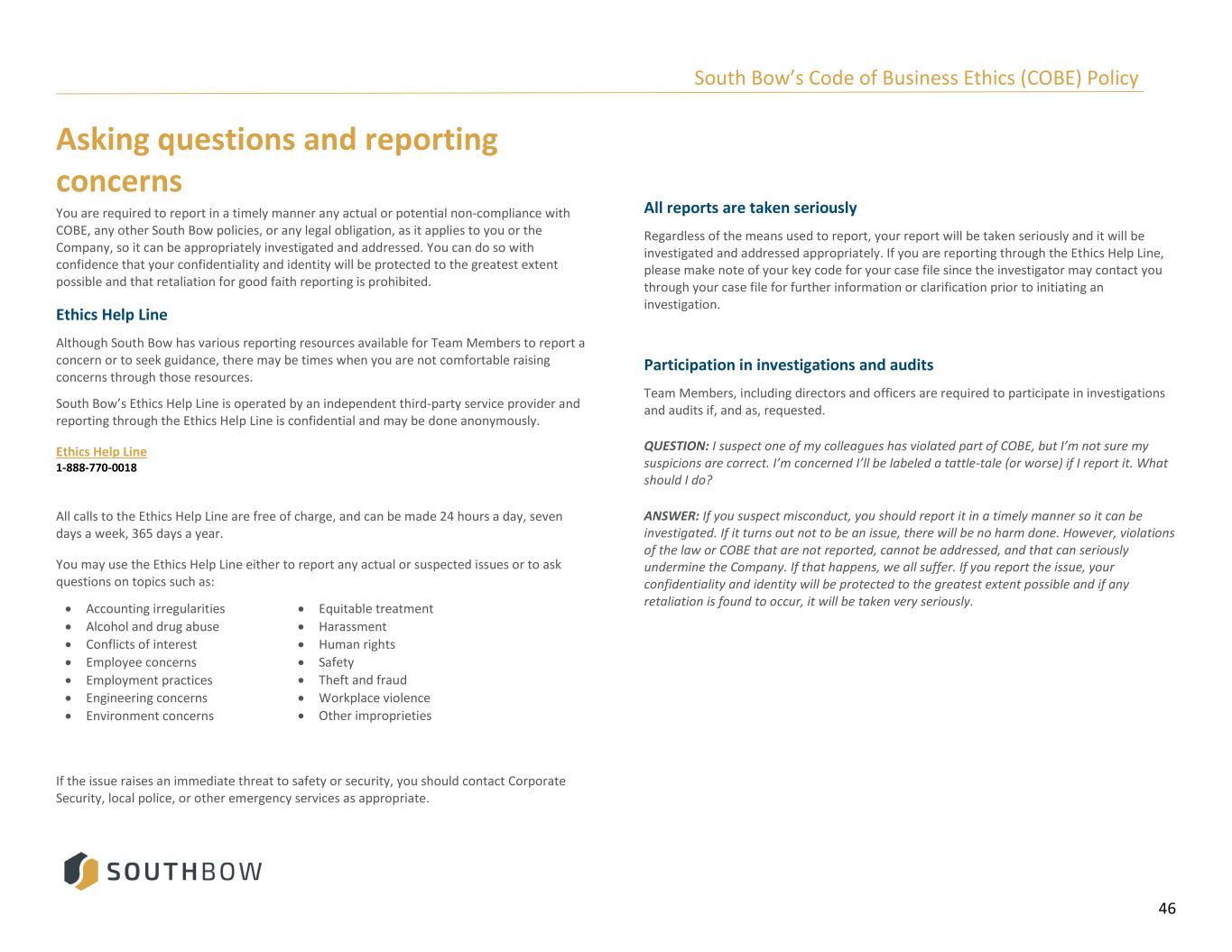
South Bow’s Code of Business Ethics (COBE) Policy 46 Asking questions and reporting concerns You are required to report in a timely manner any actual or potential non-compliance with COBE, any other South Bow policies, or any legal obligation, as it applies to you or the Company, so it can be appropriately investigated and addressed. You can do so with confidence that your confidentiality and identity will be protected to the greatest extent possible and that retaliation for good faith reporting is prohibited. Ethics Help Line Although South Bow has various reporting resources available for Team Members to report a concern or to seek guidance, there may be times when you are not comfortable raising concerns through those resources. South Bow’s Ethics Help Line is operated by an independent third-party service provider and reporting through the Ethics Help Line is confidential and may be done anonymously. Ethics Help Line 1-888-770-0018 All calls to the Ethics Help Line are free of charge, and can be made 24 hours a day, seven days a week, 365 days a year. You may use the Ethics Help Line either to report any actual or suspected issues or to ask questions on topics such as: • Equitable treatment • Harassment • Human rights • Safety • Theft and fraud • Workplace violence • Other improprieties If the issue raises an immediate threat to safety or security, you should contact Corporate Security, local police, or other emergency services as appropriate. All reports are taken seriously Regardless of the means used to report, your report will be taken seriously and it will be investigated and addressed appropriately. If you are reporting through the Ethics Help Line, please make note of your key code for your case file since the investigator may contact you through your case file for further information or clarification prior to initiating an investigation. Participation in investigations and audits Team Members, including directors and officers are required to participate in investigations and audits if, and as, requested. QUESTION: I suspect one of my colleagues has violated part of COBE, but I’m not sure my suspicions are correct. I’m concerned I’ll be labeled a tattle-tale (or worse) if I report it. What should I do? ANSWER: If you suspect misconduct, you should report it in a timely manner so it can be investigated. If it turns out not to be an issue, there will be no harm done. However, violations of the law or COBE that are not reported, cannot be addressed, and that can seriously undermine the Company. If that happens, we all suffer. If you report the issue, your confidentiality and identity will be protected to the greatest extent possible and if any retaliation is found to occur, it will be taken very seriously. • Accounting irregularities • Alcohol and drug abuse • Conflicts of interest • Employee concerns • Employment practices • Engineering concerns • Environment concerns
South Bow’s Code of Business Ethics (COBE) Policy 47 Glossary Advisory Relationship means a relationship where one provides advice, counsel, suggestions, recommendations, intelligence, guidance or any other similar types of information or opinion. Contingent Workforce Contractor (CWC) means an individual who: • is employed by a third party to work on behalf of South Bow; • uses South Bow’s assets (e.g., workstation, email, phone) and corporate services; • is compensated on an hourly basis for a defined timeline; and • works under the direction of a South Bow leader. Contractor means a third party hired by South Bow to perform services for or supply equipment, materials, or goods to the Company. Contractors include, without limitation, Contingent Workforce Contractors and Excluded Contractors. Employee means full-time, part-time, temporary and student employees of South Bow. Excluded Contractor means a third party or individual employed by a third party who: • delivers services, equipment, materials, or goods to the Company using their own tools and assets (e.g., work station, laptop, email, phone, PPE, vehicle); • does not increase South Bow corporate headcount and overhead costs; • does not use South Bow’s assets and corporate services; and • directs their own work or receives direction from their employer. Family Relationship means relatedness or connection by blood, marriage or adoption and includes, but is not limited to: • a marriage/common law spouse; • parent and grandparent; • child and grandchild; • sibling; • aunt and uncle; • niece and nephew; • first cousin; and • any “step”, “common law”, or “in law” variations of the above relationships. Good Faith Reporting means an open, honest, fair and reasonable reporting without malice or ulterior motive. Government Officials means any appointed, elected, or honorary official or any employee of a government, of a government owned or controlled company, or of a public or international organization. This definition encompasses officials in all branches and at all levels of government: federal, state/provincial or local. This definition also includes political parties and party officials and candidates for political office. Indigenous officials may also be considered Government Officials. A person does not cease to be a Government Official by claiming to act in a private capacity or by the fact that he/she serves without compensation. Examples of Government Officials relevant to South Bow’s business include: • government ministers and their staff; • members of legislative bodies or other elected officials; • officials or employees of government departments; • employees of regulatory agencies; • judges and judicial officials; • employees of state-owned oil companies, or other government-owned or controlled corporations; • customs, immigration, tax, and police personnel; and • employees of public international organizations, such as the United Nations or World Bank. Intimate Relationship means any romantic and/or dating and/or sexual relationship, including casual encounters. Personal Relationship means all Family Relationships and Intimate Relationships and any other personal relationship that is sufficiently close to create a real or perceived conflict of interest. Team Members means full-time, part-time and temporary Employees and Contingent Workforce Contractors of South Bow. South Bow or the Company means South Bow Corporation and its wholly-owned subsidiaries and/or operated entities.